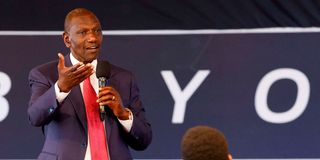
President William Ruto ’s push to develop a new long-term national development blueprint has triggered a political storm, with critics questioning its timing, rationale and the Government’s record in implementing Vision 2030.
The controversy follows the launch of the National Conversation on Kenya’s Future Beyond Vision 2030, which seeks to engage Kenyans in defining the country’s development priorities after the expiry of the current blueprint.
The initiative has been defended by Kenya Kwanza leaders as an attempt to plan beyond electoral cycles and ensure that successive administrations work towards a common national objective.
But opponents argue that the Government should first account for what happened to Vision 2030 before embarking on another ambitious promise.
Wiper Patriotic Front vice chairman and Makueni Governor Mutula Kilonzo Junior questioned the wisdom of looking so far ahead when millions of Kenyans are struggling with immediate economic hardships.
“We don't need Vision 2060. The majority of Kenyans don't know what they will eat tomorrow, and many young people have lost hope. We cannot be talking about Vision 2060 under these circumstances,” Mr Kilonzo said.
Makueni County Governor Mutula Kilonzo Junior.
Photo credit: Dennis Onsongo | Nation Media Group
The timing of Dr Ruto's launch has also raised questions among politicians and civil society actors, particularly over why the Government is beginning the process nearly three years before Vision 2030 formally reaches its target horizon.
Tetu MP Geoffrey Wandeto said the country must first confront corruption, which he described as a threat capable of undermining any development blueprint.
“If we do not address the elephant in the room, corruption, it will eat Vision 2030, Vision 2060, Vision 2100 for breakfast,” Mr Wandeto said.
He also questioned whether there had been sufficient evaluation of Vision 2030 to establish what worked, what failed and what could be salvaged.
“I have not even seen any serious stocktaking on Vision 2030. What went right? What went wrong? What can be improved? What can we salvage?” he posed.
Tetu parliamentary seat candidate Geoffrey Wandeto speaks to journalists in Nyeri town on April 15, 2022. He won the UDA ticket for the race where he defeated the incumbent James Gichohi.
Photo credit: Joseph Kanyi | Nation Media Group
The controversy has also acquired a constitutional dimension, with lawyer Harrison Kinyanjui questioning the choice of 2060 and suggesting that the proposed timeline could be influenced by the African Union’s Agenda 2063.
Mr Kinyanjui asked why Kenya was developing a Vision 2060 rather than Vision 2050, and alleged that the initiative could eventually be used to create an avenue for constitutional change.
His claims have, however, not been accompanied by evidence showing that the Government intends to use the new development blueprint as a vehicle for constitutional amendments.
Consumers Federation of Kenya (Cofek) Secretary-General Stephen Mutoro also warned against any attempt to use a national development vision to justify constitutional changes.
Mr Mutoro argued that the 2010 Constitution established a rigid framework for amendments, including public participation and, for certain provisions, a referendum.
Consumer Federation of Kenya (Cofek) Secretary-General Stephen Mutoro.
Photo credit: Lucy Wanjiru | Nation Media Group
He cited the Supreme Court’s 2022 decision in the BBI case, arguing that while the court rejected the idea of an implied unamendable “basic structure”, it affirmed the importance of the Constitution’s tiered amendment procedures.
“Those thinking they can amend the Constitution to entrench a ‘mandatory vision’ are daydreaming,” Mr Mutoro said.
He maintained that Kenya’s constitutional architecture, including devolution, the Bill of Rights, public finance controls and checks on executive power, could not simply be altered through an ordinary political process.
The opposition has also questioned whether another grand development promise is necessary when Vision 2030 remains incomplete.
Wiper Patriotic Front spokesperson Ndegwa Njiru said Kenya should first obtain an honest account of the achievements and failures of Vision 2030.
“Kenya does not need another grand promise while the commitments already made to its people remain substantially unfulfilled,” Mr Njiru said.
He argued that constitutionalism, the rule of law, human rights, accountable government, democratic freedoms and social justice should not be treated as distant objectives.
But Kenya Kwanza leaders have rejected the criticism, insisting that long-term planning should not be dictated by election cycles.
Nandi Senator Samson Cherargei said Vision 2030 itself was prepared through public participation and questioned why politicians were opposing the new initiative.
“In our party, we look at the generations that will come tomorrow, not thinking about next year's politics,” Mr Cherargei said.
Nandi Senator Samson Cherargei.
Photo credit: Jared Nyataya | Nation Media Group
Aldai MP Marianne Kitany similarly defended the timing, noting that work on Vision 2030 began in 2008 under retired President Mwai Kibaki.
“Vision 2030 itself began in 2006, when Kibaki was in power, and nobody complained that we should wait until after the 2007 elections to begin it,” Ms Kitany said.
On their part, the MPs allied to the Democracy for Citizens Party (DCP) on Thursday accused President William Ruto of breaking his covenant with Kenyans, four years into his administration, and challenged the government to provide evidence to counter claims about its record.
Their statement comes days after their party leader, former Deputy President Rigathi Gachagua, issued a “public accountability and audit statement of the Kenya Kwanza regime”, and a day after government-allied legislators issued a rebuttal to the DCP’s audit.
“Millions of Kenyans have given us their assessment on the performance of William Ruto over the last four years,” Nyandarua Senator John Methu said.
“Collectively, our representatives are clear that he has broken his covenant with the people of Kenya and that the Country must restore its dignity. We have heard and will stand with them.”
Nyandarua County Senator John Methu.
Photo credit: Bonface Bogita | Nation Media Group
According to the MPs allied to DCP, the government-allied legislators, in their rebuttal to Mr Gachagua’s address, failed to address the issues he raised, instead choosing to dwell on petty and trivial matters.
“Collectively, the government is scared of the truth, of its people and of the reality. They have responded to illusions, personalities and fear. They are confused, and have run out of ideas,” added Senator Methu, challenging the government-allied legislators to provide evidence to their claims.
Senator Methu said that Kenyans were still concerned with the rising cost of living, tax burden, a shrinking job market and growing public debt. He also questioned the government’s claims of an improving economy, saying ordinary Kenyans were yet to feel the benefits.
“Why are universities, schools, students and parents still struggling with funding if the economy is doing so well? Is SHA actually delivering better and more affordable healthcare than what Kenyans had before? Give us the figures on access, claims and outstanding bills,” the DCP Secretary-General designate said.
On the specific allegations made by Mr Gachagua on government expenditure, procurement and businesses allegedly associated with those in power, Senator Methu challenged the government to identify which claims were false and provide evidence to support its position.
On the abductions, disappearances and killings, the senator asked how many cases had been reported since 2022, how many had been investigated and how many people had been successfully prosecuted.
Senator Methu also challenged the government to publish its scorecard, asking which of the major promises William Ruto made to Kenyans in 2022 had been delivered after four years.
“The biggest question: If William Ruto deserves another term, what precisely is the measurable improvement in the life of an ordinary Kenyan after four years?” Senator Methu wondered.
“Kenyans want money in their pockets. The economy must be felt in people's pockets, homes, shops, farms and workplaces. Don't just tell Kenyans the economy has grown,” he added.