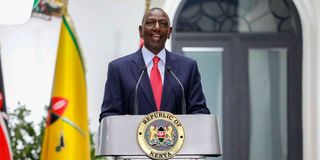
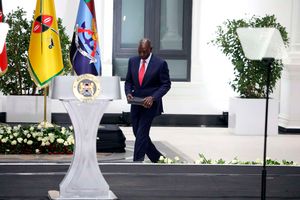
President William Ruto will today (Wednesday), August 12 open what State House describes as a landmark national conversation on Kenya’s future, with citizens, rather than Government, expected to determine the country’s long-term development destination.
The launch of the National Conversation on Kenya’s Future Beyond Vision 2030, to be hosted by the Vision 2030 board at the Jomo Kenyatta International Convention Centre (KICC), is being presented as the beginning of a process to formulate a National Development Charter that is intended to outlive individual administrations, political parties and election cycles.
State House spokesperson Hussein Mohamed said the government would facilitate the conversation, but Kenyans would determine its content and ultimate direction.
“The Government will facilitate the conversation, but the people will define the destination,” Mr Mohamed said.
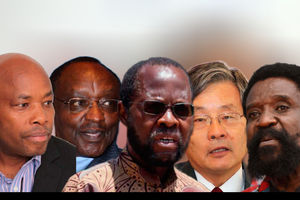
The distinction is important because the proposals presented by economists Prof Hiroyuki Hino, Prof Anyang’ Nyong’o, Prof Karuti Kanyinga, Prof Michael Chege and Prof Peter Wanyande are not the final blueprint, according to Mr Mohamed.
Instead, the report titled Developing a New Vision for Kenya: Towards a First World Nation is being treated as a starting point for a much wider national conversation.
Team of scholars crafting Kenya's post-Vision 2030 development blueprint (from left) Prof Karuti Kanyinga, Prof Michael Chege, Prof Anyang’ Nyong’o, Prof Hiroyuki Hino and Prof Peter Wanyande.
Photo credit: Nation
The process is expected to bring together the country's 47 counties and a broad spectrum of society, including young people, universities, businesses, workers, faith communities, professionals, civil society organisations, private sector, trade unions and other citizens.
Prof Kanyinga argues that the initiative should not be viewed as President Ruto’s personal project, but as a national undertaking aimed at defining Kenya’s long-term transformation path.
“This is not Ruto’s. It is Kenya’s long-term transformation agenda,” he told Nation.
President Ruto's own description of the exercise is similarly expansive. In his special national address on the development of Kenya's new national vision, he said the conversation should “rise above politics, transcend electoral cycles and unite Kenyans around a shared destiny.”
He has invited Kenyans to determine what kind of country they want to build over the next generation and beyond, arguing that the exercise should not simply produce another Government development plan.
The timing is significant. Vision 2030, which has shaped Kenya's development priorities for two decades, is approaching its horizon.
President Ruto says the country must therefore reflect honestly on the journey so far, celebrate what worked, acknowledge what did not and agree on the destination for the next phase of national transformation.
But the President's initiative is not being framed as an abandonment of his administration's existing development agenda.
According to Mr Mohamed, the Bottom-Up Economic Transformation Agenda remains the Government's long-term development framework and continues to guide its commitments.
The new conversation is instead intended to build a longer-term framework beyond the immediate priorities of the Ruto administration.
“As the President said in his 2025 State of the Nation Address, having laid the foundations for transformation, Kenya must now embark on a roadmap to a first-world nation,” Mr Mohamed said.
That roadmap, he said, will revolve around higher productivity, modern infrastructure and logistics, reliable and affordable energy, investment in human capital, peace and security, and the values that bind Kenyans together.
The Government has already begun putting in place institutions it considers necessary for the longer journey, including the National Infrastructure Fund and the Sovereign Wealth Fund.
But the central difference between the new exercise and previous national development plans will be its proposed constitutional and popular ownership.
Unlike when Vision 2030 was conceived, Kenya now has the 2010 Constitution, which places public participation at the heart of governance and national decision-making.
Mr Mohamed said the next development charter would therefore seek to give Kenya's long-term vision a stronger constitutional foundation.
“This is not about replacing Vision 2030,” Mr Mohamed said. “It is about building on its successes, learning from its challenges and ensuring that Kenya’s long-term development journey is constitutionally anchored, nationally owned, and enduring across generations.”
The President's argument is that Kenya has repeatedly struggled with the tendency for incoming administrations to introduce new priorities and plans.
The proposed charter is meant to break that cycle by establishing a common destination that survives elections.
The political contest, in this model, would not be about redefining Kenya's ultimate development destination every five years, but about competing over who has the better ideas, policies and leadership capacity to get the country there.
“Thereafter, democratic competition should be about which leaders, ideas and policies can take us there faster, more effectively and more inclusively, not about redefining the destination every election cycle,” he said.
That proposition could make the August 12 launch more than a ceremonial event. It is intended to open a process through which Kenyans will debate the country's economic, social and institutional future.
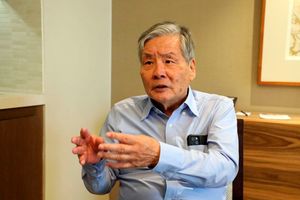
Professor Hiroyuki Hino during an interview on Monday, August 10, 2026.
Photo credit: Dennis Onsongo | Nation
Mr Mohamed said the President held discussions with former President Uhuru Kenyatta, the late former Prime Minister Raila Odinga, governors, MPs, business leaders, scholars, professionals, faith leaders, civil society representatives, young people and other stakeholders.
Those consultations, he noted, informed the engagement of Prof Hino, Prof Nyong’o and their team to develop strategic proposals.
Africa has a young and rapidly growing population, an expanding workforce and consumer market, vast agricultural potential, abundant renewable energy and minerals considered critical to the global energy transition.
The African Continental Free Trade Area also offers the possibility of transforming the continent's fragmented economies into a large integrated market, while digital technologies provide opportunities for countries to leapfrog older development systems.
Kenya, Mr Mohamed said, must not merely participate in this transformation but seek to lead it.
The President made a similar argument in his special national address, pointing to the economic transformations achieved by South Korea, Singapore, China, Vietnam, India, Bangladesh and other countries.
In 1965, he said, Kenya and South Korea had roughly similar GDP per capita levels of about $110. Today, South Korea's GDP per capita exceeds $36,000, compared with Kenya's roughly $2,400.
China, which had a lower GDP per capita than Kenya when it embarked on economic reforms in 1980, has since overtaken Kenya dramatically.
Vietnam, Bangladesh and other countries have also changed their economic fortunes within a generation.
Today's launch is therefore being positioned not as the unveiling of a finished document, but as the starting gun for that wider process.
The ultimate test will be whether Kenyans genuinely see the resulting charter as their own; if they do, President Ruto's administration hopes it can become a national compass that survives the 2027 elections and subsequent changes of government.
According to State House, the government opens the conversation, experts providing the starting ideas, “but Kenyans will be expected to write the future.”