Prime Cabinet Secretary Musalia Mudavadi’s push to amend the Constitution through a referendum alongside the 2027 General Election has sparked legal and political backlash, with senior lawyers warning it could trigger a constitutional crisis and delay the polls.
Critics argue that the creation of additional seats and new political offices to suit the ruling class would impose an extra burden on the already overtaxed Kenyans and an ailing economy.
Top lawyers have described the push as a toxic proposal designed to engineer a constitutional crisis and create a framework favourable to the Kenya Kwanza administration. They have urged the courts to prepare to strike it down as they did with the Building Bridges Initiative (BBI).
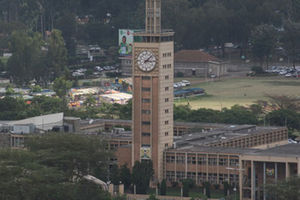
Senate Speaker Kenneth Lusaka (right) receives the BBI report from Senator Okong’o Omogeni at Parliament Buildings on Monday.
Photo credit: File | Nation Media Group
In his push dubbed the “Referendum Moment”, Mr Mudavadi, who is also the CS for Foreign and Diaspora Affairs has anchored his argument on five pillars: the boundary delimitation crisis, the census deadlock, the 12-month rule, structural bottlenecks in constituencies and wards, and the entrenchment of the National Government–Constituency Development Fund (NG-CDF) and the Senate Oversight Fund in the Constitution.
In what critics describe as an attempt to scare or coerce Kenyans into submission, Mr Mudavadi who is not the government’s legal adviser has warned of a looming constitutional crisis that could see the 2027 General Election nullified before it is held.
He suggested that legal landmines could derail the elections and that Kenya risks departing from its long-held tradition of holding elections every five years—remarks critics interpret as signalling a plan to prolong the Kenya Kwanza administration’s stay in power.
Senior Counsel Charles Kanjama and city lawyers Kibe Mungai and David Ochami have dismissed claims of a need to extend elective terms as dangerous and unconstitutional. “The proposal to increase constituencies beyond 290 is a bad idea. Increasing wards beyond 1,450 is unnecessary, though that would ordinarily be a matter of legislation,” said Mr Kanjama.
Senior Counsel Charles Kanjama.
Photo credit: File
Mr Mungai said there is no “Referendum Moment” in Kenya warranting constitutional amendment through a plebiscite.
“Mudavadi is certainly not the legal advisor to the government of Kenya. He has clearly signed a statement prepared by his master’s legal task force. It should be treated with contempt much as it should be understood as a notice for a constitutional coup in 2027,” said Mr Mungai.
He accused the government of attempting to manufacture a constitutional crisis to justify extending its stay in office.
“In modern day dictatorship when re-election math refuses to add up, the first option is to generate a constitutional crisis in order to justify postponement of a general election,” he says.
Mr Ochami accused Mr Mudavadi of gross exaggeration and misreading the Constitution. “The Kenya Kwanza regime is testing the waters through Mudavadi in an attempt to postpone the next elections. He is creating obstacles where none exist,” he said.
Mr Kanjama faulted Mr Mudavadi calling any attempt to ignore constitutional requirements on boundary delimitation “perverse.” “Let leaders to comply with the law.”
Mr Mungai said boundary reviews do not require an increase in electoral units and could be conducted using existing data, with population increases addressed after the 2029 census.
IEBC Chairperson Erastus Ethekon, on September 25, told the National Assembly that the commission requires two to three years to undertake boundary delimitation and warned of a constitutional crisis requiring parliamentary intervention.
Independent Electoral and Boundaries Commission chairperson Dr Erastus Edung Ethekon in Kisumu on November 26, 2025.
Photo credit: Alex Odhiambo | Nation Media Group
Article 89 (1) of the constitution sets constituencies at 290 “for the purposes of the election of the members of the National Assembly as provided for in Article 97 (1) (a) . Article 89 (2) states that IEBC shall review the names and boundaries of constituencies at intervals of not less than eight years, and not more than 12 years and any review shall be completed at least 12 months before a general election of MPs.
The review of the boundaries was last undertaken in 2012 and the report published in the National Assembly constituencies and County Assembly Wards Order 2012 and a gazette notice No. 14/2012.
With the Constitution already having capped the number of constituencies at 290, the 2012 delimitation exercise saw the Wards hit 1,450.
The eight-year minimum period for boundaries review lapsed in March 2020 with the 12-year maximum period lapsing on March 6, 2024.
“We have passed that timeline. We are now in a period of constitutional non-compliance,” Mr Mudavadi said, adding that boundary reviews cannot be undertaken without a valid national census.
However, critics note that although courts nullified the 2019 census data in Mandera, Wajir and Garissa counties—ordering a mini-census by January 2026—the 2009 census data remains applicable for those counties.
Mr Kanjama faulted Mr Mudavadi’s position, calling any attempt to ignore constitutional requirements on boundary delimitation “perverse.”
“Let the leaders plan to comply with the law. We knew about this from 2010, and we had the data from the 2019 census for the past six years,” says Mr Kanjama.
Mr Mungai added that boundary reviews do not necessarily require an increase in electoral units and could be conducted using existing data, with population increases addressed after the 2029 census.
IEBC Chairperson Erastus Ethekon, on September 25, 2025, told the National Assembly Committee on Constitutional Implementation and Oversight (CIOC), that the commission requires two to three years to undertake boundary delimitation and warned of a constitutional crisis requiring parliamentary intervention.
He said the Supreme Court may be required to issue an advisory opinion to guide the commission given that constitutional timelines have already been overshot.
“There are issues that might come out and it is upon us to call upon parliament to do certain things, and we may call upon the Supreme Court for another advisory,” said the IEBC chairperson.
Suba South MP Caroli Omondi.
Photo credit: Dennis Onsongo | Nation Media Group
Although the National Dialogue Committee (Nadco) report recommended extending boundary review timelines to between 10 and 12 years, the committee’s Chairperson Caroli Omondi urged the IEBC to ignore the report.
“I will encourage you not to consider the Nadco report. If you appear to be influenced by external forces, you risk exposing yourself to legal challenges. So, leave the Nadco recommendations out of it. You are an independent commission. Come up with your own proposals on the best way forward and then engage us,”said Mr Omondi.
Mr Mudavadi has also argued that there is a conflict between the Constitution—which allows IEBC to increase or reduce wards—and the County Governments Act, which caps wards at 1,450.
“Creating the posts of Prime Minister and Leader of the Opposition is an unnecessary attempt to deform the Constitution to serve the political calculations of the executive and political class. We do not manufacture a constitutional moment out of thin air,” he said.
Mr Mudavadi has argued that for a “unified face of Kenya in government,” the offices of Prime Minister and Leader of the Official Opposition must be formalised to ensure regional inclusion.
However, critics note that under the 2010 Constitution, Cabinet Ministers were replaced with Cabinet Secretaries making the Prime Cabinet Secretary position Mr Mudavadi occupies functionally equivalent to a Prime Minister.
Prime Cabinet Secretary Musalia Mudavadi during the launch of the Kenya Diaspora Investments Strategy Booklet in Nairobi on December 9,2025.
Photo credit: Evans Habil | Nation Media Group
Introducing an official opposition leader, they argue, would create confusion within Kenya’s presidential system where Cabinet Secretaries are appointed from outside Parliament.