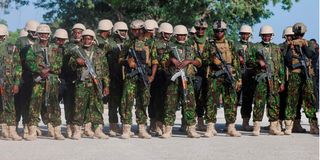
When Kenya agreed to lead the United Nations–backed Multinational Security Support (MSS) mission in Haiti, the decision was billed as bold and historic.
For a country struggling with gang violence, political collapse and humanitarian disaster, it offered a rare glimmer of hope.
That mission ended on Thursday after 15 months, with a mixed record even as the UN Security Council approved a resolution put forward by the US and Panama aimed at transforming the mission into a Gang Suppression Force (GSF).
The number of deployed personnel is expected to rise to 5,550, with a minimum deployment period of 12 months. Under a United Nations mandate – unlike the MMS – the GSF will have the authority to use military force in the event of threats to peace.
Last week, President William Ruto stressed that the mission led by his country's police had succeeded in securing Port-au-Prince airport, retaking the presidential palace and reopening several key roads in Haiti.
Dr Ruto lamented that it "operated below 40 percent of its authorised personnel strength," and was structurally "underfunded, underequipped."
Of the 2,500 police officers originally planned, fewer than 1,000 were actually deployed in Haiti.
Nairobi’s willingness to step into a crisis that many Western nations shied away from has been described as “a turning point.”
UN Secretary General António Guterres praised the deployment, saying the mission “represents international solidarity in action.”
Yesterday, the Ministry of Foreign Affairs welcomed the adoption UN council, referring to it as reflecting of the “impact of Kenya’s leadership in mobilising international attention, forging consensus, and catalysing collective action when others hesitated”.
“Kenya’s decision to deploy first was guided by principle, not prestige. Our engagement in Haiti has always been anchored in the protection of vulnerable communities, the upholding of the United Nations Charter, and our commitment to global peace and security in line with international obligations,” the ministry said.
Interior Cabinet Secretary Kipchumba Murkomen said Kenyan officers had gained valuable lessons from the Haiti Mission.
“I am very happy that recently the UN voted to expand the mission, which will ensure continued support and the deployment of additional personnel. This will also create space for some of our officers to return home, bringing with them skills and experience that will help us combat gangs here in our cities and other parts of the country. We are very proud of the work our police officers are doing. We believe the experience they have gained, and the positive publicity Kenya has received because of their work, is commendable,” he said.
Corporal Kennedy Mutuku Nzuve, the most recent officer to be killed, died in a road accident on September 1, according to a statement from the Kenyan police at the end of September. His body was repatriated to Nairobi.
Haiti’s storied past and long history of unrest are deeply rooted in centuries of political instability and the devastating impact of natural calamities.
These factors have created a fragile state vulnerable to the rise of powerful criminal gangs, culminating in the severe security and humanitarian crises witnessed today.
Political turmoil in the 1990s and early 2000s, coupled with natural catastrophes, worsened the situation.
The election of Jean-Bertrand Aristide, a champion of the poor, was celebrated as a major step toward democracy. Unfortunately, his presidency was twice interrupted by military coups in 1991 and 2004, forcing foreign interventions to reinstate him.
In 2010, a catastrophic 7.0-magnitude earthquake killed an estimated 300,000 people and displaced millions. Despite a heavy influx of international aid, recovery was painfully slow, hampered by government failures and corruption, which intensified public dissatisfaction.
The 2021 assassination of President Jovenel Moïse created a political vacuum that gangs swiftly exploited to consolidate power. By 2024, the security situation had deteriorated rapidly, with spiraling gang violence forcing Prime Minister Ariel Henry to resign in March 2024.
Haiti is now infested with violent criminal gangs that terrorize locals, making the country feel like a landmine-filled terrain where attacks can erupt at any time. The military has been relegated to the sidelines while the Haitian National Police (PNH) takes charge. Systems and service delivery chains have collapsed, and the Caribbean island nation remains in chaos even as the financially starved and logistically strained Kenyan-led MSS mission struggles to pacify the country.