Senior Counsel Ahmednasir Abdullahi, a vocal critic of the Judiciary over the years, is once again calling for a "radical surgery" to address corruption and incompetence at the courts.
The former Law Society of Kenya (LSK) president and former commissioner of the Judicial Service Commission (JSC) believes that continued public silence on these issues only serves to entrench them further in the judicial system.
In his view, it is up to the public—not judges or the JSC—to clean up the system.
“The Judiciary cannot initiate reforms. It is for Kenyans to do it, and do it now. I think we need a public revolt, you know, a public revolution on how to overturn the status quo in the Judiciary,” Mr Abdullahi said in an interview with Nation .
Mr Abdullahi noted that while the Executive may have some interest in judicial reforms, political leaders might be reluctant to act decisively because it might serve their interests.
“So it is for the common Kenyan to address this thing; to take the matter into their own hands and ensure that the corrupt judges are removed from the Judiciary,” he added.
Kenya has attempted judicial reforms on two occasions: in 2002 when over 20 judges and 82 magistrates were dismissed, and again in 2012 through the Judges and Magistrates Vetting Board.
In the second purge, 58 judges from the High Court and Court of Appeal were vetted, with at least eight senior judges deemed unfit to continue serving.
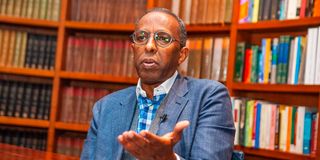
Senior Counsel Ahmednasir Abdullahi during an interview at his office in Kilimani, Nairobi on May 27, 2025.
Photo credit: Billy Ogada | Nation Media Group
Mr Abdullahi maintained that the Judiciary cannot be trusted to reform itself, claiming that the JSC has been rendered powerless.
“You know that the JSC can no longer process complaints against judges. All the complaints have been stopped by the courts. So the JSC now is finished,” he said.
On Tuesday, the Judiciary responded to his claims, dismissing them as baseless and sensational. It revealed that it had written to the Director of Public Prosecutions (DPP) Renson Ingonga, calling for investigation—and potential prosecution—of Mr Abdullahi over his continued attacks on judges.
Last year, the Supreme Court imposed an indefinite ban on Mr Abdullahi and his associates from appearing before the apex court, over his ‘persistent attacks on the court’s leadership and judges’. A case challenging the ban is pending in court.
Judiciary spokesperson Paul Ndemo urged the LSK and the Senior Counsel Bar to take disciplinary action against Mr Abdullahi, describing his conduct as unprofessional.
Mr Ndemo warned that such conduct could damage public trust in the Judiciary and undermine the rule of law.
“In the constitutional architecture of democratic states such as Kenya, the Judiciary is established as the last bastion for the realization and defence of rights and freedoms of all individuals. Judges, judicial officers and staff work under extremely difficult and constrained environments, if only but to deliver on this constitutional promise. The Judiciary, must therefore, whilst being held accountable, be jealously defended and supported by all well-meaning people,” Mr Ndemo said.
When asked why he does not name the corrupt judges or present evidence to relevant authorities, Mr Abdullahi responded that is not his role.
“I don't have a brief to collect evidence. There are institutions whose job is to collect evidence on corruption. And I can tell you, they collect it on a daily basis. But they keep quiet about it. But when I see corruption in the Judiciary, I will talk about it. I have a civic duty to talk about corruption,” he said.
He added that his critique was not limited to the Judiciary, saying he has also criticised corruption in the Executive and Parliament. The lawyer insisted that he will not stop raising concerns until real action is taken.
“I will continue with the tweets. I think, I don't tweet a lot, maybe two, three (in a day). I tweet more often just to help the system improve and to tell them that Kenyans are watching what they are doing,” he said.
Mr Abdullahi argued that the Judiciary should focus less on his social media posts and more on addressing corruption, improving access to justice, and tackling systemic challenges.
“I have been in this business for long. I was at the JSC, Law Society (of Kenya). There is corruption in other arms of government as well. And they talk about it. Even the President has acknowledged it. Chief Justice Martha Koome has previously admitted that there was corruption but when I talk about it, it becomes a problem,” he said.