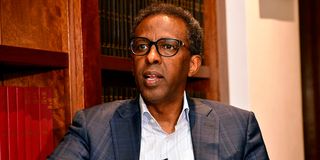
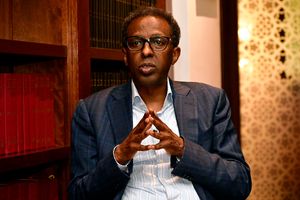
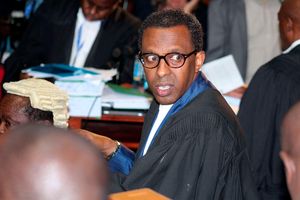
The Judiciary has written to the Director of Public Prosecutions (DPP) Renson Ingonga calling for investigations against senior counsel Ahmednasir Abdullahi over a series of attacks on judges on social media.
Renson Mulele Ingonga, the Director of Public Prosecutions.
Photo credit: File | Nation Media Group
Terming the social media posts as baseless, the Judiciary said the pattern of conduct by Mr Abdullahi amounted to crime under the laws.
The letter could spark yet another fight between the former Law Society of Kenya (LSK) president and the Judiciary.
The spat saw the LSK sue the Supreme Court judges in a matter that is pending before the Court of Appeal.
Thirteen lawyers from the law firm of Ahmednasir Abdullahi also petitioned the removal of the judges of the apex court before the Judicial Service Commission (JSC), for gross misconduct.
In the letter to the DPP dated May 20, the Judiciary said the posts on X (formerly Twitter) by Mr Abdullai had consistently painted the Judiciary as a corrupt institution.
“We are of the view that this pattern of conduct amounts to a crime under the laws of Kenya. We are also deeply concerned that if this conduct continues, it will erode public confidence in the Judiciary and eventually undermine the rule of law which is one of the ideals upon which our constitutional democracy is founded,” the letter signed on behalf of the Chief Registrar of Judiciary Winfridah Mokaya said.
The new chief registrar of the Judiciary Winfridah Boyani Mokaya.
Photo credit: Pool
The letter added, “Even as he makes these sensational claims of corruption, he has not submitted any complaint to the Judicial Service Commission or other law enforcement agencies for necessary action.”
Mr Abdullahi took to social media, in response to the letter and stated that instead of investigating the allegations of corruption, the Judiciary was calling for his investigations.
“It isn't the cries of Kenyans for a corruption-free judiciary that erodes public confidence in courts. It is the incompetent and corrupt leadership of the judiciary that erodes public confidence,” Mr Abdullahi wrote.
In the petition before the JSC, the 13 lawyers said the individual conduct of the seven judges of the Supreme Court has gravely compromised the administration of justice.
Several other petitions have been lodged before the JSC seeking the removal of the Supreme Court judges but the hearings of the complaints were stopped by the High Court, pending the determination of cases filed by the judges.
Mr Abdullahi and the lawyers from his firm were barred from appearing before the Supreme Court on January 18, last year.
High Court Judge Chacha Mwita at the Milimani Law Court on January 26, 2024.
Photo credit: File | Nation
LSK then challenged the ban and High Court judge Chacha Mwita ruled in June last year that the court had the jurisdiction to hear the petition.
The appellate court suspended the hearing of the petition before the High Court, pending the determination of the appeal filed by the judges of the apex court.
In the appeal, the apex court faulted Justice Mwita saying he erred by ignoring precedent from the Supreme Court and the Court of Appeal on the limits of the High Court’s jurisdiction.
“The learned judge erred by failing to appreciate and find that the letter and recusal order arose in the course of the Supreme Court exercising appellate jurisdiction pursuant to Article 163(4) (a) and (b) of the constitution and that for that reason, the High Court’s jurisdiction was ousted by Article 165(5)(a) of the constitution,” the Supreme Court judges said.