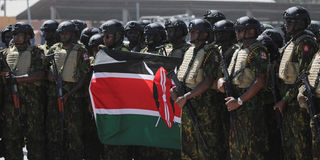
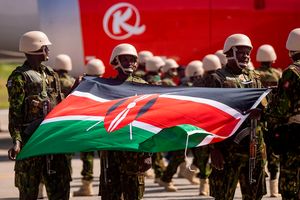
A year has passed since Kenya deployed police troops to the Multinational Security Support (MSS) mission in Haiti in June 2024.
In fact, by October 2, the mandate of the MSS itself could come to an end, unless the UN Security Council decides otherwise.
This was a mission the UN and Haiti banked on to tame gangs in the Caribbean country. President William Ruto then offered to send 1,000 Kenyan officers to lead the mission. With the first batch of those troops completing their tour of duty this month, what would Nairobi learn from the Mission?
President Ruto and Haiti PM Ariel Henry witnessed the signing ceremony in State House Nairobi.
Security missions are legal and political battles
Kenya may have bulldozed over legal challenges back home, but the idea was to earn a global honour, relevant for the country’s image. President Ruto said he was stepping forward for humanity to protect civilians in Haiti, even though Haitians didn’t buy it.
Endorsed in October 2023, the mission was delayed for nearly 9 months. At the time, the court had already ruled that the deployment of the officers was unconstitutional.
Lawyer Ekuru Aukot had, in January 2024, moved to court and successfully challenged the fly-out of the officers, and top of his arguments was that such an operation being handled by officers was unconstitutional.
In May, when Kenya wanted to send officers, Mr Aukot initiated a court challenge, saying that the government would be disregarding court orders. The troops departed nonetheless. A court later approved the deployment.
But then a political wind of change swept in the US, the main backer of the MSS. Joe Biden left office as US President, replaced by Donald Trump, who has sought to cut funding abroad.
A police vehicle is seen on patrol as people flee their homes from gang violence, in Port-au-Prince, Haiti, October 26, 2024.
Photo credit: Ralph Tedy Erol | Reuters
Haiti’s instability is more than MSS
Deployed to quell gang violence, the MSS was to back Haitian security agencies to stand on their own feet. It hasn’t quite gone that way. First, the transitional government itself staggered into formation, after an earlier transitional prime minister, Ariel Henry, who signed a pact with Kenyans, was forced out of office as violence escalated.
Official UN data shows the number of people killed or displaced in Haiti increased in 2024 compared to 2023. Those who died in 2024 from gang-related violence were 5,600 people. Some 1,000 people died in 2023.
Those displaced in 2024 were about 703,000 compared to 240,000 in 2023.
These numbers may not be a direct result of MSS deployment, but they showed that gangs became more vicious and authorities weakened in the transition.
Pius Maasai, a security expert, said that the officers have moderately achieved their main objective of protecting key installations. But he admitted the challenges were overwhelming.
“I support the idea of extending the mission time and making it a full UN Mission. We better make use of the boots on the ground in leading the UN Mission so as they achieve the main mission objective,” he told The Nation.
“ We need to liberate the Haitian People so that they continue enjoying everlasting peace,” he said.
According to Mr Maasai, the Kenyan officers had limited equipment.
“They have professional capacity but they required a continued specialised training, every other support, from technology, equipment, transport and weapons among others. Adequate Welfare and monthly subsistence allowances is another important factor to consider,” he said.
Mr George Musamali, another security expert, suggested the need to change the format of the mission, especially to ensure certainty of funding and equipping.
“The continuous deployment will only hit the Kenyan taxpayers because the government will have to ensure that the mission is ongoing,” he said.
Endorsed by the UN Security Council, MSS is not a UN peacekeeping mission, however. It relies on donor funding. Washington was the biggest funder but has since grown cold feet under Trump.
Members of a Kenyan police force, part of a new security mission, stand at the airport after disembarking, in Port-au-Prince, Haiti June 25, 2024.
Photo credit: Marckinson Pierre | Reuters
Local buy-ins are useful for foreign missions
One thing Kenyan officers may admire in Haiti is the local public support they received, even as political hotheads there said something else. In their camps, they received volunteers who offered various kinds of support, including translation.
Mr Jack Ombaka, the MSS spokesperson, has maintained that the troops are generally liked by the public, contrary to a posture fronted by gang leaders.
In an early interview, Mr Godfrey Otunge, who leads the MSS mission, said that he was happy with the reception they were being given.
"Kenya, as the lead country for the MSS mission in Haiti, is happy with the reception and trust we have received from the local people and the support we have received from various organisations, both local and international, as we have begun to engage, collaborate and operate to fulfil our mandate under United Nations Security Council Resolution No. 2699, 2023," said Mr Otunge.
Mr Ombaka has previously shared videos and photos showing locals celebrating whenever Kenyan officers arrive in certain areas.
The late Samuel Kaetuai, the police officer killed in Haiti.
Photo credit: Evans Habil | Nation Media Group
Deaths and injuries remind you of Haiti’s chaos
The contingent of officers in Haiti includes some of the most well-trained police officers. Yet losses have been recorded. Since June 2024, one officer has been killed and another is still missing. Samuel Kaetuai Tompoi, a police constable, was on February 23, 2025, shot dead by gang members during an operation within Ségur-Savien, in the Artibonite region north of Port-au-Prince. The gangs caught up with the victim after their truck got stuck in the mud.
Another officer, Benedict Kuria, is still listed as missing following a March 2025 ambush by a gang.
“We’ve tried many times to get information from the government, but they’ve refused,” said Kuria’s wife, Miriam Watima. “We don’t know what to do anymore.”
The family has now filed a case in court compelling the government to give reliable information on whether he was alive or not.
As hospitals in Haiti have been mostly inoperable, injured officers from MSS have had to be airlifted to the neighbouring Dominican Republic for specialised treatment.
Kenyan police forces patrol a neighbourhood, a day before the arrival of US Secretary of State Antony Blinken who will visit the Caribbean country as Washington seeks to solidify the UN-backed security mission, in Port-au-Prince, Haiti September 4, 2024.
Photo credit: Ralph Tedy Erol | Reuters
Fighting gangs need weapons and equipment of war
The MSS has repeatedly spoken of the need for more equipment. One officer said publicly when President Ruto toured Haiti last year.
For a mission meant to take down some of the well-equipped gangs, the idea of relying on donations hasn’t worked well. In February 2025, the US donated over 600 assorted guns, nine pickups, two trucks, two excavators, two armoured loaders and tens of bullets. This was the last donation made to the MSS mission.
Other nations like El Salvador provided air support, while the Bahamas contributed to maritime capabilities. Officers themselves have lamented that the donated equipment is insufficient or faulty.
For some time, officers in the mission also asked for donations of helicopters that would assist them in securing the country. It took longer than expected before they received the donations.
Former police officer Jimmy "Barbecue" Cherizier, leader of the 'G9' gang alliance, flanked by fellow gang members in Port-au-Prince on March 5, 2024.
Photo credit: File | Reuters
As the MSS battled gangs, talk emerged that gangs may be talked into peace. Haitian authorities themselves rejected the idea fronted by a local bloc back in April. One diplomat argued that since gangs want to remain Haitian, perhaps the idea is to talk them into peace.
Haitian gang leader Jimmy Chérizier, aka Barbecue himself, had called for dialogue, saying that it was the only option that could be used to help stop violence.
But it turned out to be a false flag. He also said he would be ruthless when dealing with the foreign police troops.
Whether dialogue can work is a matter of risk. Gangs in Haiti have lately shown the capacity to unite and share territory.
They formed an alliance against state security agencies. But that, it seems, was because they had one enemy in mind.