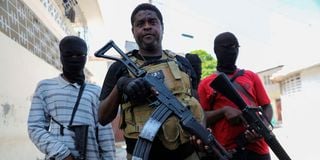
Haitian gangs, the ones the Kenya-led international mission has tried to beat down in vain, are known for their atrocities. In fact, the US has imposed sanctions on most of the gang leaders, making them international pariahs.
Yet these steps haven’t stopped their violence. Which has led to a question some regional leaders are asking: Should they just be talked to?
The question elicits anger and confusion. Anger in Haiti because the gang’s past deeds worsened when authorities offered to hold dialogue with them.
This week, however, it became clear, at least from Haitian authorities, that dialogue is off the table because it is unpopular in the public eye.
Many people, including the 700,000 displaced from the violence, want the gangs’ heads on the table instead. They want these violence merchants to face justice rather than get legitimacy through the back door of dialogue.
People flee their homes as police confront armed gangs after prominent gang leader Jimmy Cherizier called for Haiti's Prime Minister Ariel Henry's government to be toppled, in Port-au-Prince, Haiti, February 29, 2024.
Photo credit: Ralph Tedy Erol |Reuters
Yet Haiti doesn’t have those institutions working to deliver justice, which makes it a vicious cycle: If the gangs continue, no institution will ever be built. If they don’t and are brought to the table, many people will be disgruntled.
That hasn’t stopped some leaders from pushing levers. Albert Ramdim, the Surinamese diplomat now the Secretary General of the Organization of American States (OAS), raised the point recently, asking the leadership of Haiti to hold talks with the gangs to resolve the security crisis in the Caribbean nation where Kenya is leading a Multinational Security Support (MSS) Mission.
He argued, on June 9, that the Haitian leadership and international partners need to hold dialogue with “all or most of the stakeholders.”
Gang members sit together after former police officer Jimmy "Barbecue" Cherizier, and leader of an alliance of armed groups, addressed the media, in Port-au-Prince, Haiti, March 11, 2024.
Photo credit: Reuters
“One way is, of course, force and taking care of the gangs and the illegal activities, but the other one is trying to find inroads in the gangs and in the leadership,” Ramdim told the Advisor , the internal publication of OAS.
The Organization of American States (OAS) has proposed some kind of new mission to tackle the gangs. Its establishment, however, is still a matter of discussion and Ramdim said it was important for Haiti to listen to all proposals from member states and assess them.
However, the Presidential Transitional Council (CPT) in Haiti, the interim leadership meant to lead the country to peace, has made it clear that there is no room to negotiate with the gangs, as they are the reason the country has been unstable for years.
“The nation cannot engage in dialogue with those who have brought it to its knees,” CPT said in a statement on Monday.
OAS which brings together all 35 independent states of the Americas says it will try all kinds of solutions to restore peace in Haiti.
"Haitian society, in all its components, has suffered greatly from the consequences of criminal insecurity. It cannot conceive of negotiating with the perpetrators of these odious acts that jeopardise the very future of the nation," the statement from CPT read.
The gangs have, in the past, proposed dialogue with Haitian authorities and offered this plea directly to the CPT when it was being formed last year. But some experts argued at the time that the offer was, in fact, to buy time and probably infiltrate the new leadership.
CPT said on Monday that that Haitians are bitter with the way of operations of the gangs which have included kidnappings, rape, murder and drug trafficking, on top of forced displacements.
They became worse, especially after the July 2021 assassination of President Jovenel Moïse, who himself had overstayed his power by delaying elections.
The transitional Prime Minister, Ariel Henry, saw a rise in gang violence as the public accused him of corruption and lethargy. He left office while on an international trip to Kenya after gangs overran the capital, Port-Au-Prince.
In Haiti, however, some leaders have also been accused of co-opting gangs to stay in power, which in turn messed up things when gangs took on a life of their own.
A woman reacts at a crime scene where the bodies of several people, who were shot dead earlier in the morning amid an escalation in gang violence, were being removed by an ambulance, in Port-au-Prince, Haiti March 18, 2024.
Photo credit: Reuters
Instead, the CPT says its solution is to rehabilitate survivors of gang violence and dissuade more people from joining.
Currently, a number of reception centres are being set up in Haiti where minors who have been recruited to gang life are asked to surrender so that they can be rehabilitated.
"We count on the collaboration of regional institutions, but we will not compromise on principles. Haitians want justice, not pacts with their executioners," the CPT said.
It is not entirely uncommon for countries to speak with violent groups. But for Haiti, the gangs only seemed to unite when the central government collapsed. So far, it is unclear whether they operate under any common rules or chain of command, given that some occupy specific parts of Haiti and may harbour territorial rivalries amongst themselves.
It will also be unclear whether the mandate of the MSS is to change where dialogue to ensure with gangs. As it is, the UN Security Council authorised the MSS to target gangs with no option for dialogue.
However, Haitian authorities are to take in those who surrender and to ensure they face the law. That means Haiti retains sovereign authority on decisions on captured gang leaders or those offering to turn in.
Kenya has already said it is welcome to the OAS, introducing more means to tame the gangs, whether it means launching some kind of mission.
“Yes, we are aware. That is a greater involvement of Caribbean countries and it will serve to make the Haitian stabilisation effort a collective international effort, enhancing its likely success,” said Dr Korir Sing’oei, the Principal Secretary of Foreign Affairs.
That format was mooted by US President Donald Trump, who wants more states from Haiti’s neighbourhood to provide troops. Haiti has also reached out to the private military operator Blackwater to support local police.
An earlier proposal to turn the MSS into a UN mission got stuck at the UN Security Council (UNSC) after veto powers China and Russia refused to support it. The MSS, authorised by the UNSC, does not draw funds or resources from the UN. It relies on donors who have not been forthcoming.