Audrey Ashiali made her first million at the age of 26. She had just moved to Bahrain, a country in West Asia, to teach English and literature.
A Bachelor of Education graduate from Mt Kenya University, she crossed the pond to look for greener pastures in a country that, she admits, was never in the count of places she thought she would ever travel to.
To get to Bahrain, Audrey first had to jump over a few hurdles. At just 17, months away from completing her high school education, she fell pregnant. For a year and a half, she dropped out of school to raise her daughter.
Audrey, who now teaches English Language and Literature at Brooks International School in Moscow, Russia, thought it was the end of her education journey and the brute-force stoppage of her dream of becoming a lawyer.
“I had always wanted to pursue law as a career. It was all I dreamed of,” she tells Nation Lifestyle.
She got a C+ mean grade in her KCSE in 2009, which was not enough for direct university admission into a law programme. Her dream momentarily slipped away.
“In hindsight, I think it was for my good, a redirection that I would later be grateful for.”
Coincidentally, Audrey’s first-ever job was at a law firm as a clerk. “I learned valuable negotiation skills that I still use to date. My then boss, David Ashioya, taught me resilience and determination.”
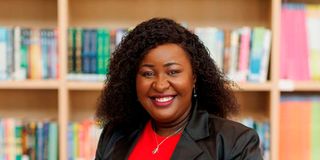
Audrey Ashiali, the 35-year-old teacher of English and Literature at Brookes Moscow International School's Library, Moscow Russia.
Photo credit: Photo | Pool
While at the law firm, she made peace with abandoning her dreams to pursue law and went for education. “I come from a big family of teachers. My father was a deputy principal at the time. The apple was not to fall very far from the tree.”
She joined Mt Kenya University’s School of Education through the concerted efforts of the connections she had made while she worked as a clerk.
“They helped me raise Sh172,000, which was enough to jumpstart my higher education journey. While at the university, she became an entrepreneur by selling music cassettes to classmates.
“I was rich,” she says with a chuckle. “I even paid my own rent.”
Audrey’s truest outing professionally was at her teaching practice posting at Chania Boys, where she learned how to connect with students.
After graduating in late 2014, she went back to Busia, where she taught at a local school for some time before falling ill.
“I went through surgery to remove ovarian cysts in July 2015,” she says.
It was a difficult period, both physically and emotionally. However, it was also a renewal of sorts.
“Everything happened all at once. I think my surgery was a rebirth. I was in the middle of shooting an advert for an insurance company (something that I did on the side) when I received my TSC number and a job offer as a relief teacher at St John’s Alupe [still in Busia County],” she says.
Sometime between August and September that year, she stumbled upon a debate on a Facebook group about teachers' welfare. In the comments, someone encouraged teachers to consider international teaching opportunities. Ever so curious, Audrey sent him a message. She had no experience with international curricula and didn't even know what IB [International Baccalaureate] or Cambridge meant.
“It is through him that I learned that international schools were looking for teachers with a degree in education, two teaching subjects, and active involvement in extracurriculars. I ticked all those boxes. When my contract in Busia came to an end, I reached out to him again. He told me about a maternity reliever opening at Aga Khan Academy in Parklands, Nairobi,” she says.
Despite her limited exposure to international curricula, she did well in the interview and got the job. This marked the beginning of Audrey’s transition from Kenya to a global teaching stage.
In 2016, Audrey, through a friend, learned about international teaching jobs.
“My short stint at Aga Khan had quite the impact. It laid the ground for what my next posting demanded. English, literature, and drama. The drama part comes naturally, as I also am an actor,” she says.
The adjustment was tough. “It took me a whole year to settle in at that school,” she says. “It required patience and tolerance to understand the students’ behaviour and the new work culture. Interestingly, Bahrain schools have a special liking for Kenyan teachers. We had left the country as a group of five, and while there, different departmental heads and even the school head said as much. They say we have a great work ethic, a commendable skill set, and excellent teacher-student relations,” she says.
Challenging as it was, the job was rewarding.
“It is here that I made my first million, bought my first car, and bought land for my parents in Bumala. The job had an attractive package that changed my life and perspective about what I had come to know as a teaching career: housing, insurance, and travel allowance, all at competitive and global rates,” she says.
She had been in Bahrain for five years when she chanced upon another opportunity in Uzbekistan, a country in central Asia.
But as with many parts of her life, the disappointment did not stop her. A former colleague, who was now in Kazakhstan at the time, shared about positions in Uzbekistan’s Presidential Schools, which were recruiting English-speaking teachers for Cambridge curriculum delivery. She quickly updated her profile on Teacher Way (a recruiting site for educators). Within a day, a recruiter named reached out for a pre-screening interview. “The main interview lasted just five minutes. I got the job on the spot. I usually know whether I will be hired within the first five minutes of the interview. I think it is something you learn after sitting for many interviews and understanding the needs of such employers,” she says.
With $4,200 (Sh542,062) as a starting salary, her salary nearly tripled what she earned in Bahrain. Within two months, she was promoted from teacher to Head of Department and later to Subject Lead, overseeing 14 schools.
At only 31, she found herself managing assessment systems, moderating work, and leading a team of other experienced teachers.
“I was the youngest expert teacher in that whole space,” she says. “Kenyans are not lazy. We perform.”
That same year, Audrey launched Audrey’s Digital School, a platform to mentor Kenyan teachers interested in international roles.
“It was out of the realisation that many teachers have content but lack the orientation to curricula like IB and Cambridge. I started coaching them to bridge this gap for global readiness,” she says.
In May 2022, opportunity knocked again. Through the Diaspora Educators of Kenya Association WhatsApp group, she learned about a vacancy at Brooks Moscow, an international IB school in Russia.
“A former colleague from Bahrain alerted me. I applied immediately; in a week, I had my job.”
Her current role in Moscow has offered her not just professional fulfilment but also additional benefits: a two-bedroom apartment, paid tuition for her daughter, travel allowances, meals, and comprehensive medical insurance. Her daughter, now in Form Five, is one of her students.
The perks are attractive, as she admits. But that is not the only thing that makes the job attractive.
“I teach students from 54 nationalities. I interact with diplomats and global professionals. I lead the Model United Nations club and have taken students to competitions in Turkey, St. Petersburg, and other cities,” she says.
In matters of accolades, she has consistently received the highest ratings in curriculum development and homeroom instruction.
When she goes back to the classroom after summer break this August, she is set to rise again—this time as Head of Department at Brooks.
“This is the best experience I’ve ever had in my career,” she tells Nation Lifestyle .
Audrey is preparing the next generation of global citizens. “What matters most is not just academic success. I want my students to learn negotiation, tolerance, and how to think critically at the global stage. Beyond their countries, beyond their communities and familiar people and places, exist other realities that call for their understanding and knowledge.”
To what, you ask, does she credit her success? Ambition. “When ambition meets opportunity, success is guaranteed. Also, hard work never takes a break. It is an everyday job. Like they say, success is never an accident.”
Her most important life lesson is to always look for opportunities and jump on them. “There is nothing extraordinary about me; I just say yes to new things, and I work hard,” the 35-year-old says.