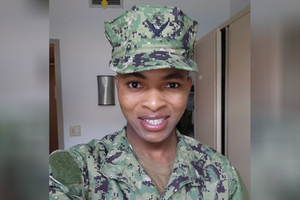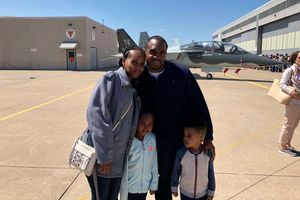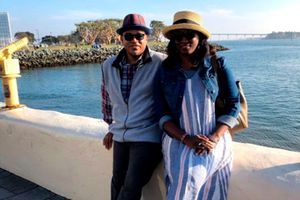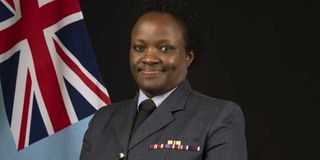
Wing Commander Joan Ochuodho at RAF Wittering in London on January 5, 2026.

From Ugenya in Siaya to commanding one of the UK’s most storied airbases, Joan Ochuodho has carved an enviable flight path. A leader made by faith, discipline, and fire, she shows that altitude is a matter of attitude and that Kenyan-born women, too, can claim the sky. Here’s a brave woman who turned a chance encounter at a London train station into a historic ascent, all while keeping the scent of nyama choma and the wisdom of the Rosary close to her cockpit.
***
Courage is not the absence of fear, but rather the judgment that something else is more important than fear. (Franklin D. Roosevelt, 32nd President of the United States)
There is a photograph, somewhere in the archives of a Kenyan family, of 12 children gathered around their parents. The 11th child, a girl with eyes turned skyward, could not have known she would one day command one of the Royal Air Force’s most strategic installations in the UK. But perhaps the sky knew. Perhaps it whispered to her even then.
In the windswept corridors of a British airbase, where the air swings with the legacy of the Battle of Britain and the hum of modern logistics, sits a woman who defies the gravity of both physics and expectation. Wing Commander Joan Ochuodho, Station Commander of RAF Wittering, personifies a truth that the ancient Greek philosopher Heraclitus understood well: character is destiny. And what character it is, built around the firm foundation of a Catholic upbringing, tempered by the loss of her father, and polished by the strong faith of a mother who chose prayer over panic when her daughter announced she was joining a military at war.
Joan’s story began with the murmur of the Rosary.
Born in Nairobi’s Parklands and raised in Siaya County, she was shaped by a household where faith was practised, respect was ingrained, and humility was a way of life. “My upbringing was rooted in faith,” Joan recalls. “And the values of respect, compassion, humility, integrity, and community have shaped who I am,” she adds, her voice carrying the cadence of a woman who knows that while she commands men and machines, she herself answers to a higher authority.
“The soul that is destined for command,” wrote Plato, “must be trained from childhood.”
Whether destiny or discipline, something in her spirit was already preparing for the sky. For young Joan growing up in Kenya, the soul-stirring roar of Kenya Air Force jets during Madaraka Day celebrations was a call to something greater than herself. While other children watched the aerial acrobatics with fleeting wonder, she absorbed the thunder, storing it away like a promise.
“I admired the Kenyan Air Force as I grew up,” she reflects with characteristic understatement.
Joan attended Parklands Primary School and completed her Kenya Certificate of Primary Education at Siror Primary in Ugenya, following her father’s retirement and the family’s relocation to their ancestral home.
She then attended the prestigious Limuru Girls’ High School. As a Brownie in primary and later a ranger in high school, she found herself drawn to the discipline, the structure, the ceremonial fidelity of raising the ensign. It was, in retrospect, a rehearsal for a life she had not yet imagined.
“Our responsibilities included marching in formation and supervising the ceremonial raising of the school ensign,” she notes.
In the Ochuodho household, there were 12 children, each carving their own path. There was no pecking order, Joan insists. How could there be when many of her siblings were already pursuing independent lives while she was still finding her footing? The death of her father cast a long shadow, but her mother provided cover. Taking on the dual role of mother and father, she became both anchor and radar. Many of her older siblings stepped in where needed, paying school fees, offering places to stay, and providing the moral support that cannot be quantified but can be felt in every achievement.
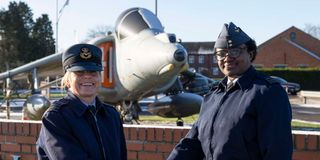
Wing Commander Nicola Duncan (left) and Joan Ochuodho on January 5, 2026.
“We faced the challenge of losing our father early in life. Many of my siblings are older than I am and, as a result, were already pursuing independent lives while I was still a child. Despite these age differences, we have always been a close-knit family,” Joan said.
“Respect,” she says, when asked about the core value that echoes from her childhood. It is a simple word, deep in its simplicity.
“Respect is a value deeply cherished by my mother, and it was the same with my father. It has shaped how I interact with others, regardless of their role or position,” says the 46-year-old.
Marcus Aurelius wrote, “Waste no more time arguing about what a good man should be. Be one.” Joan’s parents didn’t argue about goodness. They modelled it. Respect, compassion, humility, and integrity. These were daily practices.
Ecclesiastes teaches that to everything there is a season. Joan’s season would come, but not before a circuitous journey through economics, environment, and a chance encounter with a billboard at Sudbury Hill train station in London. At 19, freshly arrived in the UK to study economics and environment, Joan should have been eyeing positions at banks or NGOs. But fate often wears a disguise. In this case, it wore the form of a billboard at Sudbury.
The advertisement was for the Royal Navy. Joan, a non-swimmer, dismissed it. But a friend, seeing something Joan herself had not yet recognised, took the initiative to contact the careers office on her behalf. The information that arrived by post covered all three military branches. “I found myself instantly drawn to the Royal Air Force (RAF),” she recalls.
It was a homecoming of sorts, the childhood admiration for the Kenyan Air Force finding its echo in the RAF’s promise of opportunity and service. Joan’s military career was not meticulously planned, but the foundation had been laid long before she knew what structure would rise from it.
Physical conditioning
The irony would be poetic if it weren’t so challenging. The woman who couldn’t join the Navy because she couldn’t swim would later discover that swimming was mandatory for the RAF. Military training is not for the faint of heart. The swim test at RAF College Cranwell became her Rubicon. “Some skills are simply easier to acquire during childhood,” she reflects with wry pragmatism.
Extra training sessions became her temporary home. She prepared in other ways: football, running, and physical conditioning that would prove invaluable when sleep was scarce and alertness was essential. She had a footballer’s lungs and a runner’s legs. She had discipline. She had grit. And she had the confidence of someone raised to believe God does not give you a calling without giving you the strength to answer it. Joan accepted the water challenge, and though the exhilaration may have been dampened, victory was real. She conquered the daunting pools of Cranwell and began an ascent that would see her swap textbooks for tactical maps. Self-knowledge became her guide. Naturally mildly introverted, she found herself in environments demanding fast decisions and vocal confidence.
“I have always made it a priority to remain true to myself, consistently bringing my authentic self to every professional setting,” she says. This is not the language of corporate buzzwords but the lived philosophy of someone who understands that leadership without authenticity is merely management. Her leadership style defies easy categorisation. She found mentors who believed in her, instructors who sharpened her, and colleagues who became lifelong friends.
She learned to speak up despite her introverted nature. “Effective leadership is rarely defined by a single style,” she says. Instead, she integrates multiple approaches, adjusting to the unique needs of her teams, the organisational culture, and the specific challenges at hand. It is leadership as jazz. Structured yet improvisational, disciplined yet responsive. And she learned, as Sun Tzu once wrote, that in the midst of chaos, there is also opportunity.
Joan’s common purpose is operational excellence, team welfare, and service to the nation. The confidence she inspires comes from consistency. She is the same person in the boardroom and on the field, in crisis and in calm.
RAF Wittering is a nexus of logistics, welfare, operations, and strategy. As Station Commander, Joan is responsible for thousands. Their safety, their effectiveness, their well-being. It is a role that would overwhelm someone less grounded. “The role of Station Commander is fundamentally centred on people. This responsibility requires me to engage consistently with both internal teams and external partners, including our local communities,” she says.
Her days are filled with engagement with internal teams, external partners, and local communities. She must maintain a comprehensive understanding of all domains under her purview, fulfilling legal obligations while navigating dynamic demands.
Deployment to Iraq in 2003 presented a different kind of challenge. The RAF was engaged in active conflict. Her siblings were understandably anxious. Joan made a decision that, in retrospect, she might handle differently. She told her family where she was only after she had returned to the UK. “Given the circumstances at the time, my decisions felt appropriate,” she says.
It was an act of protection, perhaps, or an understanding that worry changes nothing but worries everything. Her mother, when she learned the truth, responded with pride. She had prayed, as promised, and her prayers had been answered. Proverbs speaks of the valorous woman: “She is clothed with strength and dignity; she can laugh at the days to come.” Joan’s mother, attending her graduation at RAF Cranwell, wore that strength and dignity like the finest garment.
The question of whether a woman can have it all seems to miss Joan’s point entirely. It’s not about having everything; it’s about building the right support systems, making thoughtful choices, and refusing to accept false binaries. As she tells women feeling pressured to choose between career and family: “It is possible to pursue any ambition with the right support and the presence of societal structures that facilitate success. I consider myself privileged to be in this position. I’m mindful of the responsibility. By sharing my story, and by drawing attention to the stories of other women who have navigated similar paths, I hope to inspire and encourage others to pursue their own ambitions.”
Joan’s excellence is no accident. Out of combat, she remains a daughter of Kenya. A woman who can discuss international relations, honed at King’s College London, in one breath and the perfect preparation of nyama choma in the next. And then, there is football. There is delightful symmetry in the fact that a military officer commands RAF Wittering while remaining spiritually loyal to Arsenal FC. Sport, she notes, is part of RAF life. She sees the pitch as a mirror of the air base. The discipline of the pitch translates directly to the discipline of command. Teamwork, perseverance, and sacrifice are transferable skills.
“The discipline, teamwork, and perseverance learned through sports have often complemented my professional journey,” she notes, her eyes flashing as she admits she’s waiting for that elusive Premier League trophy to return to North London.
Flame of literacy
“I am hopeful that this will be the year Arsenal secures the EPL trophy,” she says. When the uniform comes off, Joan is generally relaxed and, in her own words, easygoing. She reads voraciously, passing the flame of literacy and her love of books to her children. Music fills her home.
The Formula One season brings family excitement. It is a life measured in chapatis made at home, in the laughter of children, and the satisfactions of partnership. As the sun sets over RAF Wittering, Joan stands as a bridge between two worlds, underscoring the fact that the skyline is only a limit if you refuse to fly toward it. Her message to the young girls in Kenya is as simple: “Anything is possible. Just believe.”
She took command from another female officer, Wing Commander Nikki Duncan, in what is becoming a new normal, where the glass ceiling has been replaced by an open sky. This matters. Representation matters. Possibility matters. “I believe even the most ordinary individuals have the potential to make a meaningful difference,” she says.
It is a democratic vision of excellence, a refusal of elitism, a conviction that greatness is not reserved for the extraordinary but available to the faithful.
Joan has mounted up. She has soared. And in her ascent, she has charted a course for others to follow. When asked about legacy, her answer is characteristically focused outward: “To positively influence attitudes towards women in leadership roles. To be a source of encouragement to those who may have the potential but never see themselves as being change agents in society.”
“Marriage, to me, is a partnership,” Joan states with a groundedness that dismisses any notion of the intimidated husband.
Most weekends, you won’t find her in a cockpit, but on the sidelines of a pitch, cheering on her sons as they play rugby or football. In a world still grappling with questions of gender roles and career-family balance, her approach is refreshingly rational. She and her husband each follow their own professional paths, supporting rather than competing, encouraging rather than constraining.
“There are no strict rules or set expectations,” she says. Instead, there is mutual support and shared responsibilities.
What keeps her grounded on difficult days? “My sons play a central role in my life, constantly reminding me of the responsibility I have as a parent.” Here is the complete picture. A military commander who finds her deepest motivation in two young boys who call her Mum.
Joan does not hoard her success. She shares it. She uses her position as a platform. American General Douglas MacArthur, in his famous farewell address to West Point, spoke of “duty, honour, country”. For Joan, those words might be rendered “service, respect, possibility”. It is said that it is not because things are difficult that we do not dare; it is because we do not dare that they are difficult. Joan dared. She dared to dream beyond her circumstances, to pursue despite obstacles, to lead with authenticity, to balance with grace, to serve with excellence.
To her former classmates at Limuru Girls’ High School, who knew her as a serious prefect, her current status might seem like a natural evolution. To the rest of us, it is a marvel. And somewhere in Kenya, a young girl looks up at the sky, perhaps during this year’s Madaraka Day celebrations, and hears the thunder of jets overhead. She does not yet know that the sky has no ceiling. But perhaps the sky whispers to her even now. Perhaps it tells her: Anything is possible. Just believe.