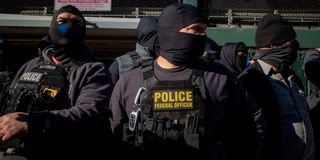
A former state prison guard and Episcopal priest who was detained by US Immigration and Customs Enforcement (ICE) has chosen to voluntarily return to his home country rather than remain in a detention centre in Conroe, Texas.
Reverend James Eliud Ngahu Mwangi, a Kenyan national, had been held in ICE custody for almost two months, despite having a valid work permit enabling him to serve with the Texas Department of Criminal Justice.
Rev Mwangi had an ongoing asylum case, but an immigration judge denied him bail, his lawyer Laban Opande told the Houston Chronicle on Monday.
“I don't think justice is being served in my client's case. He feels like he's in prison,” said Opande. “He feels like he's been confined unnecessarily. There was no need to deny bail.”
The decision to return voluntarily is strategic. Opande explained that choosing voluntary departure could protect Mwangi’s future eligibility to legally return to the United States. “Given the circumstances, he decided that returning home is the safest way to preserve his rights for the future,” Opande said.
Opande said that Mwangi was first pulled over by local police in Huntsville, who then alerted ICE. The attorney said it wasn't clear why the local police had initiated the stop.
The Episcopal Diocese of Texas, in a statement last month, said that the community is ‘heartbroken’ over the trauma experienced by Father James Mwangi and his family. “He is aware of the many calls, emails and prayers offered on his behalf, and he is deeply grateful for the outpouring of love,” the statement said.
Mwangi’s detention has raised questions about why federal authorities initiated removal proceedings against him, despite him being legally permitted to work in Texas. In November, the Texas Department of Criminal Justice confirmed that Mwangi had valid work authorisation and had been verified through E-Verify.
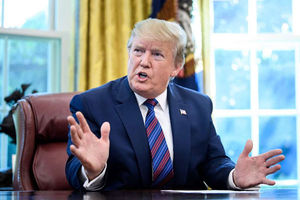
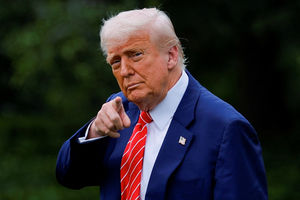
US President Donald Trump.
Photo credit: Reuters
However, ICE claims that the priest overstayed his visa and was ordered to leave the US by May 2024. A spokesperson added: “President Trump and Secretary Noem are committed to restoring integrity to the visa programme and ensuring it is not abused to allow foreigners to remain permanently in the US.
Reverend William Blake Rider, the rector of St Stephen's Church in Huntsville where Mwangi serves, said that the priest holds a valid work permit and is legally residing in the US.
“We have no reason to believe that the detained priest has committed any wrongdoing,” said Tammy Lanier, communications director for the diocese. “He did not ignore the law or his responsibilities, as his case remained in process.”
Mwangi serves as assistant priest of the Kiswahili worshipping community at St Stephen’s, led by Rev Dr James Gatungu. He is one of several Episcopalians detained by ICE amid the Trump administration’s expanded deportation efforts. In August, the daughter of a priest was detained after a visa renewal interview in New York City, despite holding a valid visa.
As of June, there were nearly 1,600 foreign nationals at the Texas Department of Criminal Justice (TDJC) with work authorisation, including 20 from Kenya.
It is unclear when Mwangi will leave for Kenya. As of Monday, he was still being held at a detention centre in Conroe.
“The process is not very clear. Sometimes there are inefficiencies in processing,” said Opande.
The Reverend Rider, has set up a fundraising account to support Mwangi when he returns to Kenya.
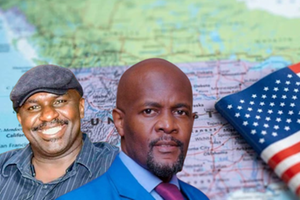
Meanwhile, a Kenyan Catholic priest serving in New York has been left stranded in Nairobi for over four months after the US Embassy rejected his routine visa renewal application, preventing him from returning to his parish in Lewis County.
Father John Ojuok, who is the parochial vicar at St Peter's, St Mary's and St Hedwig's churches, travelled to Kenya in August to visit his mother and renew his R-1 religious worker visa. Despite holding valid legal status in the US, his application was denied following an embassy interview.
Father Christopher Carrara, Episcopal Vicar for Clergy for the Diocese of Ogdensburg, said the embassy gave no official explanation beyond stating that Father Ojuok had failed the interview. Carrara speculated that the denial might reflect concerns that the priest could overstay his visa.
ICE claims that the priest overstayed his visa and was ordered to leave the US by May 2024.
Photo credit: Shutterstock
This case has alarmed religious communities that rely on foreign-born clergy, prompting the diocese to issue a warning about international travel.
Born and raised in Migori, County, Father Ojuok first arrived in the US as a seminarian in 2016. He studied theology at Christ the King Seminary in New York, after which he became an integral part of the Diocese of Ogdensburg. Prior to that, he studied at the Consolata Institute in Rome. Before leaving Kenya, he carried out pastoral work, including ministering in Nairobi to people living in poverty, in hospitals, and to children affected by AIDS.
According to a 2022 study by The Catholic University of America's Catholic Project, 24 per cent of Catholic priests in the US are foreign-born, and Father Ojuok's situation highlights the critical role they play.
The denial of Father Ojuok's visa stamp comes amid what observers describe as a climate of heightened scrutiny and unpredictability in US immigration procedures, particularly for religious workers. While a valid R-1 visa petition grants legal status to remain and work in the US, a physical visa stamp in the passport is mandatory for entry or re-entry into the country. Without it, Father Ojuok is effectively barred from returning to his ministry and legal residence.
In October, the Trump administration made the visa process more rigorous, requiring an in-person interview for nearly all applicants.