More than 350 Kenyan workers seeking employment in Saudi Arabia have been forced to return home after being denied entry over Ebola-related travel restrictions, prompting Nairobi to open urgent diplomatic talks with Riyadh and Kuwait.
The workers, despite holding valid employment visas, were stranded at Sharjah Airport in the United Arab Emirates for four days before boarding a flight back to Kenya, which landed at Jomo Kenyatta International Airport (JKIA) at about 1:30 pm on Monday, November 2 2026.
The restrictions have also disrupted the travel plans of hundreds of other jobseekers, with recruitment agencies warning that thousands of applicants could be affected if the measures remain in place.
The Association of Skilled Migrant Agencies of Kenya (ASMAK) said more than 350 workers were returning home, while approximately 150 others remained in transit. Documents for another 2,200 applicants had already been processed, with the workers expected to travel.
“Already, more than 350 workers are on their way back, and most of them are here. We estimate that about 150 are still in transit,” ASMAK Assistant Secretary General Elab Muridi said.
A map of the African continent showing countries affected by active Ebola outbreaks, at the headquarters of the Nigeria Centre for Disease Control and Prevention (NCDC) in Abuja, Nigeria, October 24, 2026.
Photo credit: Sodiq Adelakun | Reuters
The association's chairman, Francis Wahome, said recruitment partners in Gulf Cooperation Council countries were equally caught off guard, with agencies yet to receive formal communication from the Kenyan government explaining the restrictions.
“Even our partners in Saudi Arabia, Kuwait and other Gulf Cooperation Council countries were shocked. They have been calling us to ask what is happening. Everyone in the recruitment sector is seeking answers from colleagues and the government because we have not received any formal communication from the government,” Mr Wahome said.
ASMAK secretary-general Monica Mwema said the restrictions had disrupted confirmed bookings and scheduled departures, leaving recruitment agencies uncertain about how the 21-day travel rule would be implemented.
“We have people who are coming back because they were not allowed to enter Saudi Arabia. Others have confirmed tickets, with some scheduled to leave tonight and others tomorrow. We have been caught off guard and are seeking clarity on the 21-day restriction. What does it mean?” Ms Mwema posed.
The government has since moved to secure a review of the restrictions, with senior officials from the Ministry of Foreign and Diaspora Affairs meeting representatives of Saudi Arabia and Kuwait on Monday.
Director General for Political Affairs Josephat Maikara, Deputy Director General for Africa Affairs Dennis Mburu and Middle East Directorate Director Sora Katelo on Monday met Saudi Ambassador to Kenya Saad Abdullah Al Nofaia and Kuwait's Chargé d'Affaires Sami Talal Alenezi.
During the meeting, Mr Maikara expressed Kenya's concern over the suspension of arrivals, arguing that the country had complied with World Health Organisation (WHO) guidelines and taken prompt measures to contain the outbreak.
‘No new infections had been reported since October 19, and asked the two countries to review and lift the restrictions,” Mr Maikara said.
The Saudi ambassador and Kuwait's chargé d'affaires agreed to convey Nairobi's concerns to their respective governments and facilitate technical consultations between their health authorities and Kenya's Ministry of Health.
The proposed meetings are expected to provide a platform for the countries to review the restrictions in light of Kenya's disease surveillance and containment measures.
Saudi Arabia announced the restrictions on October 30 through the Saudi Press Agency, suspending travel by its citizens to Kenya and halting the issuance of all categories of visas to people travelling from the country.
The measures also bar entry to travellers who have stayed in Kenya or another country experiencing an active Ebola outbreak within the 21 days preceding their arrival, including those who transit through a third country.
The restrictions differ in scope, ranging from entry controls and quarantine requirements to enhanced screening and travel advisories. But their cumulative effect is to place Kenya under heightened international scrutiny at a time when authorities are trying to demonstrate that the outbreak remains contained.
The restrictions differ in scope, ranging from entry controls and quarantine requirements to enhanced screening and travel advisories. But their cumulative effect is to place Kenya under heightened international scrutiny at a time when authorities are trying to demonstrate that the outbreak remains contained.
The measures reflect the risks posed by sustained transmission in the DRC, where the outbreak has spread across eight provinces.
But they also illustrate the economic and humanitarian costs of containing an infectious disease in a region dependent on cross-border trade, transport and movement of people.
Kenya is responding to nine confirmed cases of the Bundibugyo strain of Ebola, which have resulted in two deaths.
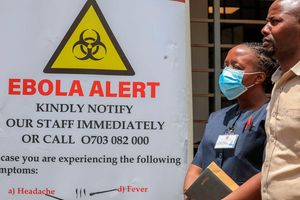
Posters displaying information about Ebola symptoms and hygiene precautions at Nairobi Hospital on October 7, 2026.
Photo credit: Reuters
The infections are linked to a single cluster that originated from an imported case involving a Kenyan man who travelled from the Democratic Republic of Congo through Uganda before arriving in Nairobi on October 3.
By October 30, the Ministry of Health had reported 10 days without a new infection and begun releasing people who had completed the mandatory 21-day monitoring period.
Public Health Principal Secretary Mary Muthoni said Kenya had gone 10 days without a new infection, crediting the progress to coordinated interventions by the national government, county administrations and development partners.
“Kenya is making progress in containing the Ebola outbreak, with no new cases reported in the last 10 days,” Ms Muthoni said.
The Ministry of Health said contacts who completed the mandatory 21-day monitoring period without developing symptoms were being progressively released from surveillance.
The World Health Organisation (WHO) has advised countries against imposing travel and trade restrictions in response to the outbreak.
In its October 23 disease outbreak update covering the DRC, Kenya and Nigeria, the organisation stated: “WHO advises against any restriction of travel to, or trade with, affected countries.”
Instead, it has called for stronger surveillance, early detection, contact tracing, preparedness at points of entry and cross-border cooperation.