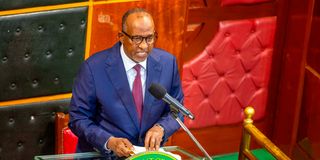
Health Cabinet Secretary Aden Duale says the government has since suspended its collaboration with the United States over the planned Ebola quarantine facility at Laikipia Airbase following a court injunction.
This even as petitioners accused President William Ruto's administration of withholding court-ordered documents of the deal and continuing implementation of the disputed arrangement.
Mr Duale said the project was stopped immediately after the High Court issued conservatory orders barring implementation of the arrangement, dismissing allegations of contempt as speculative. He said authorities complied promptly and acted in good faith throughout.
The Cabinet Secretary's defence is contained in fresh court filings in response to petitioners accusing President Ruto's administration of defying the judiciary.
Mr Duale said the government took immediate steps to comply with the orders once they were issued and stopped all activities linked to the collaboration with the United States.
“Immediately upon becoming aware of the conservatory orders issued by this court, the Government took steps to ensure compliance therewith and consequently suspended all activities being undertaken pursuant to the collaboration between the Government of Kenya and the Government of the United States of America relating to the proposed Ebola quarantine and isolation facility," he said in his affidavit.
He described claims of continued implementation as "conjecture, unsubstantiated assertions, unverified media reports and speculative inferences."
However, Katiba Institute, a petitioner, said the government's own statements undermined its defence. The institute argued that the State had failed to produce evidence showing that American counterparts had been formally instructed to halt implementation.
It also accused the government of failing to disclose documents that the High Court ordered released.
"The contradiction is fundamental. Compliance with a court order cannot, in any coherent sense, coexist with ongoing conduct that defeats the very purpose and effect of that order," said Katiba’s Executive Director Nora Mbagathi.
She argued that Mr Duale had acknowledged that activities continued at Laikipia Air Base while insisting the government had complied with the court's directives.
Ms Mbagathi said President Ruto had publicly confirmed that he approved the arrangement after a request from U.S. President Donald Trump.
"When President Trump asked the government of Kenya to support them by having a centre in Laikipia Air Base, I gave the okay because it was an agreement and a partnership with friends who have walked with Kenya for 30-40 years," the President said, according to media reports attached to the affidavit.
The petitioners also cited a statement issued by the US Embassy in Nairobi confirming that the bio-isolation facility formed part of joint Ebola response efforts between Kenya and the United States.
The embassy said it was "actively working with the Kenyan government to resolve any objections and communicate our shared objectives to the Kenyan people".
Katiba Institute further relied on Reuters reporting and satellite imagery that showed continued construction activity at the air base after the court orders were issued.
The affidavit referred to a Reuters report quoting a U.S. official as saying work had continued because Kenya had not instructed American personnel to stop.
The filings came in response to an affidavit by Mr Duale opposing an application seeking contempt proceedings against senior government officials.
The dispute centres on plans to establish an Ebola quarantine, monitoring and treatment facility at Laikipia Air Base in Nanyuki under a U.S.-supported programme that has triggered concerns over transparency, public participation and constitutional oversight.
Katiba Institute and the Law Society of Kenya moved to court seeking to stop the project, arguing that the public had not been adequately informed and that key documents relating to the arrangement had not been disclosed.
A satellite image shows the Laikipia Air Base (left) at the start of construction work on the Ebola quarantine facility on May 19. A fresh image (right) shows tents erected and vehicles parked at a new field hospital at the venue on June 6, 2026.
Photo credit: Planet Labs PBC
The court subsequently issued conservatory orders barring implementation of the arrangement pending determination of the petitions.
The court also directed the release of documents relating to the project, including agreements, approvals and assessments underpinning the proposed facility.
He said Kenya faced a genuine Ebola threat because of its regional links, including Kenyans working in neighbouring countries and about 450 peacekeepers deployed in eastern Democratic Republic of Congo.
"The Republic of Kenya remains under a constitutional obligation to protect the lives and health of its citizens through appropriate preparedness measures," he said.
Mr Duale also disclosed that the contested initiative formed part of a wider national preparedness programme involving 23 quarantine and isolation facilities across the country.
The government says it complied fully with the conservatory orders and merely continued independent preparedness efforts unrelated to the suspended collaboration.
The petitioners contend the distinction is artificial and that implementation effectively continued despite the court's directives.
The hearing is scheduled for June 18, 2026.
Separately, the suspension of a controversial United States-funded Ebola quarantine facility in Nanyuki has done little to calm tensions in Laikipia County, with human rights organisations now demanding accountability for the deaths of protesters who opposed the project.
In a joint statement issued Monday, Amnesty International Kenya and Amnesty International USA welcomed the Kenyan government's decision to halt construction of the facility in compliance with a court order, but condemned the police response to demonstrations against the project.
The rights groups said three protesters, including a 17-year-old student, were killed during confrontations with police, while several others sustained injuries. They called for independent investigations and prosecution of any officers found responsible for unlawful use of force.
"Every death must be accounted for, every allegation of excessive force must be investigated, and every officer responsible, including those who commanded or authorised unlawful actions, must be held accountable," Amnesty International Kenya Director George Morara said in the statement.
The controversy erupted after residents of Nanyuki and neighbouring areas learned of plans to establish a high-containment Ebola quarantine and research facility funded by the United States government. The project was to be constructed at the Kenya Medical Research Institute (KEMRI) grounds in Nanyuki as part of broader disease surveillance and epidemic preparedness programmes.
However, local residents, political leaders and civil society groups raised concerns over the facility's safety, the level of public participation undertaken before its approval, and the potential risks associated with handling highly infectious pathogens.
The concerns quickly escalated into public demonstrations, with protesters demanding greater transparency about the project's objectives and safety measures. Opposition to the facility intensified after claims circulated on social media that the centre would be used to house Ebola patients or conduct dangerous experiments, allegations that health authorities have repeatedly denied.
The dispute eventually landed in court, leading to orders temporarily stopping the project pending the determination of a petition challenging its establishment.
Amnesty International welcomed that decision, noting that adherence to court orders is a constitutional obligation and a key pillar of the rule of law. However, the organisation warned that compliance with the court order should not overshadow the need for accountability over the deaths and injuries recorded during the protests.
The lobbies called on the Independent Policing Oversight Authority (IPOA) to conduct swift, impartial and transparent investigations into the killings and determine not only the actions of individual officers but also whether commanders who authorised or failed to prevent excessive force bear responsibility.
Amnesty also demanded the immediate release of individuals arrested solely for participating in peaceful demonstrations, arguing that constitutional rights to assembly, expression and association must be protected.
The organisations further criticised what they termed a failure by authorities to adequately engage communities affected by the project. The residents' concerns, Amnesty said, deserved meaningful consultation rather than repression, especially on matters touching on public health infrastructure and international cooperation agreements.
The groups additionally pointed to provisions in the Kenya–United States Strategic Partnership Framework, which emphasise citizen participation, accountable governance and respect for human rights as essential components of bilateral cooperation. They argued that these principles must guide the handling of the dispute.
The Nanyuki facility has become one of the most contentious public health projects in recent weeks, exposing deep public mistrust over government decision-making and raising questions about how major health and research initiatives are communicated to communities.