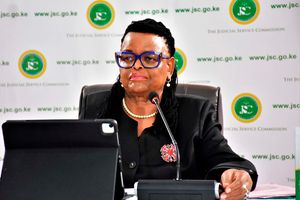
A High Court judge and the anti-corruption watchdog are locked in a legal battle over the agency’s attempt to question her in connection with alleged corruption at the Milimani Commercial and Tax Division.
The dispute raises a fundamental constitutional question on whether anti-corruption agencies can directly summon and investigate a sitting judge or if such complaints should be handled exclusively through the Judicial Service Commission (JSC).
Justice Josephine Wayua Wambua Mongare on Thursday moved to court seeking to block the Ethics and Anti-Corruption Commission (EACC), the Inspector-General of Police and the Attorney-General from summoning or investigating her. She accuses the agency, which is her former employer, of harassment and intimidation.
The High Court has since issued sweeping conservatory orders halting investigations, arrests and any disclosure of adverse information against the judge pending determination of her petition. The proceedings will also be conducted under restricted access, with the court ordering that members of the public be excluded unless directed otherwise.
“The public and/or persons unrelated to the matter shall be excluded from attending the said mention and all other future appearances, unless the Court directs otherwise,” the court ruled.
The case comes amid growing concern over corruption within the Judiciary. Chief Justice Martha Koome recently described such allegations as “deeply concerning and cannot be ignored” during the launch of the Judiciary’s anti-corruption strategy in 2025.
It also follows the recent arrest by EACC detectives of four individuals including a former judge and a lawyer over claims they solicited a Sh10.4 million bribe to influence the outcome of a case before the High Court. The suspects were later released on a Sh200,000 bond pending further investigations.
Justice Mongare’s legal challenge stems from a letter dated March 17, 2026, in which the EACC summoned her to appear at Integrity Centre for an interview and to record a statement.
“The Commission is investigating allegations of corrupt conduct and abuse of office at the Milimani High Court, Commercial and Tax Division,” reads the letter signed by EACC Director of Legal Services and Asset Recovery David Too.
However, the judge argues that the summons was irregular and unlawful. According to court documents, the letter was addressed to the Deputy Registrar of the High Court rather than directly to her.
In her affidavit, Justice Mongare says she was neither formally notified nor provided with reasons for the summons.
“Whereas I am summoned to appear for interview and statement recording, no written reasons have been provided to me,” she states.
She contends that the manner in which the summons was issued violated her constitutional right to fair administrative action and undermined her authority as a judge.
'EACC acted outside mandate'
The judge further argues that the EACC acted outside its mandate by attempting to directly investigate a sitting judge instead of channeling complaints through the JSC, as required by the Constitution.
“Any complaint regarding my conduct as a judge must be dealt with under the Constitution through the Judicial Service Commission,” she argues.
Justice Mongare maintains that the Constitution provides a clear framework for addressing allegations against judges, including investigation and possible removal from office. She warns that allowing parallel investigations by external agencies could erode judicial independence and expose the Judiciary to undue influence.
She also raises concerns about selective targeting noting that the Commercial and Tax Division has several judgesyet she was singled out.
“The letter is derogatory and discriminatory… the purported investigations singled out the petitioner despite the division having a presiding judge and seven other judges,” she states.
She describes the summons issued through the Deputy Registrar as demeaning and injurious to her reputation.
“The summons… is derogatory, demeaning, inhumane and injurious to my reputation and dignity as a judge,” she says.
Justice Mongare adds that she has not received any complaint from the JSC and is unaware of any formal proceedings against her.
“I have not received any complaint lodged before the Judicial Service Commission in respect of my conduct… nor any communication, summons, notice, or inquiry,” she states.
She accuses the EACC of overreach, saying its actions amount to intimidation and interference with her judicial functions.
“I am apprehensive that the respondent is using an excess of their powers as an instrument to harass, intimidate, and undermine me,” she adds.
In granting interim orders, the court barred the agencies from summoning, questioning, arresting, or detaining the judge. It also prohibited any search, seizure of property, or publication of adverse information relating to her.
The case now sets the stage for a constitutional showdown over the limits of investigative powers of anti-corruption agencies when dealing with members of the Judiciary.
Legal experts say the outcome could have far-reaching implications on the balance between judicial independence and accountability.
The court directed the judge to serve all parties with the application and ordered the respondents to file their responses by April 10.
Justice Mongare was appointed to the High Court in 2022 and has previously served at the Eldoret High Court and the Milimani Commercial and Tax Division. She is a former chairperson of FIDA-Kenya and has also served on the Public Procurement Administrative Review Board, with prior experience at the Kenya Anti-Corruption Commission.