The Court of Appeal has allowed the Judicial Service Commission (JSC) to continue handling complaints against judges, ruling that blocking the process risked allowing tainted judicial officers to be elevated in the ongoing recruitment of Supreme Court and High Court judges.
The appellate court suspended part of a December 2025 High Court decision that had temporarily paralysed the disciplinary process of judges.
The decision had barred the commission from handling petitions seeking the removal of judges until new regulations are developed.
However, the appellate court said halting the process risked undermining the commission’s constitutional mandate, especially at a time when it is recruiting new judges to the Supreme Court and High Court.
The court held that the order stopping the commission from handling petitions against judges was not merely declaratory but an enforceable directive capable of being stayed.
“It is an order directing the JSC not to undertake its constitutional mandate which it has been undertaking,” the judges said while allowing JSC's application to suspend implementation of the High Court judgment pending determination of an appeal.
The ruling means the commission can continue receiving and examining complaints against judges as it processes ongoing recruitment to the superior courts.
The legal dispute began early last year after advocate Kennedy Lubengu filed a constitutional petition challenging how the JSC handles complaints against judges.
The petition stemmed from JSC's decision to ask High Court judge Dora Chepkwony respond to a complaint filed against her alleging a delayed ruling on a bail application and misplaced a court file in a criminal case.
Lubengu argued that the commission had no written regulations guiding disciplinary proceedings capable of leading to the removal of judges.
According to the petition, that gap violated constitutional guarantees on fair administrative action and the right to a fair hearing.
In December, a three-judge bench of the High Court agreed with the argument and ruled that the JSC could not process or hear petitions against judges until it first gazetted regulations under the Judicial Service Act.
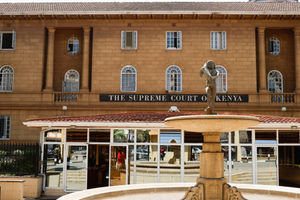
The Supreme Court in Nairobi.
Photo credit: Reuters
The judges declared that allowing the commission to proceed without formal rules would “amount to condoning an illegality”.
The decision effectively froze disciplinary proceedings against judges and sparked concern within the legal profession about its impact on judicial accountability.
The JSC immediately moved to the Court of Appeal seeking to suspend the orders, arguing the ruling threatened its constitutional functions.
"Unless the decision is stayed, the JSC will not be able to consider complaints made against judges currently being interviewed for nomination for appointment to the Court of Appeal, yet that consideration is a requirement in making its determination," JSC advocate warned.
JSC added that Article 168(4) of the Constitution, which sets out the JSC’s mandate, does not contemplate the making of regulations in disciplinary proceedings affecting judges, hence the High Court bench erred in finding that the JSC had failed to make the said regulations.
Further, the commission said the power to make regulations under section 47 of the Act is not mandatory and that the exercise of a constitutional mandate cannot be subjected to regulations.
The appellate court agreed that the intended appeal raised serious legal questions, including whether the absence of regulations can halt the exercise of a constitutional mandate.
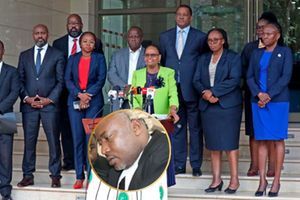
Commissioners of the Judicial Service Commission (JSC) led by Chairperson Chief Justice Martha Koome (Centre) at a past event. Judge Anthony Ombwayo (inset) has sued JSC over a land case.
Photo credit: File | Nation Media Group
“We are satisfied that the intended appeal is not frivolous. It is arguable,” the judges said.
The court also found that failure to suspend the High Court orders could disrupt the ongoing recruitment of judges.
Judicial interviews are currently underway, with the commission required to consider complaints or adverse public views about candidates seeking appointment.
The appellate court said preventing the commission from examining complaints during the process could compromise the integrity of judicial appointments.
“The effect of the impugned order is to bar the JSC from considering the adverse public views or complaints against judges,” the judges noted.
If appointments were made without considering such complaints, the court said, addressing serious allegations later through removal proceedings would be “laborious”.
The judges added that the consequences would extend beyond the commission and affect the public interest.
The High Court ruling had raised concerns among legal practitioners who feared it could stall accountability processes in the Judiciary.
In the same ruling, the Court of Appeal allowed the Law Society of Kenya to join the case as an interested party, citing its role in advancing the rule of law and protecting public interest.