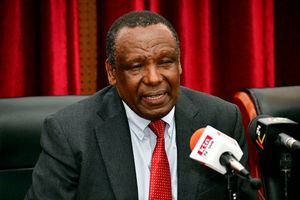
Education Cabinet Secretary Julius Ogamba has defended the government’s decision to cut university fees by up to 40 per cent, saying it was not aimed at hurting institutions financially but driving up student enrolment and revenues.
Speaking during the inauguration of the University of Nairobi Council, Mr Ogamba said the fee reduction under the new student-centred funding model is part of a strategy to make higher education more accessible while boosting universities’ incomes through increased numbers.
“The fee cut is not causing any financial strain. In fact, it is increasing [revenue],” the CS said, adding that several factors had been considered before pegging fees for degree programmes.
“It is in the numbers,” he said, further explaining that the strategy hinged on the economies of scale—by increasing class sizes, particularly in high-cost programmes like medicine, universities would be able to reduce tuition fees per student while still generating sufficient income.
“There’s no need to charge eight students exorbitantly if only two can afford to pay. If you increase the number of students from eight to 12 in a class, you’ve raised it by 50 per cent. That’s why we were able to reduce the fees by 40 per cent. When something becomes more affordable, more people pay,” Mr Ogamba added.
He clarified that the fee cuts are part of a broader funding strategy that includes enhanced efficiency in resource mobilisation.
Public universities are grappling with a growing financial burden. Under the new student funding model, the government owes institutions over Sh22 billion — Sh13 billion in unpaid Higher Education Loans Board (HELB) disbursements and Sh9 billion in scholarships for students admitted since 2023.
This adds to an existing debt of Sh85 billion, which universities have accumulated over the years, largely due to underfunding and declining student enrolment under the self-sponsored programmes.
Prof Daniel Mugendi, who chairs the Vice Chancellors Committee, is confident that public universities will not suffer under the revised funding model, dismissing claims that the VCs were excluded from the decision-making process.
Public Universities Vice-Chancellors Committee Chairperson Prof Daniel Mugendi.
Photo credit: File | Nation
“This process was very consultative. From the Presidential Working Party on Education Reforms to the National Committee on Fee Structures, vice chancellors were fully involved. I sat on one of the key committees myself, along with others like Prof Motembo, Prof Kiama, and Prof Rotich of Rongo University,” he said.
Under the new funding model introduced in July 2023, students contribute between 20 per cent and 60 per cent of tuition costs, replacing the flat rate five per cent contribution used previously. Prof Mugendi explained that, while expensive programmes saw a significant reduction, standard courses only dropped by about 15 per cent.
“Even with the changes, universities continue to receive about the same amount of funding. In fact, more money is now coming in from households; some universities admitted as few as 49 students in certain courses last year, and most of the highly-priced programmes have low enrolment figures,” he said, adding that increased enrolment numbers are helping universities absorb the changes more effectively.
“This year, about 246,000 students are joining universities, up from around 199,000 last year. The increased numbers are a big boost for institutions,” he said.
“Most universities are now operating better. The bleeding has stopped,” he said, while warning that delayed exchequer disbursements could reverse the gains.