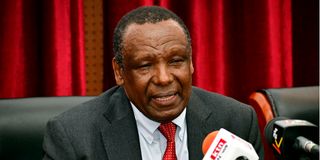
Public Universities Vice-Chancellors Committee Chairperson Prof Daniel Mugendi.

The reduced tuition fees for public universities announced by the government on Thursday were arrived at after tweaking various variables in the costing formula, the Nation can reveal.
The chairperson of the Public Universities Vice-Chancellors Committee, Prof Daniel Mugendi, said the move will make university education more affordable and accessible to Kenyans.
“You know the pricing is a function of many things, key among them being the number of students enrolled in a programme. If you realise, the programmes that have been drastically reduced by a big margin include medicine, pharmacy, dentistry, engineering,” he said.
Prof Mugendi, who is also the VC of the University of Embu, noted that degree programmes such as medicine, pharmacy, dentistry, and engineering were initially priced at a premium due to the small number of students per class.
“We are now adjusting those numbers. For instance, by increasing class size for medicine from eight to twelve students to bring the per-student cost down,” he said.
“When pricing a degree programme, numbers are key. Like initially, the number that we were using for medicine was a class of eight, so we have slightly increased that number so that we bring the cost down.”
The vice-chancellor allayed fears that the reduced fees would negatively impact universities, adding that institutions will still get government funding. Additionally, he said the quality of education in the institutions of higher learning will not be affected by the reduction in fees. “The reduction in fees is not going to hurt us financially. In fact, we embrace this move because it will reduce student dropouts and allow more learners to access higher education,” he said.
He added that the new pricing structure will make university education “reasonable and within reach” for most households across all academic programmes. “As long as the government continues to meet their bit, universities should run normally and do what we are set up to do,” added Prof Mugendi.
He said the Presidential Working Party on Education Reforms (PWPER), which was formed by President William Ruto in 2022, looked into the challenges affecting education in Kenya, including how reduced fees would affect education.
“The taskforce looked into all the issues critically, so the quality of education will not be affected,” said the VC.
The fees reduction, which takes effect from September 1, 2025, will apply to all students.
The principal of Koitaleel Samoei University College, Prof Winston Akala, who was also a member of the PWPER and chaired the Committee on Basic Education, said the taskforce recommended fees reduction based on the real cost of education.
He observed that Kenya’s data system is not sufficient to enhance transparent analysis by the Means Testing Instrument (MTI). “So you could not get true data about families, particularly those that are not employed in the public service. [These] were the majority. This complicated the feasibility and practicability of the MTI. But interactions with the vice-chancellors committee and the National Assembly came up with proposals, which were announced,” said Prof Akala.
The MTI determines how much government support each student receives, with a mix of non-repayable scholarships through the Universities Fund (UF) and loans from the Higher Education Loans Board (HELB).
However, Prof Akala said the reduced fees will compel institutions of higher learning to start looking for alternative sources of funding.
“The response of the Ministry of Education is good because it calms the parents. But, we now have to look for alternative funding for universities. In my case and in my university, I am moving in the direction of ‘educationising’ research, project and income generating units. This is the best direction we can go and this is what universities are doing internationally,” he said.
Prof Akala said most foreign governments do not fund universities. Instead, students rely on loans, while institutions raise funds through trusts, research, community outreach, and projects strategies that also help them support needy learners through scholarships.
President Ruto launched the Higher Education Funding Model on May 31, 2023, with implementation beginning in September for all first-year students. The model was a response to a financial crisis that left universities with debts exceeding Sh60 billion with some 23 universities technically bankrupt.