Two petitioners have moved to court seeking to stop the Ministry of Education from finalising senior school placements, citing alleged flaws in the Kenya Education Management Information System (KEMIS) portal that they say limit learners’ school selection choices.
Omwenga Ongegu and John Ominde accuse the ministry of operating a system that caps the number of schools displayed under each subject combination at 1,000, lists combinations with no schools available and contains school profiles that have not been properly updated.
They argue that the shortcomings prevent learners from accessing accurate information and selecting schools that offer their preferred subject combinations.
“The Petitioners have established, and now exhibit, that throughout the selection period and as at the date of this Petition, the KEMIS portal caps the number of schools displayed against any single subject combination at one thousand records, regardless of the true number of schools offering that combination nationally, and without any notice on the portal informing the user that the list shown is incomplete,” the petition stated.
Mr Ongegu said his examination of the portal revealed that the 1,000-record cap affects 26 subject combinations, concealing schools that offer those combinations but fall outside the displayed lists.
He cited combination ST1048, comprising Biology, Chemistry and Physics under the STEM pathway, where the portal displays only 1,000 of the 10,515 schools allegedly offering it nationally. This represents approximately 9.51 percent of the total.
Similarly, combination SS2025, comprising Business Studies, Christian Religious Education, and History and Citizenship under the Social Sciences pathway, displays only 1,000 of the 10,512 schools said to offer it.
According to the petitioners, the displayed schools also change as institutions update their profiles, meaning some appear on the list while others become invisible to learners searching for schools at a particular time.
They further claim that, of the 418 subject combinations listed on the portal, 28 have no school listed against them, while 303 have 94 schools or fewer nationally. Some institutions, including national and extra-county schools, are allegedly listed as offering only two or three combinations.
The petitioners argue that these discrepancies raise concerns about the accuracy and verification of the information used to guide learners during the transition from Grade 9 to Grade 10.
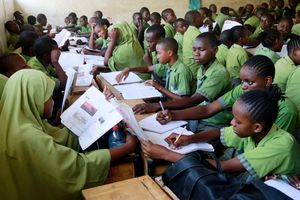
Students in class in this picture taken on August 28, 2024.
Photo credit: File | Nation Media Group
“The Petitioners aver that this misalignment cannot be left uncorrected until the current cohort of Grade 10 learners reaches the point of applying for degree and diploma courses through KUCCPS, since the pathway and subject combination a learner chooses now, at the point of Senior School selection administered by the Respondents, already narrows or preserves the courses that will be available to that learner by the time they reach that later stage,” the petition added.
They want the court to declare that limiting school displays without informing applicants that the lists are incomplete, and listing combinations with no available schools, violates Articles 10, 27, 43(1)(f) and 47 of the Constitution.
The petition also raises concerns about the relationship between senior school subject choices and future university admission requirements.
Mr Ongegu said learners and their guardians lack clarity on how Community Service Learning, a compulsory senior school subject, will affect eligibility for university courses through the Kenya Universities and Colleges Central Placement Service (KUCCPS).
He argued that treating the subject as equivalent to a humanities subject could broaden learners’ future course options and ease pressure during school selection.
The petitioners also identified other Competency-Based Education subjects, including Fine Arts, Media Technology, Marine and Fisheries, Mandarin Chinese, Indigenous Language, Literature in English, Fasihi ya Kiswahili, Theatre and Film, and Sports and Recreation, which they claim do not appear in KUCCPS’s published course requirements.
They contend that the uncertainty could leave learners unable to determine how their chosen pathways and subject combinations will affect their future academic opportunities.
The KEMIS selection portal opened on August 24, 2026, with the selection window initially scheduled to close on September 11. The ministry subsequently extended the deadline to September 15, when the portal displayed a notice confirming that the exercise had closed.
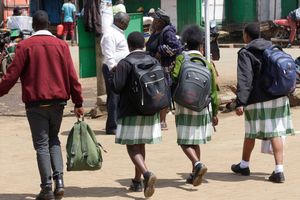
Grade 9 learners at Concordia Primary School in Mombasa attend a lesson in class January 21, 2026.
Photo credit: Kevin Odit | Nation Media Group
The petitioners are seeking temporary orders restraining the ministry and other respondents from finalising, confirming or publishing senior school placements arising from the 2026 selection exercise pending the hearing and determination of the case.
They also want the court to direct the reopening of the portal for a period to be determined by the court, allowing affected learners to review and revise their selections after receiving full disclosure of the alleged shortcomings.
They have further asked that any reopening take place after the 2026 Kenya Junior School Education Assessment examinations, scheduled to begin on October 26, to avoid placing additional pressure on candidates during the examination period.
The petitioners argue that preserving the status quo would give the authorities time to address the alleged defects and enable learners to make informed decisions before senior school placements are finalised.