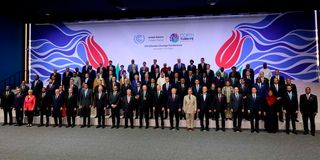
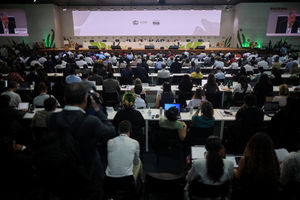
Walk through the halls of the Expo Centre in Antalya, Türkiye, this week, and you are navigating a pop-up city of more than 92,000 registered participants. When virtual attendees are factored in, the 31st UN Climate Change Conference (COP31) has topped 95,000 registrations, putting it on track to become the largest climate summit in history.
Behind the badge counts lies a high-stakes diplomatic numbers game. For countries on the front lines of climate extremes, showing up in force is about more than optics. It is about surviving a gruelling two-week marathon where dozens of technical negotiations happen simultaneously.
At the centre of that balancing act is Kenya. According to provisional delegate lists published by the UN Framework Convention on Climate Change (UNFCCC), Kenya has accredited 428 delegates for the Antalya talks, ranking 19th globally and placing it squarely in the middle of a shifting East African pack.
"Communities facing floods and droughts cannot wait until 2035 to find out what this promise means," said Mohamed Adow, director of the Nairobi-based climate and energy think tank Power Shift Africa, as talks opened in Antalya.
East Africa’s heavyweight turnout, and a regional surprise
Kenya’s 428-strong contingent, split between 259 core party badges and 169 overflow passes, represents a nearly 29% jump from the 332 delegates Nairobi sent to COP30 in Belém, Brazil, last year. Yet, it remains well below the 765 delegates Kenya brought to COP28 in Dubai in 2023, when large African delegations faced intense domestic scrutiny over travel budgets and per diems.
"There is a big Kenyan delegation here, not just from government; climate is not a government matter," Said Kenya's climate Envoy, Ambassador Ali Mohammed. "There is a huge Kenyan population, particularly from the private sector and civil society groups who are engaging in all facets of the talks here in the different rooms, and I am very proud to see the effectiveness of the team. Yes, we have several representatives from ministries too, but the larger population of Kenyans who are here are non-government actors, including media," he added.
Across the region, however, Kenya is no longer the largest voice in the room. While Tanzania sent 524 delegates (up from 465 at COP30), Uganda has surged ahead to lead East Africa with 627 delegates, making it the seventh-largest national delegation in the entire world, ahead of G7 economies like Italy (607) and Japan (588).
Across the continent as a whole, Nigeria towers above the rest. With 1,506 registered delegates, more than double its COP30 figure of 749, Abuja boasts the largest African contingent and the third-largest delegation globally, trailing only host nation Türkiye (2,950) and outgoing COP30 host Brazil (1,994).
Who isn’t in the room and who took the podium?
While over 190 parties have sent representatives to Türkiye, the provisional UNFCCC list reveals three glaring absences at the party level: the United States, Israel, and Myanmar have sent zero official delegates to COP31.
For the United States, the world’s largest historical emitter, this marks the second consecutive COP without an official federal delegation, following President Donald Trump’s decision to skip both COP30 in Brazil and COP31 in Türkiye. However, a group of U.S. Democratic lawmakers is visiting separately following the November midterm elections, though they do not hold formal negotiating credentials.
The absences extended to the top tier of the World Leaders’ Summit on November 11–12. Several G7 leaders, including those of France, Germany, Italy, Canada, and Japan, skipped the Antalya leaders' segment, while Kenya, Nigeria, and Egypt were also among countries whose heads of state dropped off the final speaking roster, leaving technical ministers and negotiators to carry their flags.
For UN Secretary-General António Guterres, delivering his final COP address before stepping down at the end of the year, the missing major emitters did not soften the urgency of the moment.
"The brutal truth is that the climate crisis is outrunning us. Emissions in 2025 reached all-time highs. Heat records keep shattering," Guterres told leaders, calling for windfall taxes on oil and gas giants to fund climate recovery. "Fossil fuels must go the way of the dinosaurs. The dinosaurs did not have a lobby. Fossil fuels do."
At the other end of the attendance roster are nations operating with skeleton crews: North Korea registered just two delegates, and Eritrea sent three.
The state of play: How COPs became mega-summits
To understand Kenya’s 428 delegates today, it helps to look at how wildly COP attendance has swung over the past few years:
COP28 (Dubai, 2023): Set the all-time attendance record with more than 80,000 in-person participants (and over 97,000 total badges issued). Kenya sent 765 delegates, Tanzania 763, and Nigeria 1,411. COP29 (Baku, 2024): Attendance dropped to 54,148 participants (plus 2,411 virtual), as tighter host-city capacity and sharper domestic budget scrutiny prompted many African governments to trim travel rosters. COP30 (Belém, 2025): Logistics in the Brazilian Amazon brought in-person attendance down further to 42,618 (45,168 including virtual). Kenya sent 332 delegates, Uganda 378, and Tanzania 465. COP31 (Antalya, 2026): Registration has rebounded past 92,000 in-person applicants, bolstered by an unprecedented 14,285 "host country guests" accredited by Türkiye, more than triple the 4,202 host guests at COP28.
That surge in badge numbers, alongside the heavy presence of corporate representatives and industry groups, drew sharp criticism outside the negotiating rooms from Swedish climate activist Greta Thunberg, returning to the UN summit circuit for the first time since COP26 in Glasgow in 2021.
"We should act to protect and benefit people rather than constantly sacrificing the global majority and the very planet we are all living on, for a fortunate few to keep making unimaginable profits and maintaining geopolitical power," Thunberg said, warning that "everything and everyone we love is at stake".
Models from Kenya pose with a mascot in front of the Azerbaijan pavilion on the opening day of the UN Climate Change Conference (COP31) in Antalya, Turkey, November 9, 2026.
Photo credit: REUTERS
Do big delegations actually win better deals?
Every November, headlines inevitably question whether developing nations need hundreds of people at a climate summit. Research into UNFCCC diplomacy suggests the answer is not that simple. Size matters, up to a point, but strategy matters more.
Climate summits operate through what researchers call "negotiation by exhaustion." Dozens of working groups on climate finance, carbon markets, adaptation, and loss and damage run concurrently, often stretching past midnight in the final days. According to peer-reviewed research on procedural justice in climate talks, countries with fewer than 15 delegates fall below a "sufficiency threshold," forcing them to leave key negotiating rooms empty.
Over the last decade, African delegations have grown by more than 325%. That expansion allows countries like Kenya to staff parallel technical tracks and coordinate within influential blocs like the African Group of Negotiators (AGN) and the G77 + China.
Yet even host leaders acknowledged in Antalya that filling conference halls is no guarantee of tangible results. Addressing the plenary, Turkish President Recep Tayyip Erdoğan, whose country is co-hosting COP31 alongside Australia, noted the persistent gap between rhetoric and delivery.
"This success at the level of ideas has not produced the same results when it comes to implementation," he said.
Researchers at the Carnegie Endowment for International Peace similarly point out that raw headcount does not automatically translate into diplomatic muscle, as many national overflow passes go to mayors, parliamentarians, academics, and civil society observers rather than treaty negotiators.
But in the, COP decisions are adopted by consensus, not by headcount. A country with 1,500 badges and a country with 15 badges hold the exact same legal veto on the final text. As UN Climate Change Executive Secretary Simon Stiell reminded delegates in Antalya, turning up is only the first step.
"No COP is a silver bullet. No single conference can bridge the chasm between the science and reality. We must deal the world as it is, not as we might wish it to be," he said.