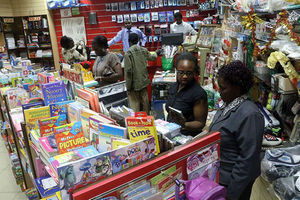
Schools and parents are spending millions of shillings buying books and other learning resources that contain harmful and misleading content, the Kenya Institute of Curriculum Development (KICD) has warned.
The CEO of the institute, Prof Charles Ong’ondo, added that the materials are not aligned with the competency-based education (CBE) and blamed the publishers of such materials for clawing back on gains made in the implementation of the curriculum.
He said the proliferation of the materials risks undermining the implementation of the CBE by misleading teachers, wasting school resources and exposing learners to content that falls outside the approved curriculum.
"It pains me when I see people marketing everything in the name of CBE. Some of those materials are even being marketed here at this conference, yet they have never been approved by KICD," he said.
Prof Ong’ondo singled out revision books and assessment packages as areas exploited by the businesspeople. He observed that learner assessment under CBE is guided exclusively by the Kenya National Examinations Council (KNEC), and schools should not administer commercial assessments developed outside the national framework.
“You are wasting your resources, you are wasting your energy, and you are courting a problem. Because we have already provided school-based continuous assessment. Assessment of learning is not the core thing. The core thing in CBE is assessment as learning and assessment for learning,” said Prof Ong’ondo.
The matter came up during the 49th Kenya Secondary School Heads Association (KESSHA) annual conference in Mombasa.
“Some of those materials are very offensive to some sections of Kenya. Producing a Kenyan curriculum support material is not an easy thing, because we have to take care of the broad spectrum of our religion, ethnicity, gender, and climatic conditions. A lot of those materials are very offensive to some sections of Kenyans, including materials that carry things that in Kenya are not acceptable," he said.
Some of the textbooks approved by the Kenya Institute of Curriculum Development for use in CBE.
Photo credit: Francis Nderitu | Nation Media Group
In Kenya’s liberalised textbook publishing economy, schools receive textbooks procured by the government. To qualify for procurement by the government, books must be approved by the KICD. However, schools are also allowed to purchase additional materials from the open market to supplement their teaching and learning resources.
It is this open market that is saturated with substandard materials that some teachers and parents have fallen prey to. Prof Ong’ondo called for the arrest of the vendors and publishers of such.
“These materials they’re selling … is there any peer, leave alone KICD or any renowned publisher, is there any editor who has looked at it. So beware of the one-man, one-woman publishing house who comes hawking materials,” Prof Ong’ondo said.
He called for the vetting of vendors who display their learning materials and merchandise during school events, accusing many of them of misleading the public.
He said that all Grade 10 materials in all subjects had been distributed to schools as per the distribution list availed by the Ministry of Education. However, the KICD boss acknowledged that admission to Grade 10 did not go as projected in the list and that data on various pathways had not been received for many institutions.
This resulted in some schools getting books for subjects they do not offer, while others did not get adequate books for subjects they offer. Prof Ong’ondo has appealed to principals to supply KICD with accurate lists of learners and the subjects they have chosen.
Equally, materials for Grade 11 have been evaluated and approved. The procurement has also been awarded to the successful publishers, but debts owed to publishers (about Sh10billion) delay the commencement of mass production and distribution of books to schools.
The curriculum expert cautioned that many schools unknowingly purchase books, revision guides and assessment packages that have not gone through KICD's quality assurance process.
He noted that developing curriculum support materials is a lengthy and highly regulated exercise involving experts, curriculum specialists, classroom teachers and multiple rounds of evaluation before any publication receives official approval.
"Some of you have participated in KICD as evaluators and understand how rigorous this process is. Before I joined KICD, I also attempted to write curriculum materials. Many of my manuscripts were rejected, and only one was approved. Producing quality curriculum support materials is not an easy task," he said.
Prof Ong'ondo warned that nearly three-quarters of some learning materials currently being sold to schools are either irrelevant to the curriculum or fail to meet the standards required for CBE.
"Approval is important because a significant proportion of these materials have nothing to do with the curriculum. They simply exploit schools and parents who believe they are buying resources that will improve learning," he said.
He singled out the growing business of selling "assessment packages" to schools, saying the practice contradicts the philosophy of CBE.
Recalling a recent encounter, Prof Ong'ondo said a young woman approached him claiming to be selling the "next assessment combinations" for junior school learners.
"A young lady, about my daughter's age, approached me and said, 'Mwalimu, I am selling the next assessment combination for junior school.' I told her she should actually be arrested because junior school is not about those assessment packages," he said.
The KICD boss directed principals, education officers and Teachers Service Commission officials to work together in identifying and reporting individuals selling illegal curriculum materials.
"If you visit a school and find curriculum materials that have not been approved by KICD, quietly confiscate them and report the matter to the nearest police station. The Communications Authority of Kenya will also come in and deal with the offenders," he said.