The 1.1 million learners who recently completed Grade 9 and sat the Kenya Junior Secondary Education Assessment (KJSEA) have until the end of December to revise pathway choices.
The government has opened a second window for the learners who will transit to senior school in January next year to revise their career pathway choices.
The pathways to choose from are science, technology, engineering and mathematics (STEM), social sciences, and arts and sports.
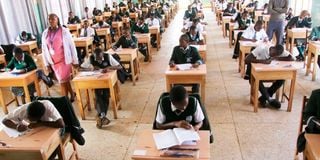
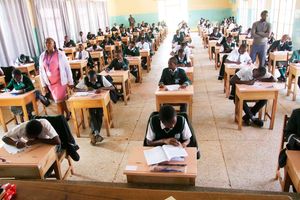
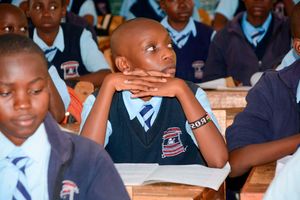
Grade 9 students at St Mary’s Girls Comprehensive and Junior School in Nakuru County sit for their Kenya Junior School Education Assessment (KJSEA) on October 27, 2025.
Photo credit: Bonface Mwangi | Nation Media Group
According to Dr William Sugut, the head of the Directorate of Secondary Education, 596,000 learners selected STEM, while 437,000 chose social sciences and 124,000 opted for arts and sports.
The Kenya Institute of Curriculum Development (KICD) has identified career guidance as a major gap at junior school level, warning that learners need structured support from parents and teachers to make informed choices as they prepare to join senior school in January.
Kenya Institute of Curriculum Development CEO Charles Ong’ondo.
Photo credit: File | Nation
The director of KICD, Prof Charles Ong’ondo, said that while career pathway selection is a defining feature of the competency-based education (CBE), learners at that level are still in the “era of discovery” and require close mentorship from adults.
“We are making a big leap telling these learners to choose pathways, which is one of the hallmarks of CBE, but it requires a lot of career guidance and discussion,” he said.
Prof Ong’ondo noted that learners in junior school are still exploring their identities and aspirations.
“One morning they want to be in the Kenya Defence Forces, the next they want to be a teacher, doctor or engineer,” he said.
Prof Ong’ondo urged teachers, parents and guardians to engage the learners in meaningful discussions once the KJSEA results are released later this month or in December.
“Because they will now have their results, let’s talk to them together with their parents to help them make well-thought-out decisions. We are in discussions at the stakeholder level to allow children some time to revise what they had earlier chosen,” he added.
Prof Ong’ondo said the consultations will ensure learners select pathways aligned to their abilities, interests and performance, rather than peer influence or parental pressure.
Prof Ong’ondo urged parents, guardians and teachers to help learners make informed choices during the upcoming revision window once KJSEA results are released within the next month.
“Placement to senior school will be based on the learners’ preferred pathway, subject combinations and performance. Cumulative assessments from Grades 6, 7, 8 and 9 — both formative and summative — will determine placement,” said Dr Sugut.
Mr William Sugut, the head of the Directorate of Secondary at the Ministry of Education.
Photo credit: File | Nation
Last week, Education Cabinet Secretary Julius Ogamba assured Kenyans that the Ministry of Education will work round-the-clock to ensure that the KJSEA results are released in good time to give parents and guardians adequate time to prepare for their children’s transition to the next levels under the 100 percent transition policy.
Speaking during the ongoing Kenya Primary Schools Heads Association (Kepsha) conference in Mombasa, Dr Sugut said the ministry is fully prepared for the transition.
“We had 1.1 million Grade 9 candidates. About 51 percent selected STEM, 38 percent chose Social Sciences, and 11 percent picked Arts and Sports. Going forward, we hope to see greater emphasis on STEM,” he said.
Each learner selected 12 schools — three from each of four new clusters (C1 to C4) — in a new placement system replacing the national, extra-county, county and sub-county categorisation.
Grade Nine candidates take KJSEA English language paper at Moi Nyeri Complex Primary School in Nyeri County on October 27, 2025.
Photo credit: Joseph Kanyi | Nation Media Group
There are 9,603 public secondary schools in the country. C1 schools will offer all three pathways — STEM, Social Sciences, and Arts & Sports — while C2 to C4 institutions will offer fewer options depending on their capacity and facilities.
“The new clustering system simplifies placement. It’s important that heads of institutions guide learners to make choices that align with their abilities and interests,” said Dr Sugut.
He said the country has adequate capacity to accommodate all learners transitioning to Grade 10, adding that the ministry has released Senior School Implementation Guidelines.
Dr Sugut also clarified that school fees will not be increased, saying the ministry remains guided by the 2015 gazette notice, which set boarding fees at Sh53,000 and capitation at Sh12,000.
“Currently, capitation stands at Sh22,244, and the prevailing fees structure remains unchanged,” he said.