The country has laboured through a curriculum reform since 2019, but its implementation still confuses many.
Parents are in the dark about assessments and transitions, teachers are barely upskilled for the task ahead and millions of children – especially the pioneer class – have missed key learning experiences, with schools remaining under-resourced.
The report drew a muted response from key stakeholders, and the government is yet to officially launch it.
Education Cabinet Secretary, Julius Ogamba, has since last year promised to release the findings of an audit conducted by his ministry.
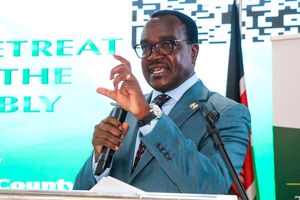
Education CS Julius Ogamba, when he appeared before MPs during the 2026 Legislative Retreat for Members of the National Assembly, at Lake Naivasha Resort in Naivasha, Nakuru County, on January 28, 2026.
Photo credit: Boniface Mwangi | Nation Media Group
His threat to prosecute ministry officials and school heads implicated in fraud remains just that – a threat.
According to the unreleased audit, some 547,000 learners in public schools could not be accounted for during a nationwide verification, raising questions about the credibility of the enrolment data the government uses to plan and budget for education.
The revelation came just after Mr Ogamba admitted that the government did not know how much it costs to educate a child from Grade One to university or college.
Before that, senior schools had raised concerns over difficulties in developing pathway-specific timetables as the government raced against time to deliver Grade 10 textbooks, a month after the learners reported to school.
The delay in delivering Grade 10 books is linked to Sh11.15 billion collectively owed to publishers for books delivered.
In November 2025, the Kenya Publishers Association (KPA) said operations in publishing houses were severely constrained and that the firms would not be able to print the books needed for the transition to senior school if the debt was not cleared.
The release of Sh5.6 billion by the Treasury to the Kenya Institute of Curriculum Development (KICD) to settle part of the bill came a little too late.
Grade 10 students were already in school but without curriculum support materials, thereby stalling commencement of teaching and learning.
True to KPA’s predictions, there are still delays in the distribution of Grade 10 textbooks across the country.
Before the textbook delays, two-thirds of the 1.13 million children moving to senior school were stuck at home as their parents and guardians struggled to meet the official requirements, including fees and uniform.
It has dawned on parents that the competency-based education (CBE), which was widely expected to address the shortcomings of the 8-4-4 system, has become a nightmare instead.
Having a child in school is increasingly becoming beyond the reach of a majority of households in Kenya.
While the government has set boarding school fees at Sh53,554 per year for Cluster 1 (C1 or formerly national schools), some parents say they are being asked to pay additional levies running into tens of thousands of shillings.
It followed the decision by the Ministry of Education to revert to school-led admissions after chaos marred the automated centralised placement system, which had seen some children reassigned to different senior schools without requesting reviews or transfers.
The remaining 17 per cent are unsure of the grading that classifies learner performance under the bands of Exceeding Expectation, Meeting Expectation, Approaching Expectation and Below Expectation.
Beyond the turmoil surrounding the Grade 10 transition, a scandal at the Teachers Service Commission (TSC) left dozens of trained tutors stranded after reportedly paying hefty sums for jobs they were promised but never got.
Konoin Member of Parliament Brighton Yegon.
Photo credit: Vitalis Kimutai | Nation Media Group
The matter came to the fore on December 29, 2025 when Bomet residents – led Konoin MP Brighton Yegon – stormed the TSC offices in Mogogosiek.
The lawmaker and the agitated crowd accused officials of demanding money from locals seeking teaching jobs.
Mr Yegon said more than 20 trained but unemployed teachers had paid Sh300,000 to Sh500,000 to TSC officers and their agents in order to secure the letters, which they did not receive or were later found to be fake.
A recent report by Usawa Agenda and Zizi Afrique paints a picture of a stretched education system, with a teacher deficit of more than 100,000 across the education ladder – from early childhood education to technical institutions.
The report shows public primary schools have a higher learner-to-teacher ratio of 42 to one, compared to private schools with 34 learners to one tutor.
According to the report, one in three Grade Six learners in Kenya cannot read and comprehend a Grade Three-level English story, raising concerns about readiness for junior school.
The situation is more dire in public schools, where 37 out of 100 Grade Six learners cannot read and comprehend a Grade Three-level English story, compared with 24 per cent in private schools.
Public universities cannot contain rising debts, and a financing model introduced in 2023 has not cured the ills.
Many students in public universities struggle to live on campus as rates for upkeep have not been revised for years despite inflation realities.
A work boycott by lecturers towards the end of last year paralysed learning in public universities and distorted the academic calendar.
The Universities Academic Staff Union says lecturers are still owed arrears stretching as far back as 2017.
The union says if promises made by the government in the return-to-work formula are not honoured, it is likely to call another strike.