Only candidates with special needs will be allowed to register for examinations meant for those living with disability in the Kenya Certificate of Secondary Education (KCSE).
This is after the Kenya National Examinations Council (Knec) introduced new stringent rules for registration of candidates in the 2026 KCSE examinations to stop a trend where some able-bodied candidates register for the Kenya Sign Language to boost their chances of scoring better grades.
Learners with special needs, including the visually, mentally or physically impaired are administered different examinations from their counterparts. In the 2025 KCSE examinations, 3,493 candidates irregularly registered for the Kenya Sign Language despite having not qualified for it.
KSL is designed as an affirmative action subject specifically for learners with hearing impairment, providing an alternative to Kiswahili, which is challenging for deaf learners due to the phonetic nature of the language. However, many students who are not hearing impaired opted for KSL, hoping to avoid the complexities of Kiswahili. This led to disappointment when they realised their performance in KSL did not count toward their overall KCSE mean grade.
Knec officials said the irregularities were identified and addressed, and candidate who were not eligible were not graded in the special needs papers.
In a letter to sub-county directors of education, seen by Nation, Knec has outlined new measures aimed at ensuring only qualified candidates are registered for examinations targeting learners with disabilities. One of such requirements is medical evidence about a candidate.
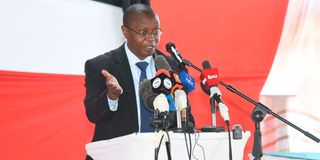
“The data presented must be accurate and error-free, including correct spelling and order of candidates' names as documented in their KCPE certificates, gender, year of birth, citizenship, entry codes (first-time candidates or repeaters), birth certificate numbers, and passport photographs,” said Knec Chief Executive Officer, Dr David Njengere.
Dr Njengere added that other critical details such as subjects registered for, category of special needs, and relevant medical evidence must be accurately captured for Visual Impairment (VI), Low Vision (LV), Hearing Impairment (HI), Intellectual Disability (ID), and Physical Impairment (PH).
Candidates with special needs are now required to provide supporting documentation, including a detailed recent medical report from a recognized doctor or practitioner, an assessment report from the Sub-county Special Needs office (EARC), a full-sized colored photograph for candidates with physical disabilities, and a report from the head of institution highlighting any special interventions required to ensure fair administration of the examinations.
“All eligible candidates must upload their correct passport-size photographs (300 × 300 pixels). There will be no replacement or change of photographs once the registration period is over. Parents’ or guardians’ details, including names and mobile numbers, must also be captured online to confirm registration and accuracy of candidate data,” Dr Njengere said.
He further emphasised that it is mandatory for principals to declare all repeaters registering for the KCSE examination at the point of registration to avoid delayed results due to incomplete information.
Revelation that the 3, 493 candidates’ KSL grades would not be used to compute the final grade sparked outrage among parents, who travelled to Knec offices in Nairobi seeking explanations.
“Why didn’t the school inform my child in advance? Why allow a candidate to learn a subject from Form 1 to Form 4 when it would not count? As parents, we feel misled. This is unfair,” said one parent, who requested anonymity due to the sensitivity of the matter.
Dr Njengere described the misuse as a tactical abuse of the system, aimed at circumventing the compulsory Kiswahili paper. He explained that KSL was not intended to replace Kiswahili for hearing learners, but to assist the learners with hearing impairment.
“The syllabus for Kenyan Sign Language was developed in 2004 specifically for learners with hearing impairment. It has not been revised to include learners without the impairment,” he said.
Investigations by Knec revealed that most of the 3,493 students who took KSL had not studied the subject at KCPE level and had no medical documentation indicating hearing loss throughout their secondary education.
Historically, deaf learners face significant challenges with Kiswahili due to its reliance on sound, intonation, and phonetics. KSL, which is based on English, was introduced to facilitate integration of hearing-impaired learners into mainstream education while allowing them to demonstrate competencies in a language accessible to them.
The controversy prompted the National Parents Association (NPA) to call for accountability. NPA Chairperson, Silas Obuhatsa, stated that teachers and principals who misled students must be held responsible.
“Many parents only realised their children had sat for KSL ‘illegally’ when they visited Knec offices for clarification. Teachers and principals should be accountable for duping candidates,” Mr Obuhatsa said.
“Some teachers are taking advantage of the subject because it is considered very easy. Parents are being misled, and students’ academic futures compromised,” he said.
Dr Njengere reiterated that KSL remains a subject for hearing-impaired learners and must not be exploited by schools seeking easier alternatives for regular students.
“The purpose of KSL is to level the playing field for learners with special needs. Allowing hearing students to use KSL for grading undermines the very essence of affirmative action in education,” he said.