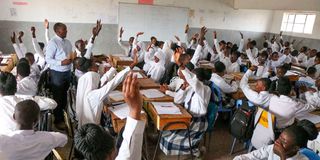
Kenyan children of school-going age have more access to education than their counterparts within the East African region, according to a new report by UNESCO.
However, the report indicates that the region is still grappling with significant gaps in enrolment, completion and quality of learning outcomes.
The 2026 Global Education Monitoring (GEM) Report released by UNESCO paints a mixed picture of global progress in education, with gains in enrolment overshadowed by persistent inequalities across developing regions.
Kenya scores better than her neighbours in transition rates at all levels. Whereas 15 percent of Kenyan children were recorded to be out of school at the primary school level, Tanzania is at 17 percent, while Uganda is at 14 and South Sudan is at 64.
87 percent of Kenyan children complete primary school education, compared with 69 percent in Rwanda, 76 percent in Tanzania, 30 percent in Uganda, and data was not available for South Sudan.
The report shows that 273 million children, adolescents and youth were out of school globally in 2024, despite decades of expansion in education systems. About half of these are in Sub-Saharan Africa.
“While 1.4 billion [learners] were attending primary and secondary school globally in 2024, it is also estimated that 273 million were out of school,” the report states.
According to the global and regional education data, Kenya has achieved relatively strong access indicators, particularly at the primary school level, compared to countries such as Uganda and Tanzania.
In the region, less than 25 per cent of children of school-going age are enrolled in pre-primary education institutions, while only about two-thirds of young people complete secondary school, highlighting major gaps in both early learning and progression.
The report notes that challenges remain across parts of Africa. By 2017, two countries—Niger and Uganda—still had transition rates below 60 per cent. Globally, the report indicates that, progress has slowed considerably in the 15 years that followed, signalling the need for renewed policy efforts to support learners moving through the education system.
“Globally, between 1985 and 2000, the transition rate improved from 78 percent to 88 percent but has slowed down considerably in the following 15 years,” the report states.
Kenya also records stronger outcomes in primary school completion. Education summaries linked to UNESCO indicate that primary school completion in Kenya is near universal, with about 99 per cent of boys and 100 per cent of girls completing primary school.
In contrast, Uganda continues to face retention challenges in basic education. Estimates show primary completion rates of about 52 per cent for boys and 54 per cent for girls, pointing to high dropout rates before learners complete the primary cycle.
The cost of schooling was cited as one of the drivers for high dropout rates. Public education expenditure fell to 6.6 percent of total government spending in 2024/25, with private schools absorbing a growing share of enrolment, especially in urban areas such as Kampala where 84 percent of pre-primary to secondary institutions are private (UNESCO GEM, 2026).
Kenya, meanwhile, has expanded access to education through diversified secondary and tertiary education, but inequalities persist. The report highlights challenges in financing and equitable access, noting that public support for low-income students remains limited and inefficiently targeted.
Open and distance learning has improved access for disadvantaged groups, but “diversification contributes to stratifying the system and entrenching inequality”.
“Countries that made the fastest gains combined steady investment, kept core policies in place, and adjusted them gradually in light of emerging evidence and experience.”
It stresses the need for a balanced policy mix, including legislation, governance, infrastructure, and demand-side financing to reduce costs for disadvantaged learners.
UNESCO warns that the goal of universal primary education is unlikely to be fully achieved by 2030, making universal secondary completion an even greater challenge.
The report argues that addressing disparities in East Africa will require coordinated efforts across national and local governments, schools, and households, particularly for marginalized children and youth.
“As the 2030 deadline approaches and multilateralism is under strain, there is a need to use data and narratives to understand the diverse pathways countries have taken towards SDG 4,” it states.
Figures from NationMaster show that Kenya’s net primary school enrolment stands at about 79 per cent, compared to Uganda’s 53 per cent, highlighting a significant gap in access to basic education between the two neighbouring countries.
The same dataset indicates that Kenya’s stronger enrolment performance reflects broader regional leadership in expanding access to primary education, driven by policies such as free primary education and increased public investment in schooling.
At the completion level, Kenya also shows relatively stronger outcomes. UNESCO-linked education summaries indicate that Kenya records near-universal primary school completion—about 99 per cent for boys and 100 per cent for girls.
In contrast, Uganda continues to face challenges in retention, with primary completion rates estimated at about 52 per cent for boys and 54 per cent for girls, pointing to significant dropout pressures before learners finish basic education.
Secondary school access also reflects similar disparities. Regional comparisons show that Kenya’s secondary school enrolment is significantly higher than Uganda’s, reinforcing Kenya’s position as a regional leader in education access and progression.