After teaching Grade 10 learners for one term, teachers in senior school are now warning that the three chaotic years of junior school that were marked by a lack of laboratories, teachers and basic learning resources may not have laid a strong foundation for learning at senior school.
Teachers and principals who spoke to the Nation say there are serious gaps in learning, particularly in science and practical subjects, with many learners struggling with content at senior school level due to limited exposure to hands-on work during junior secondary.
“These learners were not adequately prepared. They are completely green — never stepped into a laboratory, only taught theory with no practical work. There are no labs in the host primary schools, yet now in Grade 10, parents expect us to perform miracles as they grapple with advanced science. They scored highly in primary, but many cannot even read. So how did they get these marks?” Said one principal in Nairobi.
According to the Basic Education Curriculum Framework, learners at junior school should be exposed to a broad-based curriculum to enable them to explore their own interests and potential as a basis for choosing subjects according to career paths of interest at senior school.
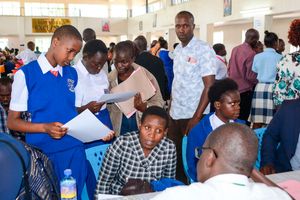
A Grade 10 student and her parent keenly listen to a teacher at Kisumu Girls High School during admission.
Photo credit: Alex Odhiambo | Nation Media Group
“How do we get to Grade 10 and start giving advanced education to learners who have never done practical work?” The principal added.
At the introduction of junior school in 2023, most public schools did not have adequate teachers specialised to offer all the subjects offered. The schools remain grossly understaffed and lack resources such as laboratories for various science and technical subjects.
A recent report by Usawa Agenda appears to offer credence to the teachers’ sentiments. The report revealed that 51.3 percent of Grade Six learners in public schools were not able to read and comprehend a simple Grade Three English story.
The report further revealed that a child in an urban area is way ahead of a child in a rural public school, and ahead of a child in the Arid and Semi-Arid Lands (ASALs) or refugee camps, where illiteracy rates soar to near 60 percent.
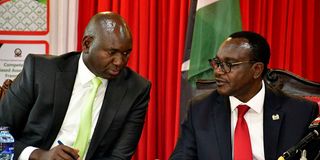
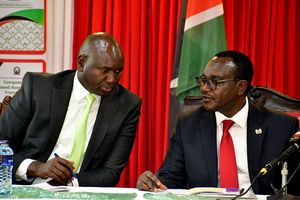
Moses Nthurima, the deputy secretary-general of the Kenya Union of Post-Primary Education Teachers (Kuppet), told Nation that the education sector is grappling with a severe staffing crisis, noting that teacher shortages remain widespread across schools. He said that projections indicated a national shortfall of nearly 100,000 teachers, a gap that continues to strain learning in both senior and junior secondary schools.
Kenya Union of Post Primary Education Teachers Deputy Secretary-General Moses Nthurima.
Photo credit: File | Nation Media Group
He further noted that science-based subjects are particularly affected, with schools reporting acute understaffing in STEM disciplines.
“When you go to subjects like science and even visual arts, we totally have no teachers. In particular, teachers of visual arts are not trained, even physical education remains critically understaffed, with very few specialised teachers available,” said Mr Nthurima
The Kuppet official also raised concern large class sizes in senior school, especially in Cluster 1 and 2 schools will affect the quality of education offered. Enrolment in most of these school rose beyond the recommended capacity as parents scrambled to enrol their children in better equipped and staffed schools.
Mr Nthurima observed that classrooms meant for far fewer students are now accommodating nearly twice the number, putting immense pressure on teachers and resources.
He highlighted gaps in practical learning facilities, particularly laboratories, saying the expansion in student population has not been matched with equivalent investment in learning spaces.
Grade 10 learners from Langalanga Senior School in Nakuru County attend a Chemistry lesson on February 5, 2026.
Photo credit: Boniface Mwangi | Nation Media Group
“If a school was originally built to accommodate about 400 learners and is now hosting around 3,000 students; you can imagine how serious the shortage is, especially in facilities such as laboratories. The student population has increased astronomically, but infrastructure like laboratories has not been expanded over the years. This challenge started with the double intake, particularly in public schools,” he said.
Principals also warn that the senior school teaching workforce is severely overstretched, with teacher manpower described as both limited and overwhelmed following the large intake of Grade 10 learners. They argue that schools are struggling to cope with staffing shortages, leading to excessive workloads for the available teachers, many of whom now handle subjects they were not trained to teach, particularly in STEM areas.
“When it comes to teacher staffing, we are really overwhelmed. The number of learners has increased significantly, but the number of teachers has not matched that growth, especially for critical subjects. As a result, teachers are handling very large classes, and it is becoming difficult to effectively support all learners,” said a principal in Nakuru.