The recent declaration by the Cabinet Secretary for Education Julius Ogamba that the government does not know the amount of money spent to educate a child from primary to university has lifted a lid on the crisis facing funding of education in the country.
Analysis of the funding shows that the government has, over the years, been inconsistent in budgeting, approving as well as disbursing funds to schools.
The problem lies deeper and the Ministry of Education last year undertook an exercise to verify the exact number of learners in school. However, despite the fact that the audit was completed, its findings have never been made public.
On Wednesday, Mr Ogamba told Members of Parliament during a meeting in Naivasha that the Ministry has a budgetary deficit of Sh48.3 billion. Data from the MoE shows that since the 2018/2019 financial year up to last year, the Free Day Secondary Education programme has cumulatively been underfunded by Sh83.5 billion.
As a result, the amount of money allocated per student has been reducing despite assurances that the government has disbursed money to schools.
Each learner in secondary school is entitled to Sh22,244 per year but this has not been achieved since 2018/2019 financial year. It was at its worst in the 2023/2024 financial year when schools received just Sh12,599 per learner for the whole year.
In the most recent disbursement, the government has once again, fallen short of the expected 50 percent allocation (Sh11,122 per learner). According to a Ministry of Education circular, FDSE funds for the first term of 2026 have been released, with each student allocated Sh7,952.04—leaving a shortfall of about Sh3,170 per learner.
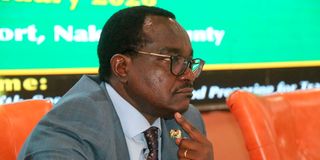
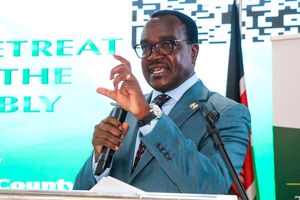
Education CS Julius Ogamba, when he appeared before MPs during the 2026 Legislative Retreat for Members of the National Assembly, at Lake Naivasha Resort in Naivasha, Nakuru County, on January 28, 2026.
Photo credit: Boniface Mwangi | Nation Media Group
“The Ministry of Education has released FDSE funds for first term of 2026 and the second quarter of the Financial Year 2025/2026. The allocation per student is Kenya Shillings Seven Thousand Nine Hundred Fifty-Two and Four Cents only) Sh7,952.04. Enrolment used was extracted from NEMIS on 22nd April, 2025 at 7.40pm and verified by HOIs and SCDEs on 24th November, 2025,” reads the circular.
While President William Ruto has repeatedly assured the country that education reforms are on track and the sector is well-resourced, Education Cabinet Secretary Julius Ogamba admitted that the government lacks official data on the actual cost of educating a learner in the country.
The shortfall, CS Ogamba revealed, spans across key areas of the education sector, including primary and secondary school capitation, teacher training, and infrastructure development. While some funds were disbursed on a termly basis 50 percent in the first term, 30 percent in the second, and 20 percent in the third officials admit that delays in previous years have left many schools struggling to meet operational needs, prompting concerns among parents, teachers, and education stakeholders about the sustainability of ongoing reforms.
“Actually, as a country we do not know how much it costs to educate a child from Grade One all the way to university. We have a deficit of Sh48.3 billion,” the CS told the MPs
An analysis done last year by the Kenya Secondary School Heads Association (Kessha) shows that it costs school managers Sh378 each day to keep one learner in a national school in Kenya. Those in extra-county and county schools spend Sh358 daily per learner while day scholars need Sh110.
The financial needs are listed in a proposal Kessha presented to the Ministry of Education under various voteheads items listed are to cover expenditures for teaching learning materials, boarding, equipment and stores (B.E.S), repairs, maintenance and improvement (RMI), local transport and travel (L.T &T), administration costs, electricity, water and conservancy (E.W.C).
The other vote heads are personal emoluments (for non-teaching staff salaries), activity, medical insurance, lunch programme and approved maintenance and improvement fund.
“The figures are arrived at after considering all the vote heads and then dividing by the average number of days that a student is supposed to be in school (252) in a year. From the average cost of keeping a student in school in a day, we get the average cost of maintaining a student in a year and from there, we derive the total fees payable per student in a year,” the document reads.
The principals argue that the approved fees guidelines are impractical and either the government or the parents must foot the balance.
Sector faces glaring shortfall
President Ruto has on several occasions said that the disbursement of Sh44 billion represents half of this year’s total funding for primary, junior, and senior schools. He said the remaining 30 per cent and 20 per cent will be released in the next two terms.
“Our reforms are transforming learning and teaching. For the first time ever, we have released Sh44 billion in capitation for schools before reopening. The rest will follow in the next terms,” the President said.
However, the numbers still raise questions. According to the CS, the education sector still faces glaring shortfall of Sh48.3billion with primary schools face a shortfall of Sh2.72 billion, junior schools Sh20.8 billion, and senior schools Sh24.84 billion, against a total requirement of Sh136.17 billion.
“Primary schools require Sh9.725 billion but have only been allocated Sh7.008 billion, leaving a deficit of Sh2.717 billion. Junior schools need Sh49.72 billion but received Sh28.918 billion, resulting in a shortfall of Sh20.802 billion. Senior schools require Sh76.73 billion but have been allocated Sh51.886 billion, leaving a gap of Sh24.844 billion. Overall, the total requirement across all levels of basic education is Sh136.175 billion, with actual allocations amounting to Sh87.812 billion, creating a combined deficit of Sh48.363 billion,” the CS told the MPs.
The President hailed the government’s efforts, noting that Sh5.6 billion has been paid to publishers to ensure the timely supply of textbooks to schools nationwide.
Grade 10 learners reported to schools without textbooks because the publishers could not print the books as they were owed in excess of Sh11 billion from previous tenders. The books were supposed to have been printed by August last year and distribution to schools to begin in September.
The Grade 10 textbooks, which have a lifespan of four years, started being delivered in schools on January 16 2026.
"As of today, 40 percent of the required books have been supplied to various institutions, with the target to complete distribution by the end of the month," CS Ogamba said in a recent interview.
He noted that during the previous transition for Grade 9, some schools did not receive the learning materials, despite the government releasing 9.9 million textbooks.
"We directed principals to notify us if they did not receive books. In Grade 10, we will maintain the one-to-one target and will continue pushing until all schools are fully equipped by the end of this month," he added.