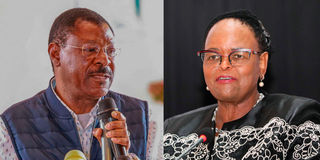
The push to make Kenya's education free for all is gaining momentum after National Assembly Speaker Moses Wetang'ula directed Members of Parliament to formulate laws to collapse bursaries and public scholarships into one fund.
Mr Wetang'ula, who took a cue from Chief Justice Martha Koome, admits that layers of duplication in the award of bursaries have been hurting education in the country.
According to Wetang'ula, consolidation of various funding streams—such as the National Government Constituencies Development Fund (NG-CDF), county government bursaries and other kitties—into one will ensure equitable distribution of resources in the education sector.
On Wednesday, Wetang'ula, who spoke at an ongoing retreat for Members of Parliament in Naivasha, challenged the Ministry of Education to engage stakeholders and find policy solutions to the issue of fragmented bursaries.
Mr Wetang'ula has warned that duplicated bursaries, inequitable resource distribution, uneven infrastructure funding and teacher deployment were undermining education equity in the country.
“I challenge the Ministry of Education to establish guidelines for consolidating duplicated education bursaries into a single central basket for efficient distribution to the intended beneficiaries. All the resources come from one source. This issue and other inequities in resource distribution are critical, and I have guided the leadership of the National Assembly, together with the Committee on Education, to convene an urgent meeting to resolve the challenges to ensure education equity in the country,” stated Mr Wetang'ula.
“If you formulate policies, the National Assembly will be happy to turn them into law so that all bursaries and funds can be consolidated to help provide free and universal education for our children,” added Speaker Wetang'ula.
In August last year, Chief Justice Martha Koome also fronted the proposal, saying moving the money into one kitty would ensure all needy learners benefit, rather than having funds distributed based on political affiliation.
Both Wetang'ula and Koome argue that the current fragmented system, where bursaries are distributed by MPs through the NG-CDF, governors, woman representatives and MCAs, is inefficient, unequal and prone to corruption, leading to the disadvantaging of deserving learners.
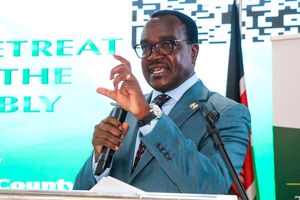
Speaker of the National Assembly Moses Wetang'ula, leads the 2026 Legislative Retreat for Members of the National Assembly, at Lake Naivasha Resort in Naivasha, Nakuru County, on January 28, 2026.
Photo credit: Boniface Mwangi | Nation Media Group
They say consolidation of the funds could make education free for all, removing the financial burden from parents and curbing “institutionalised tokenism” by leaders.
With two arms of government, the Judiciary and now the Legislature, behind the push, Kenya could be moving closer to full implementation of a single-basket bursary system for education.
Should MPs agree to collapse the bursary funds and pass laws guiding the consolidation, education in Kenya could become free for all.
Mr Wetang'ula and Ms Koome are now leading the pack in calling on the Executive to board the train and support collapsing all bursaries into one basket to boost education.
The Nation established on Thursday that the Clerk of the National Assembly, Samuel Njoroge, has already written to the Ministry of Education on the issue.
The latest support for the bid to consolidate bursary funds by Mr Wetang'ula has opened a fresh debate on the matter.
Controller of Budget Margaret Nyakang'o has also joined the bandwagon of those calling for consolidation of the funds.
“The distribution of bursaries is mostly heavily marred by favouritism. Politicians use bursaries as a campaign tool. Those bursaries are what they use to identify voting blocs and lure them. My position on bursaries is that all these scattered funds should be put together so that we have free education. They should not be with MPs, MCAs or even governors. If the Ministry wants to give out scholarships, they can do so based on merit,” said Ms Nyakang'o during an interview with the Nation.
But amid the push, governors and the Controller of Budget are locked in a tussle over the award of bursaries, leaving thousands of beneficiaries unable to access funding.
Ms Nyakang’o last year issued a circular stopping governors from distributing bursaries, reminding them that it was a national government function.
The Senate also recently directed counties to stop issuing bursaries, maintaining that the responsibility lies with the national government.
However, on Monday, during a United Democratic Alliance (UDA) party National Governing Council meeting at State House, Nairobi, the chairperson of the Committee on Education at the Council of Governors (CoG), Dr Erick Mutai, revealed that the controversy had put the education of millions of needy students in primary schools, secondary schools and universities in jeopardy due to delays by Dr Nyakang'o in approving the release of bursary funds to counties.
“We have finished signing a deal between the national government and counties on the modalities under which bursaries will be operationalised. We are now waiting for the Controller of Budget to approve the funds,” revealed the Kericho Governor.
President William Ruto also waded into the matter, directing the Controller of Budget to approve the funds.
“There was a requirement that we have an agreement with the county governments because the issue is a national government function. We have since signed the agreement and the funds should be released,” President Ruto stated.
However, even though the President said the controversy had been resolved, Dr Nyakang'o, who has the final say on the matter, reiterated during an interview with the Nation the need to uphold the rule of law.
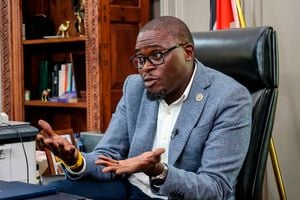
PS Treasury Dr Chris Kiptoo acknowledges greetings from National Assembly Speaker Moses Wetangula during the 2026 Legislative Retreat for Members of the National Assembly, at Lake Naivasha Resort in Naivasha, Nakuru County on January 29, 2026.
Photo credit: Boniface Mwangi | Nation Media Group
She stated that if the bursary issue is not implemented carefully, it could provide an opportunity for those who want to steal public money.
While agreeing that the modalities for releasing bursary funds for the current financial year are in place, she called for a long-lasting solution to the matter.
She maintained that the responsibility of providing bursaries to secondary schools and universities remains with the national government.
Proponents of the bid argue that the move will eliminate favouritism, prevent multiple allocations and support free education for all.
Prof Tom Nyamache, a university don at Turkana University, said the move is long overdue.
“Consolidation of the funds will curb corruption, reduce bureaucratic delays and ensure equitable and transparent distribution of aid directly to schools. It will reduce the cash-cow mentality and political manipulation often associated with fund distribution,” Prof Nyamache told the Nation.
“Centralisation will eliminate overlapping, fragmented and bureaucratic processes that cause delays in funds reaching learners,” he added.
Activist Laban Omusundi argues that the move will boost equity, ensure all children in the country get a fair chance to access free and quality education, and eliminate confusion around current bursary disbursements.
“Consolidation of bursary funds will ensure needy learners receive support, minimising the risk of some learners receiving multiple overlapping awards while others receive none. It would make education free rather than fragmented, small-scale and, at times, politically motivated handouts,” he stated.
“Multiple bursary funds controlled by politicians lead to biased allocations. There is a need for the government to establish a National Education Fund to guarantee all learners free and quality education,” said Cornelius Oduor, a member of the lobby.
However, critics argue that local leaders, such as MPs, have better knowledge of the most vulnerable learners in their areas, allowing for more targeted support than a top-down centralised system might provide.
“We MPs have better knowledge of who the needy learners are in our areas. We should be allowed to continue offering NG-CDF bursaries,” said an MP from the Rift Valley who sought anonymity.
At present, various bodies, including governors, Members of Parliament, ward representatives, the Ministry of Education and the President, are all giving out bursaries to needy learners.
According to previous audits by the Auditor-General, the uncoordinated approach has resulted in some students receiving multiple allocations while others are left out.
Kiambu Senator Karungo Thang’wa, who is also pushing for the merger of all bursaries into a single transparent system, has tabled a motion before the Senate calling for consolidation of the funds.
“In the 2024–25 financial year, about Sh656 billion was allocated to the education sector. However, it is difficult to ascertain the specific funds granted to each student,” Thang’wa said.
He added that without clear data or a framework, the Ministry of Education cannot account for how bursaries are distributed across the country.
According to Thang’wa, bias and favouritism also affect distribution, with some students missing out based on political affiliations.
The bursaries debate comes amid efforts to align education funding with the Bottom-Up Economic Transformation Agenda (BETA) and improve efficiency in supporting students.
The proposed shift aims to create a more structured approach to managing education funds, though it faces logistical and political hurdles.