Kenyatta University got the highest number of students in the universities placement announced last week.
At 11,224 students, this is more than three times the number allocated to some public universities, highlighting the growing divide in student preference across Kenya’s higher education sector.
The data by the Kenya Universities and Colleges Central Placement Service (KUCCPS) shows that Maseno University (9,196), received the second-highest number of students, followed by Moi University (8,869), University of Nairobi (8,604), Chuka University (7,946), Kisii University (7,903) and Masinde Muliro University of Science and Technology (7,586).
Entrance to Maseno University's main campus.
Photo credit: File | Nation Media Group
The figures underscore an increasingly competitive admissions landscape, with established universities continuing to dominate while several institutions struggle to attract applicants despite expanding academic programmes and infrastructure.
The placement results prompted celebrations across universities, with vice-chancellors taking to social media to welcome the new students expected to report in September.
Maasai Mara University Vice-Chancellor Prof Peninah Aloo-Obudho described the placement of 3,230 students as a milestone for the institution.
“We continue to celebrate the placement of 3,230 students at Maasai Mara University. As one of Kenya’s leading institutions of higher learning, we remain committed to academic excellence, innovation and empowering future leaders,” she said.
At Bomet University, acting Deputy Vice-Chancellor Prof Patrick Ojera welcomed the 3,889 students placed to the institution, saying they would join a university that continues to expand its academic programmes.
“We are delighted to welcome you to Bomet University. You are beginning an academic journey that can take you all the way to becoming professors, researchers and professionals who will transform society,” he said.
Kisii University Vice-Chancellor Prof Nathan Ogechi welcomed the institution’s 7,903 new students, saying they would gain knowledge, lifelong friendships and skills needed for the future.
The latest placement figures have also renewed debate over why some public universities continue to attract relatively few students despite investments in facilities and new academic programmes.
Mr John Mutie said institutions recording lower admissions should rethink their academic offerings and visibility.
“Some universities like Pwani University can do better. It is surprising that institutions established many years ago are attracting fewer students than newer universities. That should prompt serious reflection on the programmes they offer and how they position themselves to prospective students,” he said.
Public universities are grappling with financial challenges even as they prepare to admit the new cohort.
University of Embu Vice-Chancellor Prof Daniel Mugendi.
Photo credit: Francis Nderitu | Nation Media Group
However, University of Embu Vice-Chancellor Prof Daniel Mugendi, who also chairs the Vice Chancellors Committee of Public Universities, said institutions are ready to receive the students despite uncertainty over funding.
“There is some anxiety about funding because we are not certain whether we will be able to meet obligations such as staff salaries following changes in the funding model, but we are prepared to admit the new students,” Prof Mugendi said during the KUCCPS stakeholders’ forum on July 5.
Education Cabinet Secretary Julius Ogamba assured universities that the government was working to address funding challenges affecting the sector.
He said President William Ruto would soon announce a long-term solution to stabilise university financing as institutions prepare for the September intake.
A total of 270,508 candidates who scored a minimum grade of C+ in the 2025 Kenya Certificate of Secondary Education examinations qualified for university admission.
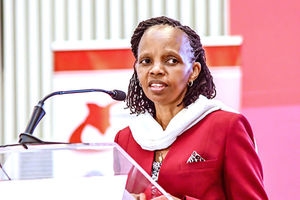
Ms Agnes Mercy Wahome, the CEO of the Kenya Universities and Colleges Central Placement Service (KUCCPS).
Photo credit: File | Nation Media Group
KUCCPS Chief Executive Officer Agnes Wahome said public universities have the capacity to admit more than 300,000 students and urged the institutions to align their academic programmes with emerging labour market needs locally and globally.
“We encourage universities to continue reviewing their programmes so that graduates acquire skills that are relevant to the changing demands of the job market,” she said.
Universities are fighting to remain relevant in an era where reputation, employability and programme quality are increasingly shaping students’ choices.