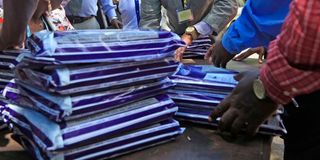
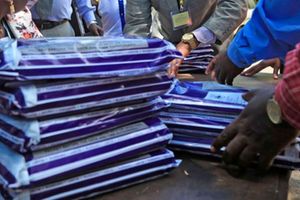
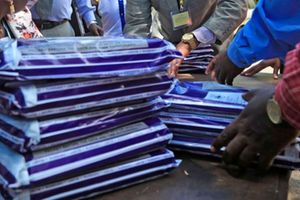
The Kenya National Examinations Council (KNEC) is set to print national examinations locally for the first time, ending a long-standing practice of outsourcing the task to Britain.
Presenting the 2026 Budget Policy Statement before the National Assembly’s Departmental Committee on Education, Basic Education Principal Secretary Prof Julius Bitok revealed that the State Department for Basic Education has allocated Sh147 million in the proposed 2026/27 budget.
The funds will go toward procuring a digital machine capable of printing KCPE Optical Mark Recognition forms, ensuring that production of examinations can now be carried out entirely within Kenya.
The move comes after years of debate over the high costs and logistical challenges of printing examination papers abroad.
Principal Secretary for Basic Education Prof Julius Bitok.
Photo credit: Dennis Onsongo | Nation Media Group
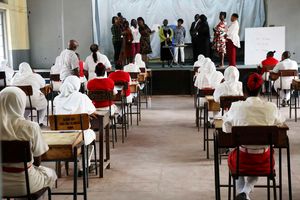
In May 2025, thousands of candidates faced uncertainty when the Treasury removed the entire budget for examination registration and invigilation. The omission prompted committee members to question the government’s priorities.
“There are certain activities that you tend to think may be done or may not be done, but putting zero budget for exams, are we serious?” asked Departmental Committee Chairperson Julius Melly at the time.
Treasury Cabinet Secretary John Mbadi in 2025 explained that the Sh11 billion annual allocation for KCSE examinations had been halted to investigate reports of fund misuse by some officials in previous years.
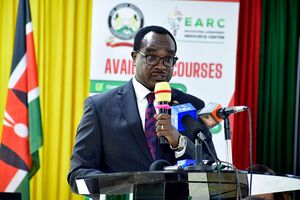
Kenya National Examination Council CEO David Njegere.
Photo credit: Wilfred Nyangaresi | Nation Media Group
“We have not removed the money so that parents can pay. No parent will pay the examination fees. We are trying to assess various things, including why the government should pay a student's examination fees,” he said.
Mr Mbadi also questioned the necessity of printing examination materials overseas, noting that papers were being printed in London at a high cost to taxpayers.
“As a minister, why should the government pay my child's examination fees? Why must our examinations be printed in London, England, just a mere examination?” he asked.
Budget estimates show that several flagship initiatives, according to the ministry, the School Examination and Invigilation function requires Sh14.7 billion for the 2026/27 financial year. However, only Sh9.9 billion has been proposed in the budget, leaving a shortfall of Sh4.82 billion.
“The Target is to administer the KJSEA assessment and other exams and assessments. Resource requirement for KJSEA is Sh3,920 million and Sh10,800 million, comprised of: administration of KCSE (Sh9.5 billion), KPSEA (Sh1.2 billion), and stage-based assessments (Sh144.7 million),’ said Prof Bitok.
Ministry has allocated Sh147 million in the proposed 2026/27 budget for procuring a digital printing machine.
Photo credit: File | Nation Media Group
The School Feeding Programme under the National Council for Nomadic Education in Kenya (NACONEK) requires Sh3.85 billion but has been allocated Sh3 billion, resulting in a Sh849.48 million shortfall. The programme targets 2.8 million learners in Arid and Semi-Arid Lands (ASAL) and urban informal settlements.
Similarly, the Low-Cost Boarding School Programme, which supports 158,286 learners in ASAL areas, has a Sh120.34 million deficit. While breakfast and dinner salaries are funded, lunch depends on the school feeding programme, which is already underfunded.
Further, the PS said the State Department for Basic Education is facing a Sh111.07 billion funding shortfall in the 2026/27 financial year, Prof Bitok noted that the department requires Sh245.85 billion to fully implement its programmes across primary, junior and secondary schools.
“Under Recurrent, the Department has a proposed allocation of Shs118,680.47 Million against a requirement of Sh216.5 billion. Similarly, under Development the proposed allocation for FY 2026/27 is Kshs. 16 billion against a requirement of Sh29.4 billion. This represents an underfunding of 45 percent for both Recurrent and Development Budgets,” prof Bitok told the committee.