Zebras are the most frequently targeted animals in an increasingly commercial bushmeat trade linking Kenya and Tanzania, with their meat finding its way into urban markets and onto the plates of Kenyans who may not know what they are eating.
As much as five tonnes of wildmeat could be moving illegally across the Kenya-Tanzania border every day, feeding demand in towns and cities while generating hundreds of millions of shillings for hunters, transporters and traders, according to a new assessment by the World Wide Fund for Nature-Kenya (WWF-Kenya) and Traffic, a non-governmental organisation.
The report, Situational Analysis: Wildmeat Trade Dynamics and Demand Reduction Initiatives in the Southern Kenya and Northern Tanzania Landscape, revealed that the business has grown beyond individual hunters killing animals to feed their families. It describes a commercial supply chain connecting wildlife-rich areas in southern Kenya and northern Tanzania to consumer markets across the region and beyond East Africa.
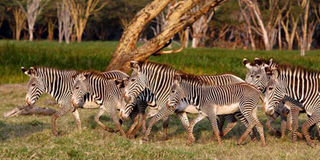
A zebra at Lake Mburo National Park. A rare zebra species is in danger of becoming extinct if measures are not taken to reverse its rapidly declining numbers.
Photo credit: File | Nation
At the centre of the trade are plains zebras, which rank first among the animals most frequently identified as being hunted in the landscape. Figures from WWF-Kenya’s biodiversity team put the volume of zebra meat at 7,680 kilogrammes, behind giraffe meat, whose estimated volume stands at 13,200 kilogrammes because of the animals’ size, despite their smaller numbers. Lesser kudu follows at 6,720 kilogrammes, while wildebeest accounts for 1,400 kilogrammes and dik-diks for 1,360 kilogrammes.
“Zebras are facing the greatest threat with movement of bush meat across the Kenya-Tanzania border which facilitates about three to five tonnes per day. This calls for concerted efforts between the two nations as well as enhanced surveillance to reduce the appetite for bush meat,” WWF-Kenya chief executive officer Jackson Kiplagat said.
The report identified 10 commonly hunted species, with plains zebras leading, followed by dik-diks, while giraffes came third. Elands and gazelles tied for fourth place, followed by wildebeest in sixth position and lesser kudus in seventh. Hartebeests, impalas and buffaloes ranked eighth, ninth and tenth, respectively.
“Across the landscape, the most frequently targeted species were Plains Zebra (Equus quagga), Masai Giraffe (Giraffa tippelskirchi), and Kirk's Dik-dik (Madoqua kirkii),” the report stated.
“Blue Wildebeest (Connochaetes taurinus) and Plains Zebra (Equus quagga) were identified as the primary targets for commercial hunting and trade.”
The report documented demand for zebra meat in parts of Kenya, particularly urban centres, where it is often marketed as fresh meat. In Tanzania, substantial quantities of zebra meat are dried and moved through informal trade networks to external markets. Once meat is processed, transported and sold through supply chains that lack reliable traceability, consumers may find it difficult to determine whether they are buying beef, other livestock meat or meat from a wild animal.
The potential returns help explain why illegal hunting persists despite enforcement efforts. Using estimates from 220 identified hunting hotspots across the two countries, the assessment estimates that approximately 340,000 animals are harvested annually, producing close to 30,000 tonnes of meat with a market value of Sh789.4 million.
The report estimated an average urban market price of Sh500 per kilogramme in Kenya. At that price, a consignment weighing between 200 and 500 kilogrammes could generate gross revenue of between Sh100, 000 and Sh250,000.
The two suspected poachers who were arrested inside Tsavo East National Park near Ithumba Elephant Sanctuary having hunted and killed 13 dik-diks and several wild birds. They were also found with dried game meat.
Photo credit: Kitavi Mutua | Nation Media Group
A typical hunting operation involving five to 10 people is estimated to cost between Sh50,000 and Sh120,000. After these expenses, the assessment estimates net profits of between Sh50,000 and Sh130,000 per consignment.
The potential margins, the report said, create an incentive for the trade to expand beyond subsistence hunting into a coordinated business involving hunters, financiers, transporters, middlemen and vendors. While hunters take the immediate risk of killing animals, other participants make money by organising transport, connecting suppliers to buyers and distributing meat to markets.
For some rural households, affordability remains an important reason for consuming wildmeat. In urban areas, however, taste, perceptions of natural food and the ability to buy in bulk can also influence demand. The assessment identified government employees, other salaried workers and private-sector business operators among the important consumer groups in growing towns.
Geoffrey Chege, WWF-Kenya’s biodiversity, research and innovation manager, said motivations ranged from household consumption to the prospect of making substantial profits, as well as the limited employment opportunities available to young people.
“There are those who hunt wild game for home use. The second motivation is that the profit margin of investing in bushmeat is very high, almost five times the investment; then the youth are also greatly unemployed; for them, this trade is for making money.
“The markets are also expanding, moving from the rural to the urban parts of Kenya, to the Rift Valley and the coastal towns,” he said.
The supply chain extends far beyond the places where animals are killed. Nairobi was identified as a major market hotspot in Kenya, receiving wild meat from the Mara, Tsavo and Amboseli ecosystems.
Meat from the Tsavo area is transported along major highways to towns including Mtito, Voi, Makindu, Isinya and Eselenkei. Malindi, Kilifi and Mombasa are among the coastal destinations identified in the assessment.
On the Tanzanian side, Rombo, Namanga and Tarakea are important operational and distribution nodes. Meat crossing the border can move to larger towns and urban centres, including Moshi and Arusha, as well as Loliondo and Lolkisale.
The trade also extends beyond the two countries. Western Serengeti was identified as a source of dried and smoked wild meat reportedly transported to markets in the Democratic Republic of Congo, South Sudan, Somalia and Uganda. Freight truck drivers are among those identified as facilitating these longer-distance movements.
The assessment also described a less-documented route from central Tanzania through Zanzibar to Arab countries, although it said the scale and organisation of this trade required further investigation.
These routes illustrate why enforcement at a single border crossing may not be enough to disrupt the business. Meat can be moved through informal crossings, transported by motorcycle or vehicle and distributed through established market channels.
Mr Kiplagat said traffickers use their knowledge of the terrain and communication systems to avoid security teams.
“The fact that you can now use a motorbike to go through rough terrain and avoid security systems makes it easy for this trade to thrive. The criminal networks and business persons are also investing in communication systems to evade authorities and coordinate their work,” he said.
During a media roundtable on the report, Kenya Wildlife Service Head of Security Operations Oswald Sangawe said rangers had seized 400 kilogrammes of bushmeat following an arrest near the Tanzanian border the previous week. The seizure was consistent with the report’s finding that a single trip could involve transporting as much as 1,000 kilogrammes of bushmeat.
The market for wildmeat is sustained partly by consumer perceptions that it is natural, free from chemicals and antibiotics, or better-tasting than conventional meat, the report said. However, Mr Chege of WWF-Kenya warned of the risk of zoonotic diseases.
“You might consume uninspected meat and end up getting diseases like anthrax or brucellosis or rabies, which are pretty lethal to human beings,” he said.
The report recommended intelligence-sharing, coordinated investigations, joint operations and harmonised enforcement procedures. It also called for greater attention to transport corridors, storage points, trading hubs and consumer markets, rather than concentrating enforcement mainly on protected areas and hunters in the field.
Mr Sangawe revealed that up to 60 per cent of animals killed for bushmeat are hunted within a 15-kilometre radius of the boundaries of legally protected areas.
“Our mandate majorly focuses inside the protected areas, but we realised that we have to change this. That is why we now work in a multi-agency approach with other security agencies to ensure we trace, apprehend and prosecute all those involved in this trade whether within or outside protected areas,” he said.