Kenya’s ambition to attract 5.5 million international visitors annually by 2028 faces a test as the tourism industry prepares for the festive season amid concerns over imported cases of Bundibugyo Ebola, forecast El Niño rains and a mandatory medical insurance requirement that some industry players say is driving visitors away.
While some operators have not recorded cancellations linked to Ebola or anticipated heavy rains, others report losing clients over the insurance requirement, raising concerns about the cost and ease of travelling to Kenya.
At the Coast, tourism businesses are calling for clear public health communication, flood preparedness and policies that support the sector’s growth
Pollman’s Tours and Safaris director Mohammed Hersi said the company had not recorded cancellations linked to Ebola but remained concerned about how the situation could evolve.
“We have not received cancellations but we are concerned with the Ebola. But we are back to Covid-19 protocols minus the mask, keeping in mind Ebola is not airborne, it is through exchange of liquid, whether it is sweat or saliva,” he said.
The company has provided sanitisers in its tour vehicles, distributed information leaflets to clients and introduced regular sanitisation of vehicle handles. Staff are also expected to report anyone who appears unwell.
Mr Hersi said the impact on tourism would partly depend on decisions by key source markets, including the United Kingdom, the United States and the United Arab Emirates, on whether to issue stricter travel advisories.
British High Commissioner to Kenya Matt Baugh said the UK had no plans to introduce additional travel restrictions against Kenya but would update its travel advice as necessary.
“Kenya has demonstrated preparedness through isolation facilities and contact-tracing measures. We are not planning on making any changes other than keeping our travel advice updated as you would expect,” he said during a reception celebrating UK-Kenya relations at Tononoka Social Hall in Mombasa.
Kenya confirmed its first imported case of Bundibugyo Ebola virus disease on October 6. The patient, who travelled from the Democratic Republic of Congo through Uganda to Nairobi, later died and was buried under public health protocols. Kenya has since confirmed a third case involving a 65-year-old woman who was already in quarantine as a primary contact.
Kenya Association of Hotelkeepers and Caterers Coast Region executive officer and Mombasa Tourism Council chairman Sam Ikwaye said tourism establishments along the Coast had not reported cancellations or reduced bookings attributable to Ebola or anticipated El Niño rains among their members.
However, tourism partners had sought clarification about the health situation.
“The Kenya Tourism Federation (KTF) and the Ministry of Tourism have been proactive in communicating that this was an imported case and that Kenya has not declared an Ebola outbreak. This clarification has been important in reassuring our international partners and maintaining confidence in the destination,” he said.
Dr Ikwaye said tourism was sensitive to perceptions of safety and that misinformation could affect confidence even when the situation was being managed.
Hotels have retained hygiene and infection-prevention measures introduced during the Covid-19 pandemic, but he said disease prevention required wider surveillance and screening, particularly at points of entry.
He also called on county governments and national agencies to work with tourism businesses to prepare for possible flooding, including by improving drainage, roads and emergency response arrangements.
“Our greatest defence against unnecessary market anxiety is credible information, effective surveillance and visible preparedness. We must avoid creating unnecessary alarm while remaining vigilant and guided by the relevant health and disaster-management authorities,” he said.
The concerns come as the government seeks to increase annual international arrivals to 5.5 million by 2028.
Cabinet Secretary for Tourism and Wildlife Rebecca.
Photo credit: Wilfred Nyangaresi | Nation Media Group
Tourism Cabinet Secretary Rebecca Miano announced the target during the opening of the 16th Magical Kenya Travel Expo at Uhuru Gardens in Nairobi.
Kenya received 2.7 million international visitors in 2025, generating Sh500 billion in earnings, according to Ms Miano. Domestic travel accounted for 5.2 million travellers.
The government is banking on simplified electronic travel authorisation, infrastructure development and diversification of tourism products to attract more visitors.
The expo, held under the theme “Digital Transformation and Artificial Intelligence: Shaping the Future of Tourism”, attracted more than 10,000 delegates, over 250 vetted international buyers and participants from more than 40 countries.
Dr Ikwaye said the target was achievable but required closer coordination between the government and the private sector.
He identified air access, destination readiness, marketing, and political and economic stability as areas requiring government intervention. Kenya also needed better connectivity, including direct international flights to coastal destinations, and improved access for airlines.
County governments, he said, should invest in cleaner and safer destinations, reliable infrastructure and tourism product development.
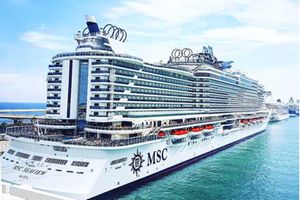
One of the MSC Cruises ships, a cruise line that has hired Kenyans.
Photo credit: Pool
“Bringing more visitors is only part of the equation; we must also give them compelling reasons to stay longer and spend more. The Kenya Tourism Board must be adequately resourced to sustain international promotion and protect our presence in key source markets,” he said.
However, Dr Ikwaye identified the mandatory medical insurance requirement for inbound international visitors as an immediate concern, saying tourism players were reporting cancellations, additional travel costs and difficulties with insurance documentation.
He said some visitors already had comprehensive medical insurance but were still being required to purchase additional cover, increasing the cost of travelling to Kenya.
“We are already receiving reports from industry partners of booking cancellations, additional travel costs and difficulties with insurance documentation following the introduction of this requirement. Many international visitors already have comprehensive medical insurance, yet they are being required to purchase additional cover,” he said.
Dr Ikwaye said the government could review the requirement to avoid undermining tourism marketing efforts by making travel more expensive or complicated.
Africa Last Minute Ltd company manager Abraham Guyo said Ebola concerns, anticipated heavy rains and the insurance requirement could affect business during the festive season.
Mr Guyo said seven international tourists from Germany had cancelled their trips, attributing the cancellations to the insurance requirement. He added that other industry players had reported further cancellations.
“Ebola case works against us as an industry. On the health insurance, the tourists feel robbed because their tourists cover is of much value than what Kenya is offering. It is sham, a useless insurance,” he said.
Mr Guyo said uncertainty remained over assurances that visitors with adequate existing insurance could upload their documents when applying for electronic travel authorisation. He urged President William Ruto to meet tourism stakeholders to address the concerns.
The industry’s concerns have also coincided with a temporary suspension of crew embarkation by MSC Cruises affecting employees residing in Kenya and those who had visited the country within the preceding 21 days.
“MSC Cruises issued a temporary notice on 7 October postponing the embarkation of crew members who are currently residing in Kenya. This measure was implemented in line with our public health protocols following reports of a potential public health concern. The temporary hold is currently planned to remain in place until 31 October, at which time the situation will be reassessed. The measure also applies to crew members who have visited Kenya during the preceding 21 days,” an MSC spokesperson told Nation in an email.
Dr Ikwaye said that if cancellations increased, the response should include coordinated communication with international tour operators, flexible commercial arrangements and targeted destination marketing.
He said the target of 5.5 million visitors was achievable, but it would not be delivered by the tourism industry alone. It required a whole-of-government commitment to creating the right environment for tourism to thrive.