KPSEA, KJSEA begin amid warnings of insecurity, hunger and weather
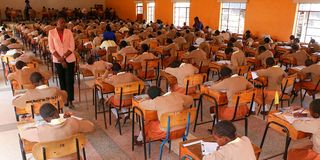
Grade-Nine candidates from St Mary's Girls Comprehensive School in Nakuru City take their Kenya Junior School Education Assessment (KJSEA) examination on October 26, 2026.

The government has warned of firm action against candidates, teachers and administrators who engage in examination malpractice as millions of learners across the country began their national assessments yesterday.
At the same time, authorities have moved to address challenges ranging from insecurity and hunger to flooding, difficult terrain and administrative errors to ensure candidates complete the exercise without disruption.
Education Cabinet Secretary Julius Ogamba and Basic Education Principal Secretary John Ololtuaa, speaking separately, warned that anyone found engaging in examination irregularities would face grave consequences, including the cancellation of results.


Mr Ogamba urged examination officials to remain accountable and cautioned candidates, parents and the public against individuals claiming to sell examination materials.
Mr Ogamba also explained why police officers were not stationed inside Kenya Primary School Education Assessment (KPSEA) and Kenya Junior School Education Assessment (KJSEA) centres.
“KPSEA and KJSEA are assessments of learners’ competences and should be conducted in supportive, calm and non-intimidating environments. We do not wish to militarise the assessment process or subject learners to unnecessary anxiety through excessive security presence,” he said.
The CS said the government was also concerned about the adverse weather conditions expected during the October to December rainy season.
“We are working closely with the Ministry of Interior to respond to emerging challenges that might arise from heavy rainfall, flooding, insecurity and difficult terrain,” he said as he oversaw the start of this year’s KJSEA at Kiambani Day and Boarding Comprehensive School in Makueni County.
Speaking at the Mbita Deputy County Commissioner’s office in Homa Bay County after overseeing the opening of the KJSEA examination container, Mr Ololtuaa said cheating and attempts to compromise the integrity of the exercise would not be tolerated.
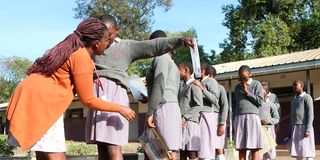
An invigilator frisks Grade Nine and Grade Six candidates from Moi Primary School in Nakuru City on October 26, 2026, ahead of the Kenya Junior School Education Assessment (KJSEA) and Kenya Primary School Education Assessment (KPSEA), respectively.
“The law is very clear, and the Kenya National Examinations Council (Knec) has given guidelines. If you are found to have violated them, then you will be dealt with in accordance with the regulations,” he said.
KPSEA is scheduled to run from October 26 to 28 while KJSEA will run from October 26 to 30.
On concerns over delays in paying teachers who mark examinations, Mr Ololtuaa said occasional government cash-flow constraints had contributed to the problem. However, he assured examiners that arrangements had been made to ensure they would be paid for this year’s work.
In Kisii, the national assessments began smoothly, with security heightened across examination centres. Kisii Central Deputy County Commissioner Gladys Nyongesa said security had been enhanced at examination collection centres and urged officers to remain vigilant and prevent irregularities. She added that areas vulnerable to the expected El Niño rains had been identified and contingency measures put in place to respond to emergencies.
The assessments also started smoothly in Kisumu County, with education officials reporting adequate preparations, timely distribution of materials and enhanced security arrangements. County Director of Education Magara Onduso expressed confidence that the candidates were adequately prepared and that the assessments would run as planned.
“The centre managers have arrived on time, and the assessment materials have been distributed in good time. We expect everything to run smoothly throughout the assessment period,” he said.
Kenya Institute of Curriculum Development (KICD) Chief Executive Officer Charles Ong’ondo, who also sits on the Knec board, commended the coordination, security and teamwork in Kisumu.
“These are assessments, not examinations. We do not want to raise the stakes unnecessarily. Our goal is to obtain genuine scores that will help us identify where learners need support as they transition to junior school or senior school,” Prof. Ong’ondo said.
Speaking during the distribution of examination materials in Nyeri town, Central Regional Director of Education Sabina Aroni said the region rarely recorded cases of malpractice at junior level but frequently had to deal with candidates falling ill during assessments.
“This is what we experienced last year, and we hope that this time around the situation will be manageable. In case it happens, we shall deliver the examinations to the hospitals or wherever the candidates will be. We are ready,” she said.
In neighbouring Murang’a County, hunger emerged as a major concern for candidates, particularly in the rangelands, where food insecurity has prompted philanthropists to support families struggling to feed their children. According to the County Disaster Management Department, at least 80,000 households face acute hunger because of environmental and economic pressures.
In the North Eastern region, the assessments began amid allegations of malpractice, with some parents claiming they had been asked to pay money to facilitate cheating. In Garissa, for example, some schools were accused of charging parents anywhere between Sh10,000 and Sh30,000 per candidate.
“My daughter came home and asked for Sh10,000 for examinations. I called the school principal, who confirmed the money was for a special arrangement during the examination period,” said a parent who declined to pay and requested anonymity.
North Eastern Regional Director of Education Adan Roble, however, said his office was unaware of the allegations. He added that the region was prepared for the assessments, with helicopters on standby and government vehicles assigned to transport examination materials. He explained that the helicopters would be used to access areas prone to insecurity.
In Nairobi, at the Embakasi Central distribution centre, Deputy County Commissioner Maonga Meda said no hitches or incidents had been experienced.
In the North Rift, education officials reported calm in most centres. In Uasin Gishu, Ainabkoi Deputy County Commissioner Henry Rop said keeping armed and uniformed police officers away from examination centres had helped ease anxiety among learners.
“For now, security is being monitored remotely,” he said.
In remote parts of Turkana, candidates from villages affected by renewed bandit attacks were being escorted to safer examination centres. County Director of Education Henry Lubanga said insecurity had been reported along the borders between Turkana and Pokot communities, particularly in Turkana East and Turkana South.
“We have our measures in place to ensure that candidates are safe,” he said.
Dr Lubanga added that the county was working with the United Nations High Commissioner for Refugees and other education partners to provide a conducive environment and prevent cheating.
Weather conditions remained another concern, with fears that seasonal rivers could flood and cut off roads.
In Baringo, officials reported some administrative challenges that were resolved in consultation with Knec. One learner’s assessment paper was initially missing, while six candidates had discrepancies in their examination details after being assigned to schools different from those where they had registered.
County Director of Education Kipruto Kosgei said all 21 distribution centres had opened on time and examination materials had reached schools as scheduled.
At the coast, Malindi Deputy County Commissioner Harrison Matevwa said candidates likely to be affected by flooding would be relocated to safer institutions within the sub-county to prevent disruption.
Lamu County Commissioner Stephen Sangolo said adequate security personnel had been deployed, particularly along the Kenya-Somalia border and in the Boni Forest region, to avert potential security threats.
In Lamu Central, Sub-County Education Director Ali Lali said some candidates had failed to report to their examination centres.
Follow our WhatsApp channel for breaking news updates and more stories like this.
Reporting by Mercy Mwende, Mwangi Muiruri, Manase Otsialo, George Odiwuor, Wycliffe Nyaberi, Domnic Ombok, Sammy Lutta, Titus Ominde, Florah Koech, Evans Jaola, Winnie Atieno, Pius Maundu, Lynet Igadwah and Kalume Kazungu.