At least 261,000 learners who should have sat this year’s Kenya Certificate of Secondary Education (KCSE) examination and Kenya Junior School Education Assessment (KJSEA) are unaccounted for, raising questions about the government’s 100 per cent transition policy.
Data from the Kenya National Examinations Council (Knec) shows that 1,233,852 candidates sat the Kenya Certificate of Primary Education (KCPE) in 2022, yet only 1,048,355 candidates are registered for this year’s KCSE. The difference of 185,497 represents 15.03 per cent of the 2022 KCPE cohort.
Similarly, according to Knec’s Kenya Primary School Education Assessment (KPSEA) national report, 1,281,210 candidates sat the KPSEA in 2023, yet the number of candidates registered for this year’s KJSEA, the subsequent national assessment, is 1,206,028. The difference of 75,182 candidates represents 5.87 per cent of the 2023 KPSEA cohort.
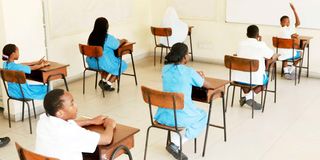
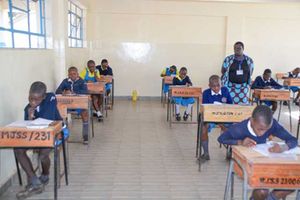
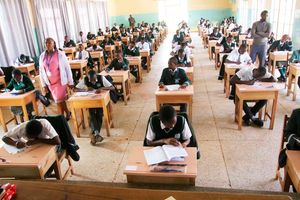
KJSEA candidates at Achievers Academy in Eldoret during exam rehearsals on October 23, 2026.
Photo credit: Titus Ominde | Nation Media Group
Combined, this means a total of 260,679 learners who sat lower-level national tests and would have been expected to continue into the next stage are unaccounted for.
The differences in candidature do not, however, mean that all the unaccounted for learners dropped out of school.
Education Cabinet Secretary Julius Ogamba told the Nation that a number of factors account for the differences in candidate numbers.
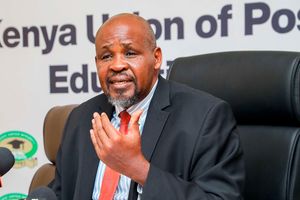
Education Cabinet Secretary Julius Migos Ogamba at New Mitihani House in Nairobi on October 5, 2026, during the launch of the 2026 national examination and assessment season.
Photo credit: Evans Habil | Nation Media Group
“Some of the reduction of numbers is due to natural attrition, which accounts for cases where learners may have passed on or are otherwise no longer able to continue. A section of learners also transitioned to alternative curricula, such as those offered in international schools,” he said.
He added: “There are also cases of dropouts and delayed progression, for instance when learners step out temporarily due to early pregnancy or sickness. But they are given the opportunity to rejoin once they are able.”
The CS, however, said he would give a more detailed response to the data later.
Grade Six and Grade Nine learners across the country begin national assessments today, with Knec reporting an increase in candidature across all three examination cohorts this year compared with previous years.
During the launch of the 2026 examination and assessment season, Mr Ogamba said KPSEA registration had risen to 1,380,463 from 1,298,089 last year. KJSEA candidature increased to 1,206,028 from 1,130,679, while KCSE registration rose to 1,048,355 from 996,078. The three national tests have a combined candidature of 3,634,846 learners.
Knec has deployed thousands of personnel to oversee the assessments and examinations, including 27,271 supervisors for KPSEA and 24,860 for KJSEA. A further 130,633 invigilators and 6,215 drivers will support the administration of the two assessments, which are being conducted concurrently.
Knec Chief Executive Officer David Njeng’ere said security arrangements would vary according to the examination and the security situation in each region.
Dr David Njeng’ere, the CEO of the Kenya National Examinations Council, at a past event.
Photo credit: Evans Habil | Nation
“As was the case in 2025, there will be no armed security officers in KPSEA and KJSEA assessment centres, except for regions that have security challenges. The security officers will only provide security for the assessment materials from the containers to the schools, and for KCSE there will be a minimum of two police officers in every examination centre,” he said.
The council has also expanded the use of smart padlocks to all examination containers following a pilot involving 250 containers last year. The locks will be monitored from Knec’s headquarters. Dr Njeng’ere said containers would be opened at 6am for the collection of KPSEA and KJSEA papers, and at 7am and 12.30pm for KCSE papers.
Dr Njeng’ere identified mobile phones as a major challenge in the administration of KCSE, warning that candidates, centre managers, supervisors, invigilators, security officers and other personnel would not be allowed to have phones during examination sessions.
“Any contravention of this rule will constitute a malpractice as per the Knec Act and the Rules and Regulations. The Knec Call Centre, with free toll numbers, will be active on a 24-hour basis to facilitate real-time communication and rapid response where necessary,” he said.
As the examinations begin, calls for higher remuneration for teachers and other personnel involved in administering the assessments and examinations have gained parliamentary backing.
Msambweni MP Feisal Bader called for a review of payments to those involved in the assessments and examinations.
Feisal Bader.
Photo credit: DDPS
“These professionals serve as centre managers, supervisors, invigilators and security personnel, ensuring the integrity and smooth conduct of examinations. However, the payment rates for these activities have remained stagnant despite the rising cost of living,” Mr Bader told the House.
He said inadequate remuneration placed additional financial pressure on examination centre managers, some of whom have to seek temporary accommodation near examination materials collection points to ensure they collect papers on time. Supervisors also incur additional expenses while overseeing examinations at designated centres, he added.
“Despite such dedication, the current remuneration remains grossly inadequate and no longer commensurate with the magnitude of their responsibilities,” he said.
At the same time, the Kenya Union of Post-Primary Education Teachers (Kuppet) has maintained its position that members should stay away from Knec activities until their grievances are addressed. Deputy Secretary-General Moses Nthurima said the dispute was not simply about timely payment, but also the amount teachers receive for their examination duties. He argued that Knec should enter into a formal agreement with teachers’ representatives specifying the rates payable for different assignments.
Kenya Union of Post Primary Education Teachers (Kuppet) Deputy Secretary-General Moses Nthurima.
Photo credit: File | Nation Media Group
“We insist that teachers should not engage themselves in the examination business because that is servitude. We spoke to Knec, but they only promised that there is money set aside for these teachers. They never disclosed the amount. They only said they will pay on time, and paying on time is not the biggest issue. The biggest issue is the payment,” Mr Nthurima said.
Separately, school principals have petitioned Parliament to suspend meetings and visits related to audits by MPs, Ministry of Education officials and auditors until the national examinations are over, saying the exercises are disrupting the administration of tests. They also argued that the visits contravene ministry guidelines intended to protect the integrity of national examinations.
The petition was presented by Emuhaya MP Omboko Milemba, who is also the chairman of Kuppet.
Emuhaya MP Omboko Milemba.
Photo credit: File | Nation
Public schools are currently subject to audits by three bodies: the Ministry of Education, the Office of the Auditor-General and Parliament through the Public Investments Committee on Governance and Education.
The Ministry of Education conducts audits at county, regional and national levels, while the Auditor-General’s office operates at regional and national levels. The parliamentary committee examines audit reports from the Auditor-General that have been tabled in the House. The National Assembly’s Education Committee also conducts on-site visits to schools when investigating matters before it.
“These parallel audits have left school principals and heads of institutions under undue pressure, considering that the national examinations, particularly practicals, commenced on October 19, 2026,” Mr Milemba said.
In their petition, the school heads argue that the visits distract principals, who also serve as examination centre managers, from their duties during the examination period.
While acknowledging the importance of audits in promoting accountability, they want the exercises rescheduled until after the examinations to allow principals to focus on the tests.
“There is an avalanche of audits in public schools; they are too many. Principals are spending too much time either dealing with officers from the Ministry of Education, the Office of the Auditor-General or MPs,” Mr Milemba said.
“The end result is that principals are too busy preparing for the audit instead of examinations, yet they are the centre managers,” he added.
However, National Assembly Speaker Moses Wetang’ula said accountability for the use of public resources was non-negotiable, warning that the timing of audits should not undermine Parliament’s constitutional oversight role.
“Let it be clear that accountability for the use of public resources is not optional. That is constitutional, fundamental and universal. Once you have been given a public resource, you must account for it,” Mr Wetang’ula said.
Gilgil MP Martha Wangari said that while the school heads had raised legitimate concerns about the timing of the audits, the issue should not be used to evade scrutiny.
“The issue of accountability must not be lost. Nowadays, we have some rogue teachers who, when they are about to retire, milk the school dry and leave it choking in debt. These are issues that we must look into as a House,” she said.
Luanda MP Dick Maungu Oyugi of the National Assembly Departmental Committee on Education on Thursday, February 19, 2026.
Photo credit: Dennis Onsongo | Nation
Luanda MP Dick Maungu, who chairs the Public Investments Committee on Governance and Education, said Parliament does not directly audit schools but examines reports submitted by the Auditor-General.
“Examination of the books of accounts is a constitutional duty bestowed in this House; it is not a privilege. All public funds must be audited and reports submitted to the people. The work of this House is therefore to report to the people how public funds have been utilised,” he said.
Nyando MP Jared Okelo said Parliament had a responsibility to ensure that public funds allocated to schools through capitation were used prudently.
Two months ago, the Public Investments Committee on Governance and Education began examining the books of accounts of national schools, now categorised as C1 institutions. The exercise has raised questions about how public funds are being spent.
Among the revelations was that one school had taken out a Sh500 million loan to install cabro paving across its compound, Mr Maungu said.
“How would we have known these things if we don’t examine books of accounts from schools?” he asked.
The MP maintained that the committee would not relent in its efforts to ensure accountability in the use of public resources.