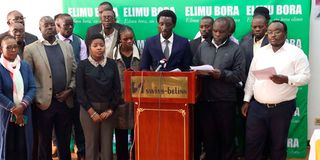
A lobby group has raised an alarm over what it terms the “systematic collapse” of the education sector, citing illegal levies, corruption, and chronic underfunding as schools reopen for third term.
The Elimu Bora Working Group (EBWG) wants Education Cabinet Secretary Julius Ogamba to issue binding circulars with enforceable penalties against school administrators imposing illegal levies.
According to the group, a nationwide survey revealed that 90 percent of public schools charge illegal admission fees ranging from Sh500 to Sh25,000—violating the constitutional guarantee of free education.
Schools are scheduled to reopen on Monday, August 25, 2025, for the nine-week third term.
Notably absent from the National Education Reforms Stakeholders’ Conference were legislators, who two weeks ago had dismissed the forum’s agenda as “poorly researched and overly negative.”
The group’s Policy and Strategy Adviser Boaz Waruku said the conference examined key challenges facing the education sector—including financing gaps, illegal levies, student and teacher safety, and pre-primary education—while centering discussions on practical solutions.
On school capitation, the group is pushing for a review of the current rates to reflect the true cost of providing quality education. Currently, learners receive tuition and operations funding of Sh1,420, Sh15,042, and Sh22,244 each in primary, junior, and senior secondary schools, respectively.
But even these funds have not been reaching schools on time, a delay the lobby says forces parents to shoulder illegal charges, creating a culture of impunity where education is turned into exploitation.
“All school payments must be received, audited, and subjected to rigorous oversight through quarterly monitoring and evaluation reports,” the group demanded.
The lobby further recommended real-time monitoring of all school accounts with transparent reporting and a mechanism to refund families who have been forced to pay illegal fees.
The unlawful levies—often collected without receipts—risk locking out many learners, with only 25 percent of those sent home for non-payment returning even after making partial payments.
On school safety, the group demanded mandatory audits, public reporting of results, and strict enforcement of safety regulations.
“Student safety remains severely compromised as schools prioritise profit over protection—as seen in the Endarasha Hillside Academy fire that claimed 21 young lives,” said lobby member Maxwel Magawi.
The group’s investigations revealed that many schools operate without proper safety audits, with funds meant for essential safety equipment routinely misappropriated—leaving learners in mortal danger.
When he took office, President William Ruto established the Presidential Working Party on Education Reforms (PWPER) to address challenges facing the sector.
However, the lobby noted that concerns raised by the public and legislators suggest a lack of clear policies and frameworks to implement PWPER recommendations.
“President Ruto must provide a comprehensive status report on PWPER implementation and establish the actual cost of transitioning to the Competency-Based Education (CBE),” said Mr Magawi.