Members of Parliament have urged the Ministry of Education to deploy principals to Junior Secondary Schools to strengthen leadership and address growing calls for autonomy from teachers.
In a document seen by Daily Nation outlining sweeping reforms proposed for the Education ministry, MPs say the move would provide clarity on the governance and management of Junior Secondary Schools.
“The Ministry of Education reviews the governance and management framework of Junior Secondary Schools with a view to clarifying autonomy , leadership structures, including feasibility of deploying Principals to Junior Secondary Schools, and access to specialised facilities and co-curricular programmes,” reads the document.
If implemented, the move will be a big win for the JSS teachers across the country who have been vocal in their call for autonomy and have a separate administration from lower primary school structures.
The teachers have argued that autonomy would provide much-needed clarity in financial management, career progression, and administration.
They have also highlighted the lack of properly equipped laboratories, ambiguous career progression guidelines, and the uncertainty surrounding the confirmation of 20,000 JSS interns as pressing issues that must be resolved to avert an impending crisis.
The Kenya Association of Junior School Teachers, Kenya Union of Post Primary Education Teachers (Kuppet) and more than 50,000 tutors have also been demanding administrative independence and recognition of junior school as its own tier in the education system.
The association argues that the current arrangement, which places the institutions under the primary school administrative structure, undermines the professional growth and career development of the Junior school teachers.
Kenya National Union of Teachers Secretary has, however, in a previous interview with the Nation , dismissed the quest for autonomy by the JSS teachers, citing recommendations of the Presidential Working Party on education Reform which he said defined two sections within the Basic Education as comprehensive school, which includes grades 1-9, with the senior schools having grades 10-12
Educators have argued that granting JSS independence will not only ease administration but also strengthen the 2-6-3-3-3 Competency-Based Curriculum (CBC) structure envisioned under the current education system.
In the document which forms the resolutions made by MPs during the recent fourth retreat in Naivasha, the lawmakers have also called the ministry of Education enforces transparency and standardisation in school fees by strengthening oversight mechanisms and eliminating irregular levies, remedial charges, and other hidden costs imposed on parents’ contrary to government policy.
The move is aimed at addressing concerns raised by parents recently while admitting their children to grade 10. The parents complained of being charged higher fees than the ones prescribed by the government.
In order to punish school heads who just increase school fees without government approval, the lawmakers resolved to prioritise, when they resume next week, amendments to the Basic Education Act, 2013, in order to introduce clear sanctions and criminal penalties for non-compliance with Ministry directives, including the imposition of illegal levies and failure to adhere to approved fee structures.
The lawmakers also called on the ministry to finalise and enforce the National Policy on School Uniforms and Lunch Program to minimise financial burden on parents and curb corruption and irregularities arising from unregulated uniform and service costs.
Most parents are currently forced by schools to purchase uniforms at the institution at a higher price than the market rates.
The lawmakers also want the ministry to review and rationalise infrastructure investment to correct regional imbalances, including ensuring fair access to learning facilities, laboratories, and diverse Senior School pathways across all school clusters, particularly in rural and C4 schools.
The lawmakers have also called on the ministry to put systems in place to ensure that the transition to grade 10 is transparent and that placement of learners to schools is done on a merit basis.
“The Ministry of Education strengthens the integrity, transparency, and auditability of the Grade 10 placement system to prevent interference and ensure fair and merit-based placement of learners across all school categories,” reads the Parliament document.
In their resolutions, MPs have also called on the ministry to publish and submit to Parliament a comprehensive and disaggregated report on education infrastructure funding and utilisation, including beneficiary schools, laboratory allocations, and school capacity data, to strengthen parliamentary oversight.
“The Ministry of Education, in collaboration with the National Treasury, undertakes a comprehensive Education Costing Analysis covering the entire learner lifecycle from Early Childhood Education to University level, with a view to rationalising capitation levels and ensuring equity across education levels,” MPs say.
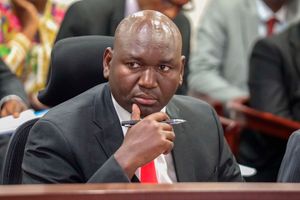
Education Cabinet Secretary Julius Ogamba when he appeared before lawmakers during the 2026 Legislative Retreat for Members of the National Assembly at Lake Naivasha Resort in Naivasha, Nakuru County on January 28, 2026.
Photo credit: Boniface Mwangi | Nation Media Group
“We actually do not know how much it costs to educate a child from grade one to university,” Mr Ogamba said.
Currently, the government gives a capitation of Sh1, 420, Sh15,000 and Sh22,000 for primary, junior and senior students, respectively.
In addition to these funds, the National Government Constituencies Development Fund and the devolved government also give bursaries to support the education of needy students.
Mr Ogamba told the lawmakers that there has been no actuarial study on the cost of educating a child in Kenya.
The CS, however, said that the ministry, through the ongoing upgrade of the Kenya Education Management Information System, is creating a module that will give learners a unique number from ECDE to university.
“This will give an actual amount. The system will help us tell whether putting all the money in one basket can make the country achieve Article of the Constitution on the provision of free and compulsory education,” the CS said.
Working in collaboration with the Teachers Service Commission, the lawmakers have also called on the ministry to urgently address staffing gaps by accelerating recruitment, rationalisation, and deployment of teachers, while reviewing hardship allowance policies to reduce inequities and staff attrition in disadvantaged regions.
The National Assembly has directed the ministry to provide periodic progress reports to the House on the measures taken to achieve the reforms.