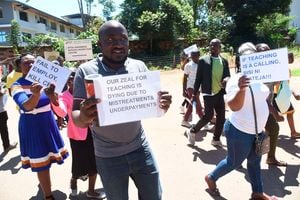
A section of teachers representing the more than 70,000 Junior Secondary School (JSS) tutors has moved to court challenging the government’s decision to place them under the management of primary school heads, escalating tensions over the implementation of the Comprehensive Schools policy, which is currently under review.
In a petition filed at the High Court in Nairobi, the JSS teachers, who have sued Education Cabinet Secretary Julius Ogamba, the Teachers Service Commission, and Attorney-General Dorcas Oduor, argue that their professional autonomy and career progression are under threat under the current model.
They want the court to suspend the operationalisation of the Comprehensive Schools policy until public participation and constitutional compliance are ensured.
Education Cabinet Secretary Julius Ogamba.
Photo credit: Lucy Wanjiru | Nation Media Group
This legal move comes just weeks after President William Ruto directed CS Ogamba to fast-track the operationalisation of Sessional Paper Number 1 of 2025, which formalises the transition to Comprehensive Schools.
Under this model, primary school heads will oversee Early Years, Junior School, and support staff — a move strongly opposed by the JSS teachers.
The 39 petitioners said that the new structure undermines their professional status, most of whom are employed on permanent and pensionable terms and trained to teach secondary-level content.
The teachers have filed a petition challenging the government’s controversial implementation of the Comprehensive Schools policy, which groups pre-primary, primary, and junior secondary schools under one head teacher.
The petitioners, who include both male and female educators, argue that the policy violates constitutional rights and undermines the professional autonomy of Junior Secondary School teachers.
The petitioners, a collective of registered teachers serving in Junior Secondary Schools under the Competency-Based Curriculum (CBC), claim that the government’s decision to place Junior Secondary Schools (Grades 7-9) under the management of primary school head teachers, often lacking secondary education qualifications, contradicts the framework set out by the CBC.
The Junior Secondary School educators, who are trained for secondary-level teaching, argue that their expertise is being undermined by primary school heads who are generally qualified to manage only primary-level education.
The controversy stems from the government’s move, beginning in 2023, to place JSS within primary schools as a transitional measure.
The Presidential Working Party on Education Reforms (PWPER) recommended the implementation of a comprehensive school policy that would merge Early Childhood Education (ECD), primary, and junior secondary levels under one management structure.
Despite this recommendation, no amendments have been made to the Basic Education Act to accommodate this policy.
In August 2025, the Council of Governors opposed the amalgamation of pre-primary, primary, and junior secondary schools into Comprehensive Schools.
The governors argued that the plan undermines the spirit of devolution by attempting to centralise key education functions, particularly ECD, which is constitutionally a county mandate.
Council of Governors Chairperson Ahmed Abdullahi during a press briefing in Nairobi on October 22, 2025.
Photo credit: Bonface Bogita | Nation Media Group
CoG Chairperson Ahmed Abdullahi said then that the Council will resist any unilateral policy changes that affect devolved functions without proper consultation, warning that such moves violate the Constitution and threaten gains made in the education sector at the county level.
“Functions are demarcated and delineated for the two levels of government by the same Constitution. ECD is a devolved function. We do understand the interdependence because this was a function that was abandoned; there was no money for ECD before 2013. Even as functions were transferred, there were no resources devolved for ECD,” said Mr Abdullahi then.
The petitioners argue that merging these educational stages under a single head teacher compromises the quality of education and violates the rights of teachers and students.
“Junior Secondary Schools cater to adolescents aged between 12 and 15, and their psychosocial and educational needs are distinct from those of younger children in primary schools. By grouping these diverse educational stages together under one management structure, the policy fails to meet the needs of these students,” said the petitioners.
The petition also highlights that the policy threatens the career progression and professional recognition of Junior Secondary School teachers, who now find themselves under the leadership of primary school head teachers with qualifications far below their own.
This, they argue, is a violation of their rights to fair treatment and career advancement, as enshrined in the Kenyan Constitution.
In their petition, the teachers seek a declaration that the policy is unconstitutional and illegal, and they call for a halt to its implementation until it aligns with existing laws, including the Constitution of Kenya 2010 and the Basic Education Act.
They argue that the government is overstepping its authority by altering the governance structure of education without the necessary legislative changes, thus acting ultra vires, or beyond its legal powers.
The petitioners also invoke various provisions of the Constitution, including the right to education (Article 53), non-discrimination (Article 27), and the right to fair labour practices (Article 41), which they believe have been violated by the policy. They are asking the courts to strike down the government’s implementation and ensure that the governance of Junior Secondary Schools is brought in line with constitutional mandates.
The petitioners contend that until the legal framework is amended to accommodate these changes, the policy remains unconstitutional.
Last month, TSC proposed a new administrative role to resolve the ongoing leadership conflict between primary school head teachers and JSS teachers.
For months, junior school teachers, through their unions — the Kenya Union of Post-Primary Education Teachers (Kuppet) and the Kenya Association of Junior School Teachers — have been demanding administrative autonomy and recognition of Junior Secondary School as an independent education level.
Currently, primary school head teachers are in charge of the comprehensive schools.
TSC Director of Staffing, Ms Antonina Lentoijoni, said the employer was aware of the discontent.
Once the laws are put in place, she said, TSC will determine the structure of a comprehensive school, including a principal and two deputies — one in charge of primary and the other in charge of JS.
Ms Lentoijoni further explained that the commission is reviewing staffing norms to align with the recommendations from the Presidential Working Party on Education Reforms.
“We have Bills that are in the National Assembly brought by the Ministry of Education. That is why you are seeing the mix, because until that is done, the commission will now have a structure for JS,” she added.
Ms Lentoijoni explained that the structure will highlight whether public schools will be headed by a principal, then perhaps two deputies — one in charge of primary school and another in charge of junior school.
On September 13, 2025, President Ruto met some 10,000 education stakeholders from across the country, including unions and associations, where he directed CS Migos and National Assembly Education Committee chairperson Mr Julius Melly to fast-track crucial bills to iron out challenges in Competency-Based Education.
“The Sessional Paper Number 1 of 2025 is a matter that is dear to us. In it is the review of all the laws that would bring up to speed all the agreements and reforms that we have agreed upon and that were championed by the Presidential Working Party. The matter should be concluded within 45 days,” said President Ruto.
If the sessional paper is passed, the more than 70,000 JS teachers who are in the Kenya Union of Post-Primary Education Teachers will be reverted to the Kenya National Union of Teachers. This will also lead to the formation of comprehensive schools as anchored in the law.
Kenya National Union of Teachers (Knut) Secretary-General Collins Oyuu.
Photo credit: Lucy Wanjiru | Nation
During the State House meeting, Knut Secretary-General Collins Oyuu said domiciling Grades 7, 8, and 9 in primary schools was one of the best things that ever happened in the sector.
Mr Oyuu said the move boosted access to education and enabled poor parents to have their children in school. He said the head teachers should be declared principals of the comprehensive schools.