Last year, when President William Ruto visited St Teresa Girls Secondary School in Nairobi’s Mathare area, the learners cheekily asked Nairobi Governor Johnson Sakaja to add chapati to the menu of the Dishi Na County school feeding programme.
The request drew laughter, but it also sparked an idea that would later inspire two young innovators from Kajiado County.
Governor Sakaja pleaded with the Head of State to help him procure the machine, noting that he feeds more than 300,000 learners in Nairobi. The President, amused by the request, promised to buy the county government a chapati-making machine capable of producing one million chapatis daily to boost the programme.
“To add chapati in the school feeding programme, the Governor has asked me to buy the machine. I have agreed, so now Governor look for a machine that makes a million chapatis,” President Ruto challenged.
While many Kenyans dismissed the promise as a gimmick, two Form Four candidates at Olkejuado Boys High School, Meshack Muasa and Jake Alvin Waweru, took the challenge seriously. They began researching chapati-making machines and eventually developed their own prototype.
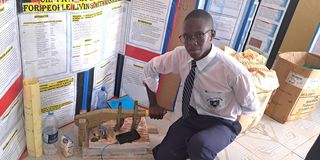
Their innovation, a Manually Operated Chapati Rolling Machine, was showcased at the 62nd Kenya Science and Engineering Fair (KSEF) in 2026.
The project, under the Food Technology category, attracted huge crowds at Garissa High School, where the fair was held. Judges, lecturers from universities, teachers, Ministry of Education officials and visitors alike were impressed by the ingenuity of the two students, who explained how their machine would work.
Jake Waweru (left) and Meshack Muasa hold their trophy after emerging top in the Food Technology category and clinching the Best Innovative Project award at the 62nd Kenya Science and Engineering Fair on April 4, 2026.
Photo credit: Winnie Atieno | Nation Media Group
“Our machine was inspired by the President’s remarks. Our aim was to improve consistency, efficiency, and ergonomics in chapati preparation while keeping it affordable and accessible,” said Meshack.
Chapati, a popular food in Kenya, is traditionally rolled by hand, a process that is labour-intensive, time-consuming, and dependent on skill. The students noted that traditional rolling often produces inconsistent shapes, sizes and thicknesses, reduces productivity during peak cooking times, and can cause repetitive strain injuries. Hygiene concerns also arise due to repeated hand contact with dough.
To address these challenges, the Art and Craft students fabricated a simple lever-operated mechanical device to standardise the rolling stage. The machine is manually powered, making it suitable for households and small-scale vendors, especially in areas with unreliable electricity. It targets a chapati diameter of approximately 18 cm.
Performance testing compared the machine with traditional rolling using dough masses of 50g, 60g, and 70g. Results showed that the machine produced consistent diameters ranging from 16.5 cm to 17.6 cm, with minimal variation. In contrast, traditional rolling showed greater inconsistencies.
Time efficiency was another breakthrough. The machine consistently flattened dough in about five seconds, regardless of mass, while the traditional method required 20–25 seconds, increasing with dough size.
“This demonstrates improved productivity and reduced operator fatigue. The project successfully achieved its objectives by fabricating a functional prototype, proving improved size consistency, and demonstrating greater efficiency,” explained Jake.
The study concluded that simple mechanical innovation can significantly enhance traditional food preparation without expensive automation. Future improvements include adding a spring-return mechanism, improving non-stick surfaces, and enhancing ergonomic design for wider adoption.
“As scientists, we need to come up with innovations that can be adopted in our country. We would like to meet the President to showcase this project so that we can move it to the next level. We urge flour-making companies to take up this innovation,” said Meshack.
The machine is particularly designed to assist people living with disabilities, especially those with one functioning arm, as well as small restaurants and traders.
“You require one arm to make the chapati dough, thereafter this machine helps you flatten it instead of using a lot of time and strength. Before we came to this fair, we tested it in our school and our principal pledged to consider it once it becomes a product in the market. This machine simplifies the process of making chapatis,” Meshack added.
The chapati machine flattens dough in five seconds, four times faster than traditional hand-rolling.
Photo credit: Shutterstock
The students began by sketching and researching before building the prototype. The machine is multipurpose and can also be used in doughnut making. The manufacturing cost is approximately Sh5,100. They used readily available materials such as blue gum wood, nails, hinges, wood glue, and furnishings.
Last year, the duo attempted to compete in the fair with a different project, but only reached the county level. This year, however, they advanced to the national stage and emerged among the top innovators.
“Science fair is all about providing innovative solutions to problems facing society. We saw a gap, especially for people living with disabilities and small-scale traders who spend a lot of time rolling chapati. With this machine, it is very efficient—10 seconds and you are done flattening the dough,” said Meshack.
Jake added that their success came from focusing on solving a problem facing a community often forgotten by society. A budding chef, Jake hopes to pursue aeronautical engineering after Form Four and later join the forces.
Meshack, passionate about cooking, plans to venture into the building and construction industry to study architecture.
They urged fellow students to seize every opportunity that comes their way. Their Drawing and Design teacher, Mr Josphat Kuria, praised the innovation, saying it aligns with President Ruto’s “one million chapati” initiative.
“It might not make a million in a day, but we are hoping if 50,000 Kenyans can buy this machine and make 20 chapatis each day, then we will achieve the one million chapati initiative. What many people thought was impossible is actually possible,” he said, terming the innovation superb.
He urged President Ruto to reach out to the two boys to showcase their innovation.
For the first time, Junior School learners in Grades 7 to 9 showcased projects alongside senior schools, with a strong emphasis on STEM innovations such as robotics.
“This fair not only builds critical thinking and creativity among learners but also positions STEM as a pathway for Kenya’s future workforce,” Dr Abdi said.
KSEF, which began in 1962 as the Science Congress, has grown from three categories limited to Nairobi schools to 18 categories in senior schools and six in junior schools.
Kenyan learners have also showcased their innovations internationally, including at the Expo for Young Scientists in Johannesburg and the International Science and Engineering Fair in Ohio, USA.