The government has made hundreds of university graduates master jugglers early in their careers as it engages them on meagre pay, yet requires them to teach for long hours in crowded and ill-equipped classes as intern junior school teachers.
Having left university with high hopes, the interns interviewed by the Sunday Nation said they teach up to 40 lessons a week, twelve more than the recommended number, are made to go to class with few or no teaching materials and are forced to take subjects they did not train for.
Even with all this, they have no medical cover or allowances. They cannot take loans as financial institutions fear dealing with employees on such contracts.
Just days ago, the Teachers Service Commission (TSC) said contracts for serving junior school intern teachers would be extended by 12 months to December 31, 2026.
TSC said the extension, aligned with the 2019 Internship Policy, prevents disruptions in learning.
“The commission approved the extension of contracts ... for a further 12 months, with effect from January 1, 2026. The interns shall remain in their current stations, subject to their formal confirmation of acceptance,” the notice reads.
For many, teaching in junior school under the Competency-Based Education (CBE) is a daily struggle. Most were recruited as interns or placed on short-term contracts, earning Sh17,000 a month on average despite the same workload as their permanently employed secondary school colleagues.
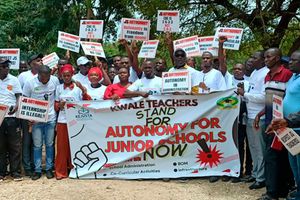
Junior Secondary School teachers hold a protest match.
Photo credit: Isaac Wale | Nation Media Group
However, Treasury Cabinet Secretary John Mbadi gave the position of the government on the matter.
“The Ministry of Education has communicated with these teachers and told them that they have done one year as interns, and that they will do another year before being converted to permanent and pensionable,” he told Citizen TV on Thursday.
“There have been complaints, and they’re saying, and rightly so, that Sh17,000 is little; that they’re working like slaves,” he said.
The CS, however, added that the teachers should “count themselves lucky” for having something to engage in.
“This economy is producing many college leavers: graduates of whatever professions, and some don’t even have the opportunity to work as interns. For teachers, there’s that space,” he said, pointing to the “poor” state of the economy.
Kenya Junior School Teachers Association Chairman, Rodgers Odhiambo, said whatever the tutors are going through is part of a broader global challenge in education.
“One of the main challenges is understaffing. An intern teacher has 40 lessons per week. One needs to prepare for every lesson and move from one class to another. There is no time to prepare,” Mr Odhiambo told the Sunday Nation.
“Planning, scheming, and all the preparation a lesson requires are not done. You just rush to class to finish and move to the next. Even breaks are non-existent.”
Mr Odhiambo added that most junior schools are severely understaffed, making interns handle subjects they were never trained to teach.
He said the mismatch undermines the quality of instruction and affects learners’ understanding and engagement.
“A teacher trained in mathematics and chemistry ends up handling creative arts. That affects the children for the teacher has little content and does not know how to deliver it,” he said.
A Sunday Nation spot-check on the working conditions of interns across the country returned sobering results; a picture of wretched lives.
Mr Alex Ochomba, an intern teacher in Murang’a, said he is struggling to survive. Mr Ochomba, who signed his contract on January 6, 2025, said the agreement has since lapsed, though he has renewed it.
“The Sh17,000 cannot sustain me. If I do the calculation, I go home with Sh580 to Sh600 daily. Compare that to a person at a mjengo (construction) site, who takes home Sh800,” he said.
“A foreman at a construction site earns Sh1,200 a day. University graduates are being treated like casual workers. How are we supposed to survive?”
The trained chemistry and physics teacher is often made to teach mathematics in Grades Eight and Nine. Mr Ochomba handles creative arts classes on some occasions.
“Because schools are understaffed, we teach subjects we never trained for,” he said.
Mr Ochomba explained that his responsibilities extend beyond teaching, making the situation even more challenging.
He said the challenges faced by intern teachers reflect wider systemic issues, including delays in confirmation of appointments, poor remuneration and inadequate support for such instructors in the understaffed institutions.
“I have a family and my monthly house rent is Sh5,000. How do I support my wife and children? Society has expectations. To be honest, intern teachers are demoralised and drained,” Mr Ochomba said.
“I do all I can to manage the situation but it is nearly impossible. It’s really unfair, and the government still refuses to listen. Authorities admit that the economy is tough, so why are they giving us Sh17,000?”
“We are demoralised. I urge officials in the Ministry of Education and TSC to listen to junior school teachers,” he said.
Ms Racheal Naliaka, a junior school teacher in Bungoma County, said practical lessons essential to the CBE are often skipped because schools lack resources or support from administrators.
She added that students are missing hands-on experience that is important in grasping concepts in subjects like science and agriculture.
“Learning would be great if the system supported it. Junior school teachers are left to their own devices. Most institutions don’t treat junior school like secondary school,” she told the Sunday Nation.
“Learners cannot do practicals because resources are withheld by the administrators or the ministry. We teach science without laboratories. Sometimes we improvise with bottles and stones, but it is the children that are losing.”
Ms Naliaka added that it is not easy to survive on Sh17,000 a month.
In major cities like Nairobi, Mombasa and Kisumu, rent alone can consume more than half of a teacher’s pay, some said, adding that it forces many to look for additional jobs in order to make ends meet.
“We are going through a lot. Everyone knows a junior school teacher walks home with Sh17,000 at the end of the month. Rent alone in Bungoma is high, and my two children need to be in school,” Ms Naliaka said.
“How can anyone with a family survive on that? Many teachers wake up early to look for odd or menial jobs. It is the same case in the evening. While we struggle to survive, the learners suffer since our energy and focus are divided.”
Mr Gaster Ochieng, the chairperson of Murang’a County Intern Teachers, raised the alarm over the challenges facing the tutors.
“The economy has led to the suffering of teachers. Every day is struggle. You wake up and go to work knowing that what you earn is barely enough to keep your family going,” Mr Ochieng said.
He added that intern teachers have been working for a full year, earning Sh17,000, but the government’s decision to extend the internship by an additional year has left many anxious, angry and feeling neglected.
“To describe it as demoralising is an understatement. We work long hours, commit ourselves to shaping young minds and yet the system does not recognise our efforts. Imagine working for a full year, earning Sh17,000 every month, only to be told the internship will be extended for 12 months,” Mr Ochieng said.
“That uncertainty has taken a toll on us all. We put in our time, commit ourselves to teaching but are treated like nothing. The only difference between junior school teachers and mjengo employees is that they earn more than us.”
He added that intern teachers are disadvantaged because they are not legible for medical allowance or cover.
“In case of an illness, the teacher still has to go into the pocket for the medical bill,” Mr Ochieng said.
Without intervention, many junior school teachers fear the growing economic pressures could lead to a decline in the quality of education.
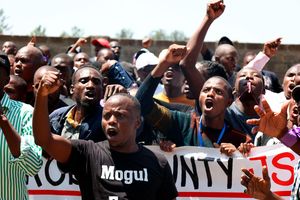
Junior Secondary School teachers outside the Teachers Service Commission offices on May 13, 2024
Photo credit: Evans Habil | Nation Media Group
“We don’t have medical allowances, but contribute to the Social Health Authority, which is not even helping us. Junior school teachers do not enjoy perks like their permanent pensionable colleagues yet we too have families and other dependants.”
Mr Hilary Muhangani, a mathematics and chemistry teacher in Kakamega, teaches other subjects he knows little about.
These include physical education, science, creative arts and pre-technical studies.
“I handle 33 lessons a week when I should be having around 20. The government needs to look into the welfare of junior school teachers and what ails education in general,” he told the Sunday Nation.
Mr Muhangani, who is married, added that the government has failed to uphold its promises to junior school teachers.
He said with a monthly stipend of Sh17,000, it is near-impossible to support a family, cover basic needs and save for the future.
“The economy is harsh. A teacher should not be living like a labourer. The government has not kept its promise to confirm us. It is demoralising and unfair,” he said.