The education sector has been plunged into confusion after President William Ruto sent mixed signals regarding the management structure of Junior Schools (JS), barely three months after aggressively advocating for a unified policy.
The sudden shift, which saw the President promise autonomy for JS teachers last week, directly contradicts his September directive giving Education Cabinet Secretary Julius Ogamba 45 days to finalise the establishment of Comprehensive Schools—a model that mandates primary school head teachers oversee the JS level.
The uncertainty affects over 23,000 primary school heads, learners and parents just a month before 1.1 million Grade 9 learners are due to transition to Senior School in January 2026.
In September, during a meeting with education officials at State House, President Ruto championed the Comprehensive Schools policy, which groups Early Childhood Development (ECD), Primary, and Junior Schools under one head.
"The Sessional Paper Number 1 of 2025 is dear to us. In it is the review of all laws that would bring up to speed all agreements and reforms championed by the Presidential Working Party. The 45 days start running from today. Deputy President Kithure Kindiki will help us speed up the process in the cabinet, while Julius Melly and his colleagues will ensure its passage in the National Assembly. Each to play their role," the President declared, setting a firm deadline for integrating the structures.
The directive was seen as a bold step to streamline Competency-Based Education (CBE) implementation and provide a unified administrative structure for foundational learning up to Junior School, a level that has faced challenges involving unions and associations in both primary and secondary schools.
However, during a meeting with JS teachers last week, the President backtracked on this policy direction.
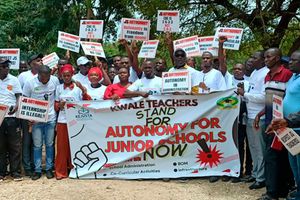
Junior Secondary School teachers from Nairobi County stage a procession to the Teachers Service Commission offices on May 13, 2024.
Photo credit: Evans Habil | Nation Media Group
"So the problem is that you are reporting to the bosses (head teachers) in primary schools? I see the quagmire. But you are really pushing me, and I have heard you. I think you have a point," Dr Ruto said, assuring teachers he would work with the TSC to provide a "policy direction" on autonomy.
Education analysts suggest the recent remarks may signal a political shift influenced by mounting pressure, especially from the vocal Kenya Junior School Teachers Association (Kejusta).
The Comprehensive School model, despite lacking legal backing with the Sessional Paper yet to be tabled, had been embraced by primary head teachers and the Kenya National Union of Teachers (Knut).
"The education sector is in flux," said a senior union leader who requested anonymity due to the sensitivity of the matter. "Contradicting the head of state is dire, but the uncertainty threatens not just the structure, but the careers of thousands of school heads whose roles were set to be upgraded or reassigned."
A head teacher and Kepsha official, also speaking on condition of anonymity, accused the Head of State of "playing politics with the education sector" due to inconsistent communication.
"There is no consistency in communication. One day, we are told we will have a new structure; the next day, it’s about autonomy. Which one is it?" the head teacher asked.
The President’s promise of intervention comes as JS teachers intensify their push for independence through legal action.
"The government must decide whether to fully adopt the Comprehensive School model, modify it, or abandon it altogether. Either way, as head teachers, we are demanding a clear, consultative roadmap that puts our roles, welfare, and career progression at the centre," said another head teacher.
Thirty-nine JS educators have filed a petition at the High Court in Nairobi, suing CS Julius Ogamba, TSC acting chief executive officer Eveleen Mitei, and Attorney-General Dorcas Oduor. They argue that placing their secondary-trained personnel under primary school heads—who often lack the requisite qualifications—undermines professional autonomy and career progression.
Education Cabinet Secretary Julius Ogamba at a past event.
Photo credit: Kevin Odit | Nation
This legal move directly challenges the operationalisation of the Comprehensive School policy before it has been legally enacted.
The TSC itself has acknowledged the leadership chaos. TSC Director of Staffing Antonina Lentoijoni admitted that JS teachers are "not respecting the heads, especially when they know that they are just P1 trained teachers."
She clarified that the Comprehensive School model is not yet legally recognised, but proposed a potential future solution: a single principal supported by two deputies—one for primary and one for Junior School.
Both Kepsha and Knut have rejected the proposed dual-deputy structure. Kepsha National Chairman Fuad Ali and Knut Secretary General Collins Oyuu said it offers no autonomy.
Fuad Ali, Kepssha national chairperson and headteacher at Tom Mboya Comprehensive School in Mombasa, addressing Grade 9 Students on February 4, 2025.
Photo credit: Kevin Odit | Nation Media Group
"You either respect the administration of the day in the comprehensive schools or go and teach in senior school," said Mr Ali during their annual conference two weeks ago.
JS was domiciled in primary schools in 2022 due to lack of capacity in secondary institutions. The Kenya Kwanza administration rescinded the previous regime’s decision to move learners to secondary schools, citing a mismatch in school numbers: 32,000 primary schools versus 10,000 secondary schools.
"This mix will clearly continue to frustrate our efforts to deliver 100 per cent transition to secondary education. This is one of the reasons the working party proposed hosting Junior Secondary School in primary schools," said President Ruto.
The current regime has since renamed Junior Secondary School (JSS) to JS after the learners were domiciled in primary schools. The Head of State acknowledged that most primary schools are congested due to progressive primary education and the push for 100 per cent transition to secondary programs.
President Ruto’s recent promise of autonomy for JS teachers, which contradicts his earlier push for the Comprehensive Schools policy, has drawn criticism from sector experts, who accuse the Head of State of "politicking with a crucial sector."
Mr Cornelius Oduor, of the Kenya Human Rights Commission (KHRC), expressed concern over the lack of policy coherence, warning that the continuous flip-flopping creates confusion and uncertainty for teachers and parents.
"We can’t have a situation where we keep flip-flopping with education policies," Mr Oduor stated. He noted that the Jubilee government invested public funds to build structures in secondary schools for JS, only for the Ruto administration to domicile learners in primary schools and now promise autonomy again.
He warned that the President’s pronouncement risks creating an unofficial "third tier" within the education system and called for a focus on immediate challenges like teacher shortages and sustainable resource allocation.
"We must invest resources sustainably. Kenyans need clarity on structures; we cannot keep shifting education policy," he said.
The uncertain policy direction has left parents confused, prompting Mr Oduor to question whether the President’s moves are politically motivated.
However, Kejusta official James Odhiambo welcomed the President’s statement.
"The President should come up with a policy to recognise the distinctiveness of JS. He listened to our concerns and recognised the point. We want a legal policy that will recognise the autonomy of JS," he told Nation.