After the flames died down and schools shut their gates, learners are now expected to return to class carrying the burden of destruction.
At Mang’u High School in Kiambu and Chasimba Secondary School in Kilifi, students will each pay Sh1,000. At Moi Girls, Lanet, and Kakamega Boys, learners will first clear outstanding fees before being allowed back to class.
At Utumishi Girls High School, the cost will be less financial and more psychological.
It will linger in empty desks, in the scars left behind, and in the absence of peers who never returned. For survivors, the trauma of escaping a fire that others did not will remain long after classrooms are rebuilt.
Caskets carrying the remains of the 16 Utumishi Girls Senior School students who lost their lives in a dormitory fire during a requiem mass at Gilgil Stadium on June 12, 2026.
Photo credit: Boniface Mwangi | Nation Media Group
Across the country, school administrators, parents and education officials are grappling with a pressing question: why are learners going on strike and, in some cases, setting their schools ablaze?
While government officials insist only a small fraction of schools have been affected, the incidents have been widespread enough to raise concern at the highest levels.
In a briefing last week, Education Cabinet Secretary Migos Ogamba said 204 schools had been affected by unrest, about two per cent of all schools nationwide.
He added that at least 59 institutions had resumed learning as authorities moved to restore normalcy and protect the academic calendar.
Education Cabinet Secretary Julius Ogamba.
Photo credit: Lucy Wanjiru | Nation Media Group
Behind the figures are stories of frustration, fear and unresolved grievances.
At Agoro Sare High School, Principal Isack Okeyo said some students linked to a recent arson incident admitted they were influenced by unrest in other schools.
“Two suspects said they were motivated by what happened in other schools,” he told the Nation. “We are yet to receive a report from Public Works on the estimated cost of the damage.”
His remarks point to growing concerns among education stakeholders that a copycat culture is emerging in schools, amplified by social media, mobile phones and constant reporting of unrest.
In Siaya County, the High Court recently intervened after Ambira High School sought to compel parents to pay Sh33,000 per student to repair damage caused during unrest that erupted on May 18.
The school estimated the destruction at Sh50 million and ordered parents to fund repairs before students could resume learning. Parents challenged the decision in court.
Through their lawyer, John Kihara, they accused the administration of negligence and complacency, arguing that the unrest stemmed from serious allegations involving the school captain and members of the prefect council accused of sexually abusing younger students.
“The school captain, his prefect council, some of the Form Fours and some of the Form Threes were forcefully sodomising the smaller and vulnerable boys,” the legal letter alleged, saying Grade 10 students were among the worst affected.
The parents maintained that the unrest was not mere indiscipline but an eruption of long-ignored grievances.
That view aligns with findings by security and governance expert Major (Rtd) Dr Mohamed Morowa, who says school unrest is a “hydra-headed” phenomenon rarely driven by a single cause.
He says it often stems from a mix of academic pressure, poor communication, harsh discipline, poor living conditions, family challenges, substance abuse, peer influence and weak counselling systems.
“Schools are expected to provide a safe environment where students can learn, develop their talents and prepare for future careers,” he said. “When this environment becomes stressful or unsatisfactory, students may resort to destructive actions as a way of expressing their frustrations.”
He argues that many institutions treat unrest purely as a disciplinary issue while ignoring deeper structural and welfare concerns.
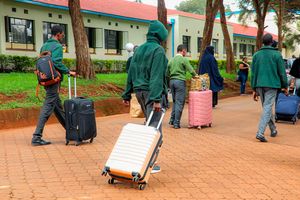
Students leave Alliance High School in Kikuyu, Kiambu County on June 4, 2026 after the institution announced an indefinite closure following a fire that destroyed a storage facility within the school compound.
Photo credit: Lucy Wanjiru | Nation Media Group
Unresolved grievances over accommodation, food, discipline and leadership, he warns, can quickly escalate into violence even from minor triggers.
At Mang’u High School, students were required to pay Sh1,000 each before resuming classes after a strike that left broken windows and damaged property. Administrators had closed the school to prevent further escalation.
At Chasimba Secondary School, boarders were also directed to pay Sh1,000 following unrest at the institution. The school has faced repeated incidents, including an attempted arson attack and a case in which the principal’s vehicle was vandalised.
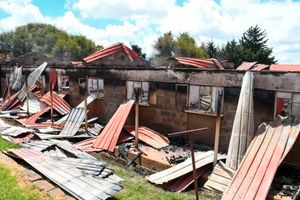
At Kakamega High School, students were ordered to clear second-term fee balances before returning after a dormitory fire forced closure of the school.
“It was not just about going home,” he said. “We had repeatedly complained that the food portions were too small, but the administration was not listening.”
“We watch television during entertainment sessions and there are students with phones. Information spreads very easily.”
Unlike previous generations that relied on word of mouth, today’s students follow events in real time through social media, online news and mobile communication.
Dr Morowa cautions that this has created a copycat effect, where unrest in one school can trigger similar incidents elsewhere.
A parent said the latest disturbance on May 24 nearly escalated into tragedy after students allegedly poured fuel into a dormitory but failed to find a matchstick.
Dissatisfaction with the school administration is partly to blame, with a Form Three student accusing it of failing to listen to learners.
“This principal does not listen to us and always relies on prefects to solve issues,” the student said. “We eat githeri almost five days a week, and sometimes the bread served has mould.”
Such complaints may appear routine, but experts warn that when concerns about food, accommodation, discipline or welfare repeatedly go unaddressed, frustration accumulates. Eventually, students may resort to destructive means to force administrators to pay attention.
At Moi Girls High School, Lanet, students were not required to pay for damages after unrest, but were directed to clear all outstanding fee balances before being readmitted.
One parent said the directive had placed a heavy burden on families already struggling with the cost of education.
“I am being told I have arrears of Sh19,000 which must be cleared before my daughter returns to school,” he said.
The school also narrowly escaped an arson attack after paraffin allegedly intended for use in setting a fire was discovered before the plan could be executed.
Psychologist Jared Omache says the current wave of unrest cannot be understood without examining the realities facing modern adolescents. He argues that while student grievances are not new, today’s learners are growing up in a rapidly changing environment.
“It appears like all of a sudden there is a wave of unrest in schools across the country,” he said. “But while the concerns of the students are legitimate, many of those concerns have existed for a long time. The difference is that something has changed.”
Omache says adolescents often lack the emotional tools adults use to manage pressure and disappointment.
“We are having a generation of teenagers who are risk-takers. Their rebellion starts from within, just a behaviour change as a kind of rebellion. You may think it is stubbornness, but it is a demonstration waiting for a moment to manifest physically,” he said.
A teacher at Upperhill School, who spoke in confidence, believes many of the problems originate outside school, pointing to family instability, absent parents and weakening support systems as key drivers of student distress.
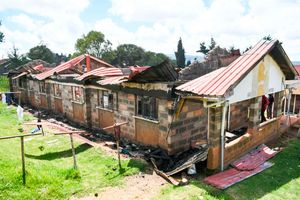
One of the dormitories, on June, 3, 2026, that was destroyed by a fire at St Joseph's Seminary School in Molo, Nakuru County.
Photo credit: Boniface Mwangi | Nation Media Group
“Many children come from dysfunctional families where nobody has time to listen to them and they use rebellion as a way of seeking attention,” she said.
She argued that teachers are increasingly being expected to handle emotional and social challenges they were never trained to address.
“We were trained to teach subjects, not to raise children. There is a disconnect somewhere.”
Boaz Waruku, Policy and Strategy Advisor at Elimu Bora Working Group, said understanding the causes of unrest should never be mistaken for justifying it. He said that while many students feel ignored, arson and destruction can never be an acceptable form of protest.
“The underlying issue is that students have been left with no option other than finding a way through which they can draw attention,” he said.
“Unfortunately, some do not understand the extent of the damage they are causing to themselves, their peers, the school and society.”
Waruku said many schools are struggling to provide basic needs due to financial pressures, with meals, water, accommodation and sanitation increasingly becoming points of tension.
But once lives are lost and property is destroyed, he noted, sympathy quickly disappears.
Former Basic Education Principal Secretary Prof Julius Bitok has linked part of the unrest to examination pressure and rising anxiety among learners.
Basic Education Principal Secretary Prof Julius Bitok addresses the media outside Utumishi Girls Senior School on May 29, 2026.
Photo credit: Boniface Mwangi | Nation Media Group
“In some cases, rather than forcing students to sit examinations, schools can consider postponing them,” he said.
Some incidents are linked to examination anxiety, while others stem from grievances over meals, water, facilities or poor communication with administrators. The remedy, experts say, lies in listening early and addressing concerns before they escalate.
As schools reopen, immediate attention is likely to focus on rebuilding dormitories, replacing broken windows and recovering lost learning time.
Dr Morowa said school unrest should not be viewed merely as a disciplinary problem, but as a symptom of deeper systemic challenges within the education environment.
He called for stronger guidance and counselling programmes, improved communication channels, greater student participation in decision-making, and closer collaboration between schools, parents and communities.
“Through shared responsibility and sustained commitment, schools can be made safer and more supportive spaces where learners can learn effectively and develop into responsible members of society,” he said.
Reporting by Steve Otieno, Daniel Ogetta and Domnic Ombok