Public universities face total shutdown as lecturers issue strike notice
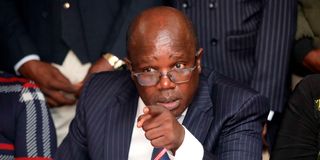
Universities Academic Staff Union (UASU) Secretary-General Dr Constantine Wasonga addresses journalists during a press conference at the Nairobi Safari Club in Nairobi on September 18, 2026.

Lecturers in public universities have issued a seven-day strike notice after the government failed to commit to funding their 2025–2029 Collective Bargaining Agreement (CBA) through the National Exchequer.
The Universities Academic Staff Union (UASU) issued the notice today, saying the Salaries and Remuneration Commission (SRC) had disclosed that neither the Ministry of Education nor the National Treasury had provided a written commitment on how the agreement would be financed.
The union said the absence of the commitment had prevented the SRC from issuing the constitutional advice required to facilitate financial counter-proposals in the negotiations.


The disclosure came at a time the union had issued a one-month ultimatum on assurance from government that the funding parameters needed to move the negotiations forward would be available this week,
“But when we visited the SRC, they categorically told us that they could not issue the parameters for negotiations because the government had not committed to fund that CBA,” UASU secretary general Constantine Wasonga said.
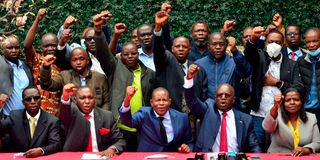
Universities Academic Staff Union (UASU) officials when they issued a strike notice.
Following the latest development, UASU has now issued a seven-day notice, with the strike scheduled to begin next week on October 2 2026 (Friday).
The union's dispute with the government has now widened beyond the delayed CBA to the proposed financing model for public universities.
It has since emerged that the government is considering a model under which individual universities would finance national CBAs, a position UASU has rejected.
The union is also opposed to the government’s emerging funding model, arguing that linking university staff salaries to student fees would expose lecturers to uncertainty whenever students fail to pay.
“We are not going to allow our salaries to be paid from students’ fees, because what happens in case students don’t pay,” Dr Wasonga asked.
The recently published Tertiary Education, Placement and Funding Bill, 2026, does not provide a mechanism for financing the remuneration of academic staff, leaving the question of how future salary agreements will be funded unresolved.
Dr Wasonga, who was flanked by other UASU officials, noted that lecturers in public universities are public officers whose remuneration should be funded either through the Consolidated Fund or money appropriated by Parliament.
The union also argues that individual universities cannot sustainably finance CBAs because public universities are already struggling with accumulated government funding arrears.
“Government owes public universities to the tune of Sh100 billion,” Dr Wasonga said, adding that universities had been deemed technically insolvent when they sought to negotiate institution-level CBAs because of their financial position.
He attributed the financial difficulties to what he described as failure by the government to remit funds owed to the institutions.
“We have given them the seven-day notice to rectify this. They must commit that our salaries shall be paid from the Exchequer and that the national CBAs shall be negotiated and funded from the Exchequer,” he said.
UASU chairperson Grace Nyongesa said the proposed funding approach would unfairly shift responsibility for lecturers’ salaries to students.
“We are not going to allow ourselves to be subjected to collection of fees in order to meet our salaries and even to meet the CBA’s agreed issues. It is unfair, unacceptable and illegal,” she said.
The union said its latest action follows the government's failure to honour the Return-to-Work Formula signed on November 5, 2025, and the continued delay in concluding the 2025–2029 CBA.
UASU noted other employees in the public education sector had already concluded their 2025–2029 CBAs while university lecturers remained without a new agreement.
The union further questioned the government's emerging market-based approach to university financing, saying it had not been presented with a formal policy document outlining how the proposed model would work.
UASU said it had been directed by some government officials to consider social media posts on the proposed funding model, including statements attributed to economist David Ndii.
The union rejected this approach, saying it could not rely on social media declarations or interpret provisions of the proposed Tertiary Education, Placement and Funding Bill, 2026, which is yet to become law.
“Do we still have public universities or have they changed to market-based universities? If so, when and how did they change to market-based universities?” the union asked.
UASU wants the government to commit to funding the 2025–2029 CBA through the National Exchequer, conclude and implement the agreement, and retain the public-officer status of university lecturers.
It also wants the proposed Tertiary Education, Placement and Funding Bill to expressly safeguard the remuneration of academic staff through the Exchequer.
The union has warned that it will proceed with the strike unless the government addresses what it calls the “irreducible minimum” of its demands within the seven-day notice period.
Follow our WhatsApp channel for breaking news updates and more stories like this.