Universities are increasingly hiring more part-time lecturers even as some reduce permanent academic staff, raising questions about staffing levels and the quality of teaching in higher education.
Data from the Commission for University Education (CUE) shows that the number of adjunct academic staff more than doubled in one year, rising from 758 in 2024 to 1,611 in 2025.
This comes amid a proliferation of advertisements by public universities seeking part-time lecturers, highlighting a staffing challenge that institutions are increasingly managing through temporary academic workers rather than permanent recruitment.
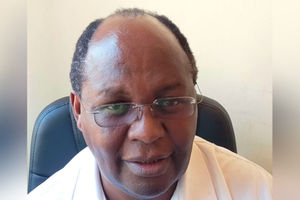
The Universities Academic Staff Union (UASU) has questioned how universities with increased student enrollments are being allowed to operate with a fraction of the academic staff they require.
“We are asking CUE, how do you charter these universities, given a university with 43 full-time academic staff has 17,000 students, another one has 33 full-time academic staff with 10,000 students, and another has 70 while they have 12,000 students,” UASU secretary general Constantine Wasonga posed.
He noted the growing number of advertisements for part-time teaching positions was evidence of a staffing crisis that universities were attempting to manage through temporary academic workers.
An analysis of public university adverts for part-time and adjunct lecturers between 2024 and September 2026 shows that recruitment cuts are occurring across virtually the entire academic spectrum.
The entrance to Kenyatta University in this picture taken on April 5, 2025.
Photo credit: Wilfred Nyangaresi | Nation Media Group
In March 2026, Kenyatta University advertised multiple part-time teaching positions across Agriculture, Animal Science, Agricultural Economics, Environment, Accounting and Finance, Business, Management Science, Applied Economics, Econometrics and Statistics, among other disciplines.
In May, Mama Ngina University College advertised part-time teaching opportunities in fields including Nursing and other medical disciplines, Computer Science, Information Technology, Data Analytics, Mathematics and Statistics.
A month later, the Open University of Kenya advertised for part-time lecturers in Health Sciences, Media, Communication and Design Technologies, Agriculture and Food Systems, and IT, Computing and Artificial Intelligence, among other areas.
The University of Nairobi also advertised 27 part-time lecturer positions in its engineering schools, 15 in Electrical and Information Engineering and 12 in Civil and Construction Engineering.
The latest institution to advertise for part-time lecturers was Kabarnet University College, which on August 4, 2026, invited applications for part-time and adjunct teaching positions.
Dr Wasonga said some universities were advertising dozens of positions at a time, citing examples of institutions seeking 99 and 160 part-time lecturers.
“Part-time teaching is compromising quality because how do you teach students who are standing because the lecture hall is full,” he posed.
The union's concerns are reflected in CUE statistics, which show a sharp rise in the number of adjunct academic staff over the years. The data show adjunct academic staff doubling from 379 in 2023 to 758 in 2024, before surging to 1,611 in 2025, more than four times the 2023 figure in just two years.
“The implications of these trends are multifaceted. First, the rapid expansion of Adjunct Academic Staff suggests increasing reliance on flexible employment models to meet teaching demands,” CUE notes in the University Statistics Report 2025.
The commission says that while this offers short-term cost savings and adaptability, it raises concerns about teaching continuity, student mentorship, curriculum development, and institutional commitment.
Adjunct staff are often less integrated into institutional governance and research activities, which may affect overall academic quality if their proportion continues to rise significantly.
Overall, the number of academic staff grew from 15,383 in 2024 to 16,434 in 2025, representing a net gain of 1,051 personnel, with male staff constituting the majority in both years.
At the same time, the number of students has continued to grow faster than academic staffing in public universities. In public chartered universities, the student-to-teacher ratio deteriorated from 40.77 students per teacher in 2023 to 44.36 in 2024.
Public chartered universities accounted for 10,555 teaching staff, or 68.6 per cent of all teaching staff recorded by CUE in 2024.
The regulator's figures also point to a weakening pipeline of junior academics. Tutorial fellows declined from 3,498 in 2023 to 3,119 in 2024, while graduate assistants fell from 815 to 604.
CUE says the decline in these entry-level academic positions could raise concerns about the future academic talent pipeline and succession planning in universities.
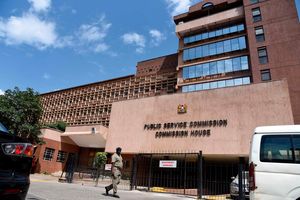
Staffing in universities has further complicated plans by the Public Service Commission (PSC)s to reduce the length of service of experienced academics through changes to the retirement age.
UASU has opposed the PSC's retirement framework, arguing that forcing experienced academics out of universities at a time when institutions are struggling to recruit lecturers is contradictory.
Uasu Secretary-General Constantine Wasonga (left) and Education Cabinet Secretary Julius Ogamba at County Hall, Nairobi, on November 4, 2025.
Photo credit: Dennis Onsongo | Nation Media Group
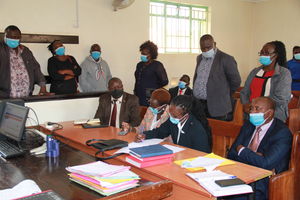
Dr Wasonga questioned how universities could simultaneously advertise for part-time lecturers while declaring permanent academic staff redundant.
“How can academic staff be declared redundant? University is meant for teaching staff and students,” he said.
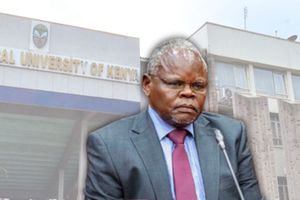
The issue has become particularly contentious at Moi University, where UASU is opposing a redundancy process affecting academic staff.
Dr Wasonga said the union would not allow professors to be declared redundant while the institution faced what he described as serious governance and financial management problems.
The Auditor-General has raised several governance and financial management concerns involving public universities in an analysis of public universities. Audits flagged instances of councils or committees holding meetings beyond the approved limit of six meetings per financial year.