Some 122,908 learners who sat the Kenya Primary School Education Assessment (KPSEA) in Grade 6 three years ago will not undertake the assessment at the end of junior school next month, dealing a serious blow to the government's 100 per cent transition policy.
The KPSEA results were not used for placement to junior school as the government is keen on ensuring 100 per cent transition at the various exit points, in line with the competency-based education (CBE). The decision was made to cure the perennial high drop-out rates associated with the 8-4-4 structure, but it appears the problem still persists.
According to data seen by the Nation , the Kenya National Examinations Council (Knec) has registered 1,130,699 candidates for the 2025 Kenya Junior School Education Assessment (KJSEA) . This is the class that undertook KPSEA in 2022, with 1,253,577 candidates undertaking the assessment in Grade 6.
This will be the first-ever KJSEA administered since the change from 8-4-4 to the CBE. The results of the assessment will determine the senior schools and career pathways learners will be placed to based on their performance as well as interests.
When Knec conducted a monitoring of learners’ progress assessment in 2019 when this class was in Grade 3, an even higher number of learners (1,282,150) were enrolled for the assessment.
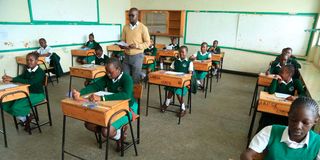
Learners at Mount St Mary's Girls Primary School in Molo, Nakuru County, take their Mathematics paper during the Competence-Based-Curriculum assessment.
Photo credit: John Njoroge | Nation Media Group
Education Cabinet Secretary Julius Ogamba said that the difference in the number of learners in Grade 6 in 2022 and those expected to sit KJSEA next month is attributable to several factors.
“Some of the reduction is due to natural attrition, which accounts for cases where learners may have passed on or are otherwise no longer able to continue. A section of learners opted for vocational training centres (VTCs). Others have transitioned to alternative curricula such as international schools. There are also cases of dropouts and delayed progression, for instance when learners step out temporarily due to early pregnancies or sickness, but they are given the opportunity to rejoin once they are able,” he told Nation.
Education CS Julius Ogamba addressing the press during the release of 2024 Kenya Universities and Colleges Central Placement Service placement results at Jogoo House, Nairobi on July 1, 2025.
Photo credit: Lucy Wanjiru | Nation Media Group
The CS defended the 100 per cent transition policy, insisting it remains intact despite growing concerns over the fate of hundreds of thousands of learners who appear to have dropped out of the system. He argued that the policy should not be judged narrowly by students who do not proceed directly to secondary school, but rather by the broader opportunities available within the education sector.
“The 100 per cent policy is not struggling. Transition to VTCs or to other curricula means that the learners are still in the education system, only that they are pursuing alternative pathways. Those who have delayed progression, such as girls who became pregnant, will be able to rejoin school once able,” he said.
The wastage in the education system is not only confined to primary and junior schools; it is also experienced in secondary schools. According to registration data held by Knec, 996,078 candidates are registered for this year’s Kenya Certificate of Secondary Education. Compared to 1,214,031 candidates who sat the Kenya Certificate of Primary School Education exam in March 2021, it means 217,953 have not made it to the end of secondary education.
Kenya Primary School Heads Association chairperson Fuad Ali.
Photo credit: File | Nation Media Group
Kenya Primary School Heads Association Chairperson Fuad Ali said he was not aware of the figures, but added that they do not represent his region.
However, the National Parents Association demanded an immediate audit to establish the whereabouts of the children and explain why their absence has gone unaccounted for.
The association described the revelation as a serious indictment of the 100 per cent transition policy, citing concerns over the fate of more than 340,000 learners who appear to have vanished from Kenya’s education system despite the government’s promise of full transition.
“We are demanding that the government carries out a thorough investigation and audit. After completing checks in schools, they must establish where these missing children are. The government promised us 100 per cent transition, and we trusted that commitment. Now we want them to come out clearly and tell us where these children are,” said association chairperson, Silas Obuhatsa.
Mr Obuhatsa noted that school heads file daily reports to the Ministry of Education, yet no explanation has been offered for the glaring discrepancy.
National Parents Association Chairman David Obuhatsa Silas (centre) and other members of the association.
Photo credit: File | Nation Media Group
“This is a huge and worrying number. Are these children at home with their parents? Have they dropped out? We need answers. The Cabinet secretary must speak on this matter, and principals who submit daily reports should also account for these figures. Why is nobody explaining such a big gap?” he asked.
The association also challenged local administrators and chiefs to play a more active role in monitoring school-age children.
“This is not just a Ministry of Education issue. Chiefs and county directors should be on the ground, moving door-to-door, if need be. We want to know if these children dropped out, if they are working, if they were married off, or if they simply disappeared from the system. Silence is unacceptable,” Mr Obuhatsa said.
The association want the Education ministry to conduct a physical enrolment verification exercise across the country and release the findings.
“The audit should not be done in Nairobi offices. It should go down to the classrooms. How many children are in Grade Six? How many moved to Grade Seven? How many left? These figures should be verified and made public so that Kenyans can hold leaders accountable,” he said.
Hesbon Otieno, deputy secretary-general of the Kenya National Union Teachers.
Photo credit: Jared Nyataya | Nation Media Group
Mr Hesbon Otieno, the deputy secretary-general of the Kenya National Union of Teachers, said that more than 340,000 learners missing from the education system raises fundamental questions about the transition policy.
He stated that while natural attrition may account for a small decline in numbers, the scale of the gap is alarming.
“If we were talking about 100 per cent transition, then the numbers should reflect that commitment. We expected the candidates who enrolled three years ago to be the same number now, or at least with only a small difference. But what we are seeing runs into the hundreds of thousands, which cannot be explained by natural attrition alone,” he said.
He insisted that it is the Ministry of Education’s responsibility to trace, monitor and account for the whereabouts of every learner.
“The ministry must tell us where these students have gone. Is it death? Is it dropout caused by poverty levels? Is it early pregnancies, or is it lack of facilities in schools and lack of motivation among children? The government must come clean,” Mr Otieno emphasised.
The union official pointed to multiple dropout causes, particularly between Grade 6 and Grade 9, ranging from overstretched school facilities, poverty that forces parents to withdraw children, to children being pushed into child labour or domestic work.
He added that unless government addresses these challenges—including timely release of capitation for schools—the promise of 100 per cent transition will remain hollow.
“You can only talk about 100 per cent transition if the funds are released in good time and according to the calculations that were done. Without adequate funding, this policy cannot work,” Mr Otieno said.