Ruto's directive to CUE on university reforms
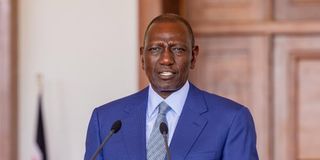
President William Ruto.

President William Ruto on Thursday directed the Commission for University Education (CUE) to review, align and reform university courses across the country, to eliminate redundant programmes and ensure graduates acquire practical, market-ready skills.
President Ruto who spoke when he presided over the 4th graduation ceremony of the National Defence University-Kenya (NDU-K), in Lanet, Nakuru County, said the move can help produce graduates capable of addressing society's most pressing challenges while adapting to a dynamic workplace.
"I ask CUE to provide greater support to all our accredited universities. We need a deeper interrogation of the courses that have been approved and we need to do more on the assessment of the approved courses and the impact they are creating in our society," stated President Ruto.


"The rate at which the world is changing, knowledge can be absolute, unless it is continuously refined and teaching can be behind schedule, unless we have greater understanding and updating of the foundation upon which teaching was set up," he added.
He said universities and other institutions of higher learning must align their academic programmes with the realities of society and the evolving demands of industry.
President Ruto said, the ultimate measure of education should not be the certificates and degrees graduates acquire, but the ability to apply knowledge, create opportunities and contribute meaningfully to national development.
"There is a difference between education that produces qualifications and education that builds capability. A degree should certify more than a graduate knows. It should demonstrate what that graduate can achieve. This is why as chancellor, l do not want the National Defence University to be just a factory of degrees and certificates. I want it to be an intellectual powerhouse that generates practical solutions to our most pressing defence and security challenges," stated President Ruto.
"Its success must be measured not only on the number of graduates it produces, but how much safer and more secure our country becomes. For this reason, I expect the National Defense University -Kenya to align its research with our national priorities and lead the development of homegrown solutions to emerging security challenges in the country and the world," he added.
President Ruto also directed the National Defence University, to conduct research alongside government agencies on the political economy of illicit alcohol and narcotics.
"I task the university to conduct a research on the drug economy and national security. l direct the university, to work with the National Authority for the Campaign Against Alcohol and Drug Abuse, the National Intelligence Service and the Ministry of Interior, to undertake a comprehensive study of the political economy of illicit alcohol and narcotics," said the Head of State.
"We must understand how these networks operate, how they are financed, how they sustain organized crime and how they perpetuate substance abuse. The findings must inform a coordinated, evidence-based, whole-of-government response,” he added.
The Head of State also directed the institution to conduct a research on the relationship between climate, security and conflict in North Rift, Tana River and Northern Kenya.
"Recurring conflicts in the North Rift, Tana River and Northern Kenya cannot be understood solely through the lens of historical and cultural differences. Increasingly, they are being aggravated by climate change, resource scarcity and population displacement,” Dr Ruto said.
He said, “I therefore task the university to establish a Centre for Climate, Peace and Security and develop Kenya’s first Climate Security Early Warning Model, to strengthen our capacity to anticipate, prevent and respond to climate-induced conflicts," said President Ruto.
At the same time, he tasked the university to conduct a research, investigate and establish the causes and motives of the frequent fires at Gikomba Market in Nairobi.
"I also task the university to investigate the recurring fires in Gikomba and other informal markets that destroy livelihoods and displace traders. We need answers grounded in scientific evidence. Are these fires accidental, the result of inadequate safety infrastructure, or deliberate acts of economic sabotage?” He posed.
Informal sector
The President said, “The findings must inform policy and interventions to protect the lives, livelihoods and investments of traders in the informal economy, a sector that accounts for more than 80 per cent of employment in Kenya.”
Further, President Ruto asked the university to research and develop a National Defence AI and Cyber Resilience Strategy to safeguard critical infrastructure, strengthen technological capabilities and protect national sovereignty.
"Kenya cannot afford to be merely a consumer of technologies developed elsewhere. We must build our own capacity to develop, deploy and govern emerging technologies in the service of our national interests. I direct the university’s College of Defence Technology, working with relevant stakeholders, to come up with a National Defence AI and Cyber Resilience Strategy," he said.
He expressed confidence that, through research, innovation, and technology at NDU-K, the country would enhance its resilience in a dynamic security environment, thereby securing national development and prosperity.
President Ruto encouraged the graduates to uphold the traditions of excellence, integrity and service that define the National Defense University of Kenya. He also called on them to serve the people with courage, honour and unwavering patriotism.
"Play your part in elevating Africa and championing our collective aspirations for a secure and thriving continent. Go out there and challenge conventional thinking, solve complex problems and shape the future of defence and national security. The security of a Nation depends not only on the strength of its defence forces, but also on the strength of its ideas, depth of its known land and the ingenuity of its people," said Ruto.
"We want leaders who innovate ahead of those who seek to undermine our society," he added.
During the event, President Ruto conferred degrees and diplomas on 350 graduates from NDU-K’s constituent colleges, various Ministries, Departments and Agencies (MDAs), as well as senior military officers from allied nations.
Fifty nine (59) graduates acquired a Masters of Arts in National Security and Strategy studies and two (2) Masters of Arts in Crisis Response and Disaster Management.
The remaining graduands acquired higher diplomas and diplomas in National Security and Strategy and other studies.
In her address, Defence Cabinet Secretary Soipan Tuya, appreciated that NDU-K continues to play a central role in advancing the Ministry’s vision of nurturing resilient, ethical, and visionary leaders for the defence and security sector.
She noted that, through its seven colleges, NDU-K has been instrumental in developing strategic thinkers, policy experts, and leaders capable of addressing complex security challenges both at home and across the globe.
The Chief of the Defence Forces, General Charles Kahariri, who is also the chairperson of the NDU-K council, expressed pride in the institution’s illustrious journey.
He added that NDU-K continues to grow and fulfil its founding vision of being a hub of intellectual growth, professional discipline, and ethical leadership.
"The knowledge and skills acquired here, equip graduates to confront emerging security and policy challenges with clarity, foresight, and integrity,"he said.
On his part, the Vice-Chancellor NDU-K, Lieutenant General David Tarus, reiterated the University’s immense strides in strengthening its academic and institutional foundations through deepening existing collaborations, forging new ones, expanding its research footprint, and integrating emerging technologies and innovation into the teaching and learning environment.
He revealed that the number of students at the university have increased from 367 in 2021 to 1,024 currently. The university will roll out PhD programmes in January 2027.
A host of Members of Parliament, Principal Secretaries including Higher Education's Beatrice Inyangala, local leaders, the Vice-Chief of the Defence Forces, Service Commanders, serving and retired General Officers, senior officers, NDU-K faculty and staff, as well as families and friends of the graduates also attended the event.
Follow our WhatsApp channel for breaking news updates and more stories like this.