Parents are being forced to pay school fees higher than the official guidelines as government funding for public basic education continues to decline.
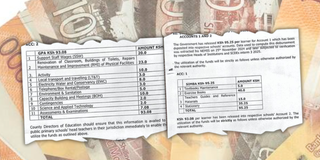
A circular by Basic Education PS Julius Bitok on the breakdown of the funds to primary schools for the second term paints a grim picture of the situation. The document shows that the government disbursed Sh188.33 per learner for the entire term. The funds are: Sh95.25 per learner for learning materials, and Sh93.08 for school operations.
Free Primary Education (FPE) has an allocation of Sh1,420 per learner, which has remained unchanged since its introduction in 2003. Had the government disbursed the expected 30 per cent, each learner would have received Sh426 instead of Sh188.33.
The Nation has established that many public schools are charging school fees way beyond the reach of many parents.
Photo credit: Pool
The Nation has established that many public schools are charging school fees way beyond the reach of many parents, even as managements of schools and teachers’ unions insist it is impossible to run the schools with the meagre government allocations.
They also blame the government for not releasing the full allocation to schools as well as delaying the disbursements.
Funding of programmes for basic education has remained unchanged for years and do not factor in inflation. The Free Day Secondary Education (FDSE) allocation of Sh22,244 was last reviewed in 2018.
On Wednesday, Cabinet Secretary for Education Julius Ogamba revealed that the Ministry of Education had investigated an irregular increase in school fees at Alliance Girls High School. The school had increased its fees from the official figure of Sh53,554 to Sh120,179 — over twice the government-approved annual cap.
After the investigation, Mr Ogamba asked the Teachers Service Commission (TSC) to take disciplinary action against the principal, Margaret Njeru. The CS also ordered dissolution of the board of management (BoM).
On Thursday, Mr Ogamba said the his ministry is investigating many other schools.
“The issue facing Alliance is prevalent in many other institutions, and the same processes will be undertaken against any principals who have increased school fees without the ministry’s authorisation as this increases the burden on parents,” he said.
"County Education Boards will look into BoMs that have approved or sanctioned expenditures in the budget for non-essential issues that are not core to the school's mission, such as various trips by teachers to different institutions or costs that are unsupported,” Mr Ogamba said.
"This is really what we are trying to do: to ensure that where there is a fee increment, it is sanctioned and approved by all stakeholders, including the parents. It is the same parents of Alliance who raised the issue, and therefore the ministry had no choice but to take action as we did yesterday,” Mr Ogamba said.
According to a recent survey by The Elimu Bora Working Group (EBWG), 90 per cent of schools unlawfully charge admission fees ranging from Sh500 to as high as Sh25,000, particularly in urban areas.
According to the findings, the illegal levies include admission fees, charges for desks and lockers, books and stationery, development projects, remedial and extra lessons, co-curricular activities, and examination fees.
Although primary and junior secondary education should be free, the survey revealed that over 90 per cent of schools unlawfully charge admission fees.
Moreover, many schools impose additional charges on parents for desks and lockers, occasionally requiring them to supply the furniture themselves.”
Parents protest at Gingo Secondary School over Sh7,000 fee hike
The Kenya Union of Post Primary Education Teachers (KUPPET) Deputy Secretary General Moses Nthurima said the FPE and FDSE should have been reviewed by now, warning that delays in funding reforms are pushing learning institutions into financial distress. He observed that review is long overdue to ensure schools function effectively without overburdening parents.
“The government is playing politics with education,” he said. “They cannot solve the problem because they’re not addressing the real issue. We should have reviewed the capitation funding system by now,” he said.
However, Mr Nthurima noted that despite this structured process, the government has failed to remit capitation funds amounting to Sh122 billion since 2018. As a result, many schools are accumulating debts and struggling to operate effectively.
He said without sufficient government funding, schools are left with limited options.
Managements of schools and teachers’ unions insist it is impossible to run schools with meagre government allocations.
Photo credit: Pool
“If money is not charged from parents, it means schools cannot run. Even the capitation they give schools is hardly enough. Schools are in debt, principals are suffering running schools. Even if they were to remit every coin per student, it would still not be enough to run schools. The problem lies with the capitation, which they are not admitting,” he said.
The Ministry of Education has maintained that all funds received so far have been disbursed to schools based on approved allocations and verified learner numbers, insisting that the current disbursement plan remains on track and that there is no immediate cause for concern
In a circular, the term two capitation was announced, bringing the total disbursement to Sh188.33 per learner. This has sparked public uproar.
“The figures in reference to the circular are based on this practice. In summary, the Ministry of Education wishes to clarify the following: MoE determines how much money is allocated to each vote head based on the total capitation received from the National Treasury. Capitation funds are released in three phases corresponding to the school calendar terms.,” said Prof Bitok.
Headteachers say the allocation is too little to cover basic classroom needs, including books, stationery, support staff, electricity, water and routine maintenance, leaving schools struggling to operate even before the term gathers pace.
“Honestly, schools are being asked to run on impossible figures. When capitation arrives, sometimes late and in amounts that cannot even cover basic utilities, you are forced into a corner.
“No principal wants to burden parents, but without adequate funding, ensuring that learning continues becomes a daily struggle,” said one principal.
Parents and guardians buy books at Savani's Book Centre Limited in Nairobi on April 27, 2026 ahead of the nationwide school reopening.
Photo credit: Dennis Onsongo | Nation Media Group
“It is time for us as a country to look at capitation increases in the education sector so that when there is an increase it is justified. School fees must not be increased arbitrarily, even where there is a genuine need, because exorbitant hikes—such as fees doubling—are unacceptable and unreasonable,” he said.
Mr Wangenye called for stricter regulation and consultation in the review of school fees, warning against what he termed arbitrary and excessive increments by school administrations.
He said fee adjustments must be anchored on clear justification and inclusive decision-making involving parents.
“Any increase should be reasonable, for instance around 20 percent, and only with the approval of parents through AGMs, while fee reviews must remain within clear, acceptable and well-justified limits,” he said.
In March last year, the Kenya Secondary School Heads Association (KESSHA) raised concerns that the amount released for capitation was below the expected tranches, arguing that schools were still owed a significant balance under the approved funding framework.
The association further raised concern over additional financial pressures, including a Sh2,000 per learner allocation reportedly directed towards infrastructure development, which it argues is straining operational budgets. KESSHA also noted that not all funds disbursed reach schools directly, citing deductions such as Sh100 per learner for CEMASTEA capacity building and Sh325 per learner for co-curricular activities.
It further claims that between 2021 and 2023, billions of shillings were retained at the ministry level for various programmes.
The heads also warned that schools are struggling to meet statutory obligations, including staff salaries and deductions, leading to an increase in legal disputes against institutions.
Underfunding of schools sparks fee variations, governance crackdowns and renewed debate over the cost of ‘free’ education.
According to the different fee structures of various secondary schools, the annual fees at Limuru Girls High School goes up to Sh98,236, while those at Alliance High School pay up to Sh91,554.
“At Moi Forces Academy in Nairobi, the school fees for Grade 10 was increased to Sh120,000. The principal even threatened parents, saying that should they announce the increase on social media, the school, which is linked to KDF, would trace them and take action. Parents had to pay a development fee of Sh10,000 and a remedial fee of Sh15,000,” a parent told the Daily Nation.
The National Parents Association maintains that schools must strictly adhere to the Ministry of Education’s official fee guidelines, warning that any institution introducing its own fee structure outside the approved framework is acting illegally.
The association notes that any deviation from the Ministry’s prescribed fees amounts to an unauthorised levy, unless proper procedures are followed — including formal approval from the CS for Education.
“From the parents’ perspective, any extra charges must involve full consultation and agreement. Schools are required to formally submit any proposed fee adjustments to the Ministry for approval. If such changes are not approved by the CS they remain illegal regardless of the justification provided by the school,” said NPA chairman Silas Obuhatsa.
The association also insists that parents must be fully involved in any decisions affecting school fees and argues that no additional payments should be introduced without their consent and the Ministry’s authorisation.
“School fees must not be increased unless parents are involved or the government has given schools leeway to engage stakeholders. Schools should meet with all parties to reach an agreement on any financial decisions that affect parents,” said Mr Obuhatsa.
“Where fee structures are prepared without parental involvement, that is illegal. From the parents’ perspective, it is illegal. Any changes made outside of what the Ministry has stipulated are considered illegal. Any extra payments or charges must be agreed with parents in full.”