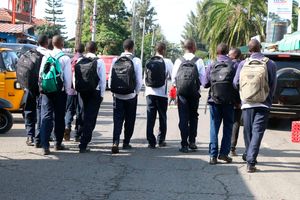
Secondary school heads have rejected a proposal to introduce standardised uniforms in public learning institutions across the country, arguing that such a move would erase school identity, weaken discipline and fail to take into account the diverse climatic conditions in different parts of the country.
The Kenya Senior School Heads Association (KESSHA) said school uniforms are more than just dress codes, describing them as symbols of institutional pride, heritage, tradition and belonging that should not be replaced by a single national design.
The principals said each school should be allowed to retain its unique uniform while efforts focus on making school attire affordable, decent and accessible to all learners.
“Each school should retain its unique identity, culture, heritage and traditions as reflected in its uniform. School uniforms are an important symbol of institutional pride, belonging and diversity within our education system,” said KESSHA chairman Mr Willie Kuria.
Rather than adopting a uniform national dress code, the principals said they support efforts aimed at ensuring school uniforms are affordable, decent and accessible to all learners while preserving the distinct character and identity of individual schools.
“On the proposal for a standardised school uniform across the country. We believe that each school should retain its unique identity, culture, heritage and traditions as reflected in its uniform,” the association said.
The principals argued that uniforms play a central role in shaping school identity and are closely tied to the history and reputation of institutions, some of which have built their traditions over decades.
“School uniforms are an important symbol of institutional pride, belonging and diversity within our education system,” said the KESSHA chairperson, adding that alumni, parents and local communities often identify strongly with schools through their uniforms.
National chairman of Kenya Secondary Schools Heads Association Willie Kuria (centre) speaks to the media in Mombasa on June 22, 2026.
Photo credit: Kevin Odit | Nation Media Group
According to the school heads, introducing a uniform national dress code would erode the heritage of individual schools and strip learners of an important source of pride and motivation.
The principals also linked unique school uniforms to discipline and accountability, saying they make students easily identifiable both within and outside school compounds.
KESSHA warned that similar uniforms across schools would make it harder to identify learners involved in misconduct in public spaces, thereby undermining an important disciplinary tool used by school administrators.
“Distinct uniforms make students easily identifiable and help associate them with their respective schools. This makes it easier to hold learners accountable for their conduct,” the association told Chief of Staff and Head of Public Service Felix Koskei who officially opened the conference.
If students from different schools are dressed alike, principals argue, it would become difficult for members of the public, school officials and even law enforcement officers to quickly determine which institution a learner belongs to in cases of indiscipline or criminal behaviour.
The school heads further defended diversity in school uniforms as part of healthy competition among institutions, saying distinctive dress contributes to school branding and reinforces standards of presentation and discipline.
Unique culture and history
Mr Kuria who is also the chief principal of Muranga High School said every school has a unique culture, history and tradition reflected in its uniform. Uniforms help distinguish one institution from another and contribute to school branding and reputation.
“We have heard in several occasions that school uniforms are quite expensive and we really want them to remain affordable. In our research from many schools, we have noted that the average cost of school uniform for boys is Sh9,562 and girls is Sh10,182. So sometimes there is some misinformation that the uniform is extra expensive. Sometimes the uniforms are said to be expensive because it includes mattress, blanket, bedsheets, pillows, PE uniform which is lumped as school uniform,” said Mr Kuria.
Mr Kuria said the full uniform consists of 3 Shirts or Blouses, 2 Trousers or Skirts, 3 Pairs of Socks, 1 Long-sleeved Sweater, 1 Sleeveless sweater, 1 Jumper, 1 School Blazer or Fleece Jacket and 2 Games Kits.
The association warned that standardisation would remove an important aspect of institutional uniqueness at a time when schools are being encouraged to build strong identities and cultures under the Competency-Based Education framework.
The principals also raised practical concerns over the suitability of a single national uniform in a country with varied climatic zones.
Students of Alliance Girls High School applaud during the school’s prize giving day.
Photo credit: File| Nation Media Group
They noted that learners in colder regions require heavier fabrics and warmer clothing than those in hot and arid areas, making a one-size-fits-all uniform impractical.
“Uniform design should be responsive to local environmental conditions. Kenya has diverse climatic zones, and schools in cold regions require different fabrics from those in hot and arid regions,” said Mr Kuria.
The principals said student comfort directly affects concentration, wellbeing and learning outcomes, and warned that imposing one standard uniform could disadvantage learners in areas where weather conditions demand specialised attire.
Instead of standardising uniforms, KESSHA said the government should focus on policies that lower the cost of school clothing without interfering with school identity.
The principals proposed a model in which schools retain their distinct uniforms but work with the government, parents and suppliers to ensure the attire remains affordable and accessible to all learners, particularly those from low-income households.
“Rather than adopting a uniform national dress code, we support efforts aimed at ensuring school uniforms remain affordable, decent and accessible to all learners while preserving the distinct character and identity of individual schools,” the association said.
The debate over school uniforms comes a few months after the government announced that it is considering introducing standardized school uniforms across all public schools to cut costs for parents and promote equity.
During the Education Conference that Delegates in Naivasha Ministry of Education officials said that while uniforms would be standardized nationally, schools could retain their identity through unique badges.
The proposal included allowing schools to retain their unique identity through badges attached to the uniforms.
President William Ruto, who opened the conference, challenged stakeholders to confront the growing expense of uniforms, noting that high costs were locking vulnerable learners out of classrooms.
During the transition of 1.1 million Grade 10 learners to senior school in January, the government allowed the minors to report to school with Junior School uniforms after many were stuck at home due to lack of uniforms.