Parents will pay more to educate their children in public senior schools, if proposals for a new fees structure by principals to the government are adopted.
The principals said the current fees structure was last reviewed in 2015 and faulted the government for failure to fully fund education despite rising inflation and cost of living. The document proposing the new fees structure was presented to the Principal Secretary for Basic Education John Ololtua during the annual Kenya Senior Schools Heads Association (KESSHA) conference in Mombasa.
The document puts set the new fees for day schools at Sh7,675. Learners in day schools, in principle, do not pay any fees as this is covered under the Free Day Secondary Education (FDSE).
The presentation exposed gaps in funding for the FDSE which has a budget for Sh22,244 for every learner but which has over the years been falling, hitting a low of 15,385.12 in the 2024/2025 financial year. This, the principals say, has made them incur massive pending bills owed to suppliers as well as unpaid salaries for non-teaching staff in schools.
According to KESSHA calculations based on Ministry of Education circulars in each disbursement cycle, the government has failed to remit a total of Sh22.5 billion to schools in 2025 alone.
The way out of the situation, they say is either for the government to increase the funding or allow them to charge the parents higher fees.
Public secondary school principals have proposed a review of school fees, arguing that the current funding model is no longer sustainable amid rising inflation, escalating operational costs and persistent delays in government capitation.
Food remains one of the largest expenditure items in boarding schools. According to KESSHA, it currently costs approximately Sh242 per day to feed a learner, covering breakfast, lunch and dinner.
KESSHA national chairman Willy Kuria said the vote head which is financed by parents caters for foodstuffs, boarding equipment, kitchen supplies, cooking gas, firewood, cleaning materials and disinfectants.
Photo credit: Nation Media Group
Under a unit-cost formula developed by the school heads, parents with children in national schools (Cluster 1) would be required to pay Sh87,781 annually after deduction of the government's capitation grant of Sh22,244 per learner. The principals estimate that the actual annual cost of educating a learner in a national boarding school has risen to Sh110,025.
For extra-county schools (Cluster 2 and 3), the new proposed fees is Sh83,622 per learner annually, based on an estimated cost of Sh105,866 per student. County day schools (Category C4) would charge Sh7,675 after government capitation, against a projected annual cost of Sh29,919 per learner.
The school heads say the current fee structure, which was introduced in 2015, has been overtaken by economic realities and no longer reflects the actual cost of running schools.
"The current fees charged in secondary schools were set in 2015, about 11 years ago. It is therefore no longer possible to sustainably run our institutions under the existing framework," said KESSHA national chairman Willie Kuria.
Mr Kuria noted that the fees structure established through a Ministry of Education circular dated March 4, 2015 has remained unchanged despite sharp increases in the cost of essential goods and services.
He cited inflation, depreciation of the Kenya shilling and rising costs of educational resources as key factors driving the need for a review. The KESSHA chair gave a blow-by-blow of the expenditure schools incur, including the amount and cost of food each student consumes.
"The movement in the price index of goods and services between 2015 and 2026 reflects a substantial increase in the general cost of living and, by extension, the cost of running educational institutions," he said.
According to KESSHA, Kenya's national budget has grown from Sh2.246 trillion in the 2015/2016 financial year to Sh4.82 trillion in 2026/2027, representing a 115 per cent increase over the period.
The principals argue that the increase mirrors the rising cost of providing services and justifies a corresponding review of school fees.
Mr Kuria pointed to the sharp rise in prices of commonly used school supplies. For instance, a ream of photocopy paper that sold for Sh420 in 2015 now costs approximately Sh800, an increase of more than 90 per cent.
"These perspectives provide a rational and evidence-based framework to support a comprehensive review and upward adjustment of the current school fees structure," he said.
The principals are proposing that school fees be calculated using a unit-cost approach that determines the actual cost of maintaining a learner per day, including tuition, accommodation, meals, learning resources and operational expenses.
National chairman of Kenya Secondary Schools Heads Association Willie Kuria (centre) speaks to the media in Mombasa on June 22, 2026.
Photo credit: Kevin Odit | Nation Media Group
Using this formula, administrators derive the annual cost of educating a learner and determine the fees payable after factoring in government support.
The principals also raised concerns over the increasing cost of implementing Competency-Based Education (CBE), particularly following the expansion of subject choices in secondary schools.
While the Ministry of Education continues to fund tuition expenses such as exercise books, laboratory chemicals, reference materials and teaching aids, school heads say the introduction of new learning pathways has significantly increased resource requirements.
Many schools now offer additional examinable subjects including music and dance, French, fine art, sports and recreation, electricity, aviation, home science, building and construction, theatre and film, marine and fisheries, and media technology.
Most of these subjects fall under the Technical and Applied category and require specialised facilities, equipment and learning materials.
"In order for schools to sustain and effectively teach these subjects, additional resources are required," Mr Kuria said.
However, he noted that many schools lack the necessary equipment to support technical subjects, while existing facilities are often inadequate or obsolete.
The rapid pace of technological advancement has also rendered some learning resources outdated, forcing schools to invest in new equipment.
"Old-model computers are no longer suitable for current learning requirements and replacing them has become inevitable," he said.
Laboratory funding has emerged as another area of concern. According to KESSHA, allocations for laboratory equipment and chemicals are insufficient to support practical lessons and national examinations.
Although the government continues to provide Transition Infrastructure Grants (TIG) for construction of classrooms and laboratories, principals argue that no corresponding funds are allocated for furnishing and equipping the new facilities.
"No grants are provided for desks, chairs, laboratory stools, equipment, chemicals and other essential furniture needed to make these facilities operational," Mr Kuria said.
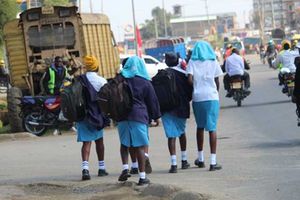
Students walk on the streets of Bomet town in Bomet County on June 19, 2026 as they head home for the mid-term break.
Photo credit: Vitalis Kimutai | Nation Media Group
The school heads also faulted the government's capitation programme, saying actual disbursements have consistently fallen below the approved allocation.
The capitation rate per learner was increased from Sh10,625 in 2008 to Sh12,870 in 2015 before rising to the current Sh22,244 in 2018. Since then, the amount has remained unchanged despite rising costs. Mr Kuria said the situation has been worsened by delayed and partial disbursements.
"The current capitation of Sh22,244 per learner was last reviewed seven years ago and is incongruent with prevailing economic realities. The cost of common goods and services has increased significantly while capitation has remained constant," he said.
Schools were expected to receive 50 per cent of annual capitation during the first term, 30 per cent in the second term and 20 per cent in the third term.
However, principals say only 35 per cent was disbursed in the first term, while schools have received only 21 per cent instead of the expected 30 per cent for the second term.
"As we begin the second term, schools have received only 56 per cent of the expected 80 per cent capitation by this point in the academic calendar. This translates into a funding deficit of 24 per cent per learner," Mr Kuria said.
The principals warned that unless school fees are reviewed and FDSE fully funded, schools will continue to struggle to meet their obligations, maintain standards and effectively implement education reforms under the Competency-Based Education framework.
However, PS Ololtuaa assured the principals that the government would re-examine the financing challenges facing the learning institutions, while acknowledging that budget constraints continue to hamper the Ministry of Education's ability to fully meet its funding obligations.
The Kenya Union of Post Primary Education Teachers (Kuppet) also faulted the government over delays in the disbursement of capitation funds to schools, warning that the funding crisis is undermining the smooth running of learning institutions across the country.
Kuppet Deputy Secretary-General Moses Nthurima said schools continue to face financial uncertainty due to inconsistencies in the release of government funds.
"As a union, we remain concerned by the perennial delays in the disbursement of capitation funds. Indeed, it is becoming difficult for us to track how much capitation funds are being disbursed due to constant changes in the disbursement criteria and contradictory circulars issued by the Ministry of Education," said Mr Nthurima.