Senior school placement: KNEC puts 1.2m Grade 9 scripts first in marking queue
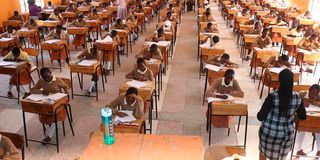
Grade-Nine candidates from St Mary's Girls Comprehensive School in Nakuru City take their Kenya Junior School Education Assessment (KJSEA) examination on October 26, 2026.

What you need to know:
- A total of 2.58 million candidates sat the assessments, which began on October 26, including 1.38 million KPSEA candidates.
- KPSEA was administered in 30,965 assessment centres countrywide, while KJSEA was conducted in 25,226 centres.
The Kenya National Examinations Council (Knec) will prioritise the marking of answer scripts for 1.2 million Grade 9 learners to facilitate the timely selection and placement of candidates into Senior School next year.
Basic Education Principal Secretary John Ololtuaa announced the move n Friday as he gave an update on the administration of the 2026 Kenya Primary School Education Assessment (KPSEA) and Kenya Junior School Education Assessment (KJSEA).
A total of 2.58 million candidates sat the assessments, which began on October 26, including 1.38 million KPSEA candidates and 1.2 million KJSEA candidates.


“The Council will embark on scoring of candidates’ answer scripts, with priority being given to KJSEA, to enable timely selection and placement of the learners into Senior School,” said Mr Ololtuaa, who was accompanied by KNEC Chief Executive Officer David Njengere at Nairobi Primary School.
KPSEA was administered in 30,965 assessment centres countrywide, while KJSEA was conducted in 25,226 centres.
The KPSEA assessment ran for three days, from Monday, October 26, to Wednesday, October 28, while KJSEA took five days, concluding yesterday, Friday, October 30.
Mr Ololtuaa said the assessments were conducted without major disruptions, except in a few areas that experienced heavy rainfall, which affected the transportation of examination materials.
The affected areas included Tarasaa in Tana River County, Kalokol in the North Rift and Kutulo in Mandera County.
“KNEC made quick arrangements, including deploying helicopters, and the challenge was addressed. All candidates who presented themselves were able to sit the assessments,” he said.
Meanwhile, the administration of the Kenya Certificate of Secondary Education (KCSE) examination has been progressing well since it began on October 19, with candidates sitting low-candidature papers, mainly oral, aural and practical examinations in foreign languages, Kenyan Sign Language, Music, Home Science and Computer Studies.
The Council will begin administering compulsory theory papers on Monday, November 2, with the examination scheduled to conclude on November 20.
Dr Njengere said about 70 per cent of KCSE candidates are day scholars, urging parents to check their children for mobile phones before they leave home for examination centres.
“While we have sealed all loopholes as far as early exposure is concerned, the only problem we have is people with mobile phones in examination centres,” he said.
He said examination centre managers, supervisors, invigilators and security officers were required to switch off their mobile phones and surrender them to supervisors for safekeeping until the examinations were over.
Dr Njengere reiterated that KNEC would not tolerate anyone found with a mobile phone in an examination centre.
The Council also administered assessments to candidates following the stage-based pathway, including the Kenya Intermediate Level Education Assessment (KILEA), which had 3,439 candidates, and the Kenya Pre-Vocational Level Education Assessment (KPLEA), which was sat by 1,191 candidates.
Follow our WhatsApp channel for breaking news updates and more stories like this.