Hello

Your subscription is almost coming to an end. Don’t miss out on the great content on Nation.Africa

Ready to continue your informative journey with us?

Hello

Your premium access has ended, but the best of Nation.Africa is still within reach. Renew now to unlock exclusive stories and in-depth features.

Reclaim your full access. Click below to renew.

Geoffrey Ruku
Caption for the landscape image:

State suspends new hardship area classifications after teachers' outcry

Scroll down to read the article

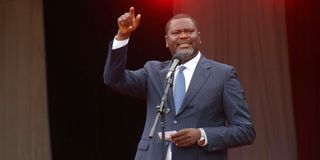
Public Service Cabinet Secretary Geoffrey Ruku addresses the faithful during a church service to mark the 35th Embu ACK Diocesan Anniversary at St. Mark’s College, Kigari, Embu County, on July 6, 2025. 

Photo credit: Joseph Kanyi | Nation Media Group

The government has temporarily halted the implementation of the recent review of hardship area classifications following a wave of public outcry from teachers, civil servants and political leaders across the country.

Public Service Cabinet Secretary Geoffrey Ruku confirmed that they have, jointly with the Ministry of Education, decided to hold the implementation of the report on hardship classifications to allow for a re-evaluation exercise aimed at redefining areas eligible for hardship allowances.
The reclassification had triggered widespread uproar, particularly in arid and semi-arid regions.

"We have decided to hold on to the report for now. We need to re-evaluate the report together with the stakeholders and elected leaders before its implementation," CS Ruku announced when he toured Samburu County. 

Public servants especially teachers in Turkana, Samburu, Marsabit, West Pokot and parts of the Coast and North Eastern regions voiced fears, that the review would lead to the removal of their regions from the hardship category — a move they said would worsen their already difficult working conditions.

Allowance not at risk 

The CS assured public servants that their hardship allowances were not at risk of being discontinued in the upcoming review. 

"Let public servants not fear that their hardship allowances may be discontinued any time soon. The government is committed to ensuring there is rigorous public participation from all stakeholders before the implementation of the report," the CS added.

Lawmakers and teachers' unions had demanded answers from the executive over what they termed as a scheme to disenfranchise marginalised regions. 

In Samburu, Senator Steve Lelegwe noted that the government's decision to downgrade Samburu County's hardship classification from "extreme" to "moderate," would disadvantage public servants working in the region. 

The legislator said that the move ignored Samburu County’s ongoing struggles with constant insecurity, frequent drought, poor mobile network coverage, and even poor infrastructure.

"Sometimes you wonder why they decided to reclassify Samburu as a moderate working area. This region is actually extremely owing season long challenges ranging from poor mobile network coverage to poor infrastructure," the Senator said.

Senator Naisula Lesuuda.

Photo credit: File | Nation

Samburu West Member of Parliament Naisula Lesuuda also argued that the new status was painting a misleading picture of life in Samburu County and risks deepening long-existing inequality in a region already grappling with chronic challenges.

Samburu County is probably among the harshest places to live in Kenya,because of the unforgiving weather conditions, insecurity, and terrain. This, coupled with the decades long government marginalisation, has made many people on the brink of despair.

The lawmaker said that the decision by the government was unjust and out of touch with the realities on the ground.

"The government's recent classification is unfair to all civil servants working in Samburu in the midst of rampant insecurity, extreme weather events, and impassable roads that hinder access to basic services," the MP said recently. 

At the same time, Samburu teachers have already voiced opposition to the proposed hardship allowances as outlined in the Kenya Union of Post- Primary Education Teachers (Kuppet) 2025-2029 Collective Bargaining Agreement (CBA). 

The tutors called the proposals "discriminatory and poorly handled."

In a letter addressed to the Teachers Service Commission (TSC), the Kuppet Samburu branch accused the CBA drafters of failing to consult Asal teachers and their leadership, which ended up neglecting their unique challenges in the CBA.

Hardship allowances are meant to compensate public officers serving in regions with extremely difficult living and working conditions.