With the rollout of senior school in 2026, tutor shortage in Kenya is expected to deepen due to insufficient funding of the Teachers Service Commission (TSC).
A biting staff shortage in schools has resulted in burnout, crowded classrooms and a lack of subject specialists required for the proper implementation of the Competency-Based Education (CBE).
A recent report by Usawa Agenda and Zizi Afrique paints a picture of a stretched education system, with a teacher deficit of more than 100,000 across the ladder – from early childhood centres to technical training institutions.
This is despite the country having nearly 40,000 registered experienced and qualified teachers aged 45 and above but not employed by the TSC.
“There is still a deficit of at least 72,000 teachers in junior school. That, obviously, is a matter of concern, yet the commission can only employ as many teachers as taxpayers can afford,” said Mr Peter Kega, a TSC official at the Directorate of Teacher Professional Management, during a recent stakeholder forum.
The TSC was given Sh387.7 billion in the current financial year, with several key areas such as the conversion of interns to permanent and pensionable terms, remaining unfunded.
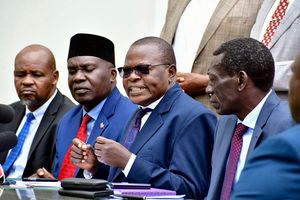
Junior Secondary School teachers from Nairobi County demonstrate outside the Teachers Service Commission offices on May 13, 2024.
Photo credit: Evans Havil | Nation Media Group
Mr Kega added that the commission is exploring ways to utilise teachers in primary school, now that the number of classes has been reduced from eight to six.
The teacher gap in junior school came to the bare when the Kenya Kwanza government took the decision to domicile Grades Seven, Eight and Nine in primary instead of secondary school as had been planned by the Jubilee administration under then-president Uhuru Kenyatta.
The previous government had invested billions of shillings in building classrooms in secondary schools to accommodate the anticipated increase in learner numbers.
TSC had focused more on hiring secondary school teachers. The abrupt shift to domicile junior school in primary schools caught the commission unprepared in terms of teacher adequacy and capacity.
“We are not so much concerned about the transition to senior school because the 130,899 teachers in secondary schools will soon be handling senior school learners,” Mr Kega said.
Even with recent recruitment, the commission appears unable to keep pace with the growing demand of the CBE, which requires subject specialists.
During a question-and-answer session in the Senate, Murang’a Senator Joe Nyutu demanded to be informed why junior school teachers were being assigned subjects outside their areas of training.
The senator said it was a matter of concern, given its impact on instructional quality, content accuracy and learners’ preparedness for the three senior school career pathways.
A study by the People’s Action for Learning (PAL) Network found that not all children who reach Grade Nine in low and middle-income countries can read with comprehension or perform basic arithmetic.
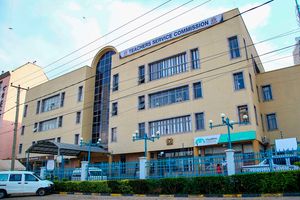
Teachers Service Commission (TSC) headquarters in Upper Hill, Nairobi.
Photo credit: File | Nation Media Group
In response, Education Cabinet Secretary Julius Ogamba said measures were being taken to address the challenge, including reserving 60 per cent of upcoming recruitment for Science, Technology, Engineering and Mathematics (STEM)-trained teachers.
The government says it plans to hire 24,000 teachers by January 2026, bringing the total number recruited by the current administration to 100,000.
“Over the past two years, the TSC has recruited 76,000 teachers and contracted 20,000 junior school interns to deliver the curriculum,” TSC Acting Chief Executive Eveleen Mitei said during the release of the 2025 Kenya Junior School Education Assessment (KJSEA) results.
Due to budgetary constraints, the commission is unable to hire intern teachers on permanent and pensionable terms, resulting in discontent, low morale and even court cases.
A junior school teacher recently moved to court to challenge the decision by the commission to extend internship contracts from 12 to 24 months, amid claims of favouritism in confirming some.
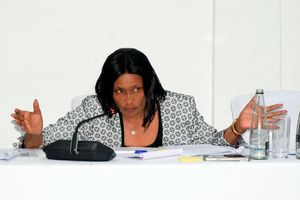
The Teachers Service Commission Acting CEO Eveleen Mitei.
Photo credit: Dennis Onsongo | Nation Media Groip
There are reports of interns of a previous cohort being hired on permanent and pensionable terms after working for only a year.
A TSC report tabled before the Senate Committee on National Cohesion, Equal Opportunity and Regional Integration showed that five ethnic communities – Kalenjin, Luhya, Kamba, Kikuyu and Luo – secured more than two-thirds of the recent applications for junior school teachers.
The report indicates that 67 per cent of the 68,313 JSS teachers hired during the Kenya Kwanza administration came from these five communities, with the Kalenjin taking the largest share at 15.7 per cent (10,769), despite accounting for just 13 per cent of the country’s population.
The Luhya came second at 15.3 per cent (10,466), followed by Kamba at 13.9 per cent (9,557), Kikuyu at 12.8 per cent (8,799) and the Luo at 12.7 per cent or 8,721.
In May, lawmakers raised concerns that the commission had been overlooking a significant pool of experienced and qualified teachers just because they were aged 45 and above.
A ruling by the Employment and Labour Relations Court in 2019 found the age restriction by the TSC discriminatory and in violation of the right to equal opportunity.
The National Assembly Committee on Education maintains that a teacher can be recruited up to two years before retirement, noting that it is not an individual’s fault for not being employed earlier.